Contents
Overview
Every temple on Koh Samui is built from the same small set of parts and populated by the same handful of recurring figures, once you know what you are looking at. A wat is a walled compound of several distinct buildings, not one building; the naga serpents on the stairs, the yak giants at the gate, and the many-armed Guanyin at Wat Plai Laem all carry specific, sourced meanings rather than being decoration. This guide is the key: how a wat is laid out, the four religious traditions represented on the island, the Buddha statue linked to your birth day, the guardians and symbols you will meet at 14 named Samui temples, and five short stories behind the most-asked-about statues.
Key takeaways
- A wat has distinct buildings — the ordination hall (ubosot), the assembly hall (viharn), the chedi, and more — each with a different rule about who may enter.
- Koh Samui carries four living traditions in one small area: Theravada Buddhism, Chinese Mahayana Buddhism, Hainanese Taoist folk religion, and mixed sites that combine all three.
- Thai tradition assigns a Buddha posture, colour and legend to each day of the week — useful shorthand once you know your own.
- Nagas, yaks, dragons and the dharma wheel are not random ornament; each has a specific job and a specific temple where you can see it.
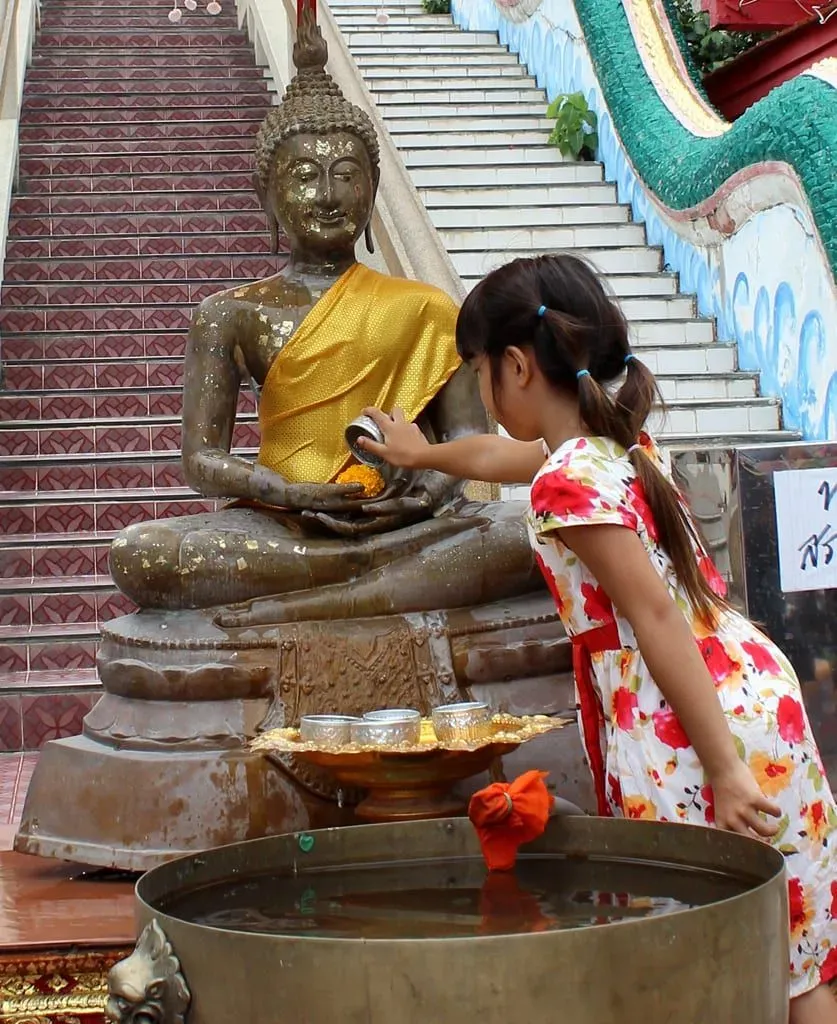
- “Tham bun,” making merit through giving, is the everyday reason Thais visit a temple — not sightseeing.
The Anatomy of a Wat — What You Can Enter and What’s Off-Limits
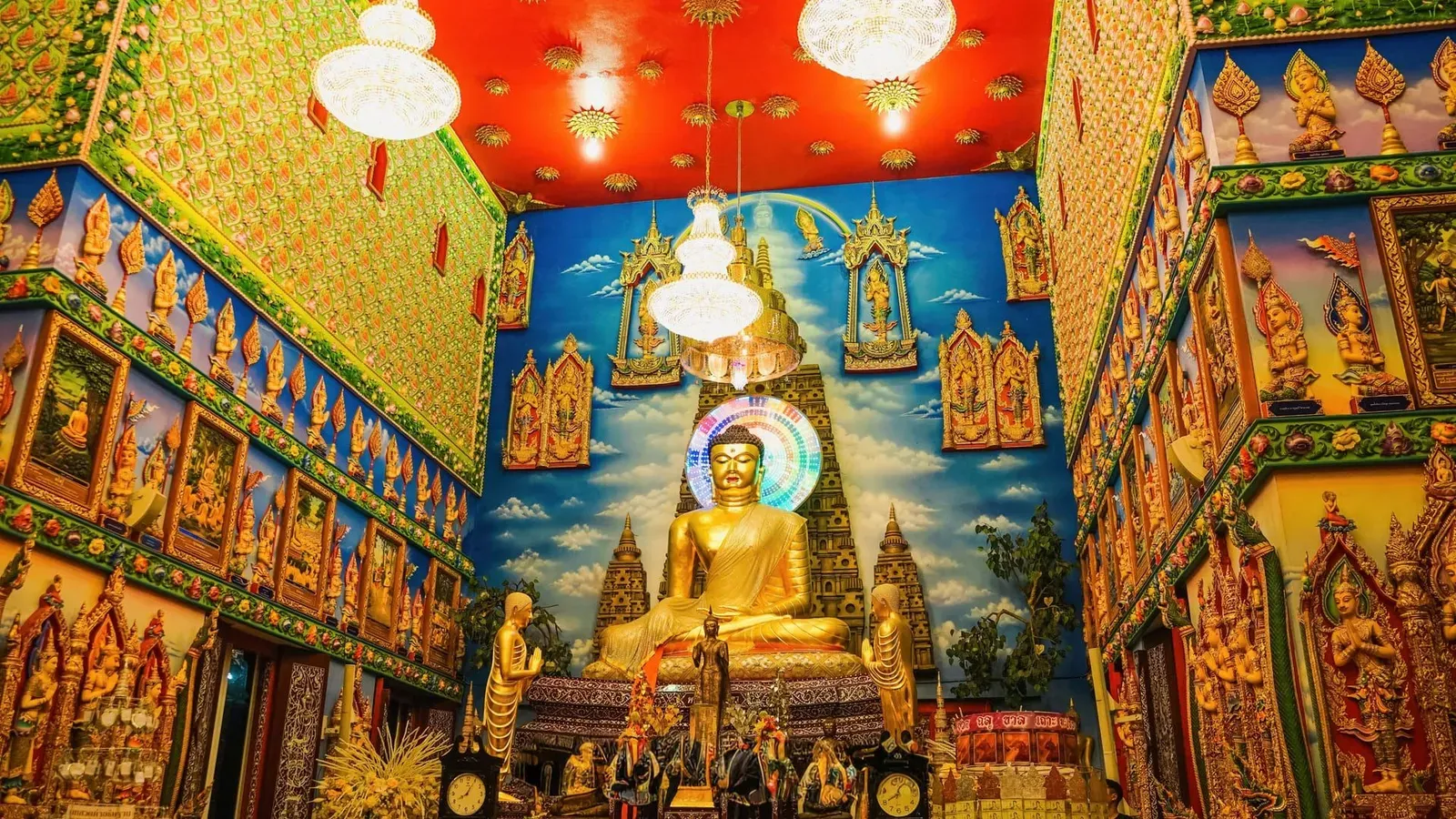
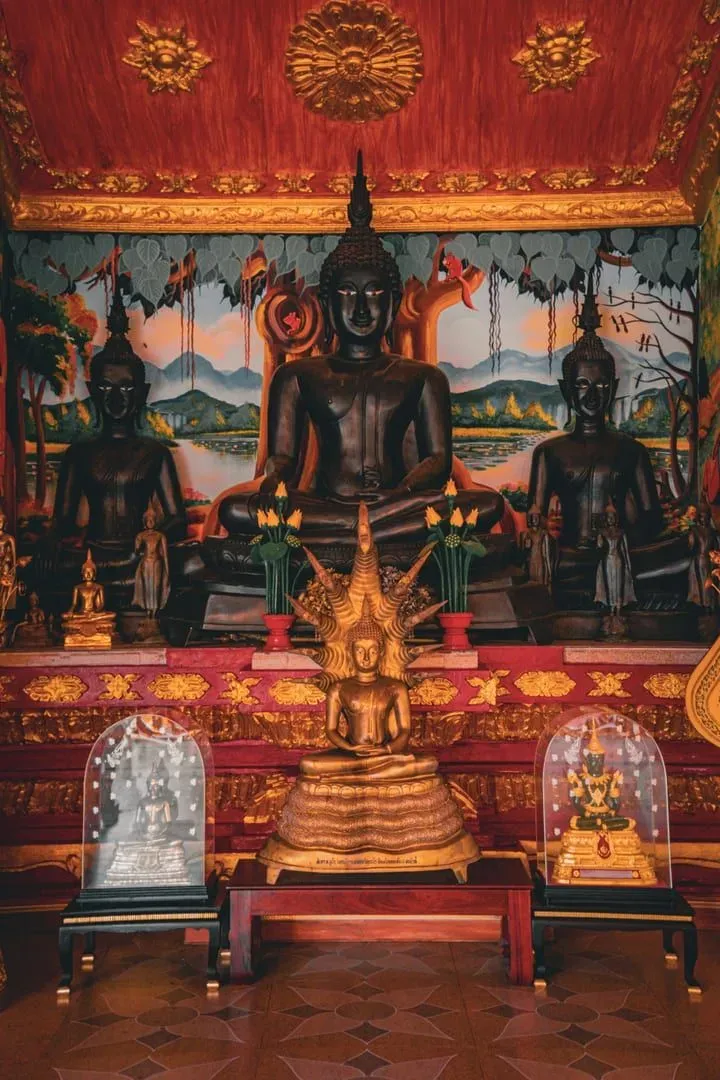
A Thai wat is a compound of separate buildings, each with its own function and its own rule about visitor access, not a single hall. The ubosot (ordination hall, also called the bot) is the holiest and most restricted building: it is the only structure ringed by eight bai sema boundary stones, which mark the sacred boundary required for formal monastic acts such as ordination, and it is sometimes locked outside ceremonies (Wikipedia — Ordination hall; Wikipedia — Bai sema). The viharn is the assembly hall that holds the main Buddha image visitors actually pray to, and unlike the ubosot it carries no sima stones — this is generally where you are welcome. Around those two sit the chedi (a solid, bell-shaped monument enshrining relics), the sala (an open-sided pavilion for rest and teaching), the mondop (a square, spire-roofed pavilion for sacred objects), and the ho trai (a raised scripture library, traditionally built over water to keep insects from the manuscripts) (buddha-images.com — Thai temple buildings).
A bell tower stands near the monks’ quarters; the bell traditionally wakes the monks around 4 AM and calls them to chanting and meals (Wikipedia — Bell tower). The kuti, the monks’ individual living quarters, is private and off-limits to visitors. As a rule of thumb: the viharn and sala are open to everyone (shoes off, shoulders and knees covered), the ubosot is entered only when unlocked or with permission, and the kuti is never entered. Full dress-code and behaviour rules are in our temple etiquette guide.
Four Traditions on One Island
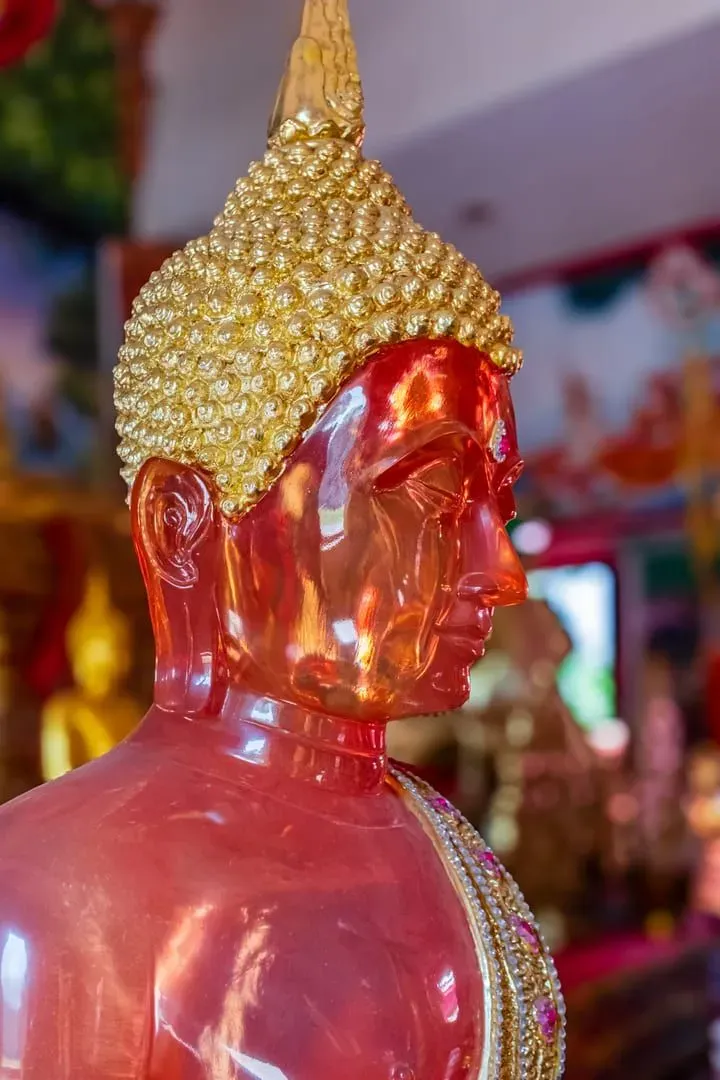
Koh Samui’s temples represent four distinct religious traditions rather than one uniform “Buddhism,” a mix that reflects both Thai Theravada practice and the island’s 19th-century Hainanese-Chinese migration. Theravada wats are the majority and the classic Thai temple: whitewashed halls, gold chedis, a single main Buddha image, seen at village temples like Wat Samret and Wat Bo Phuttharam. Chinese Mahayana shrines centre on Guanyin, the bodhisattva of compassion, most spectacularly at Wat Plai Laem, where an 18-armed statue rises from a lake. Taoist and folk shrines of the Hainanese community honour Chinese deities and ancestors rather than the Buddha directly — the 16-metre bronze Guan Yu at the Guan Yu Shrine in Hua Thanon, the dragon-carved Chinese Temple of Maenam, and the Nathon Hainan Shrine all trace to the same 19th-century migration wave.
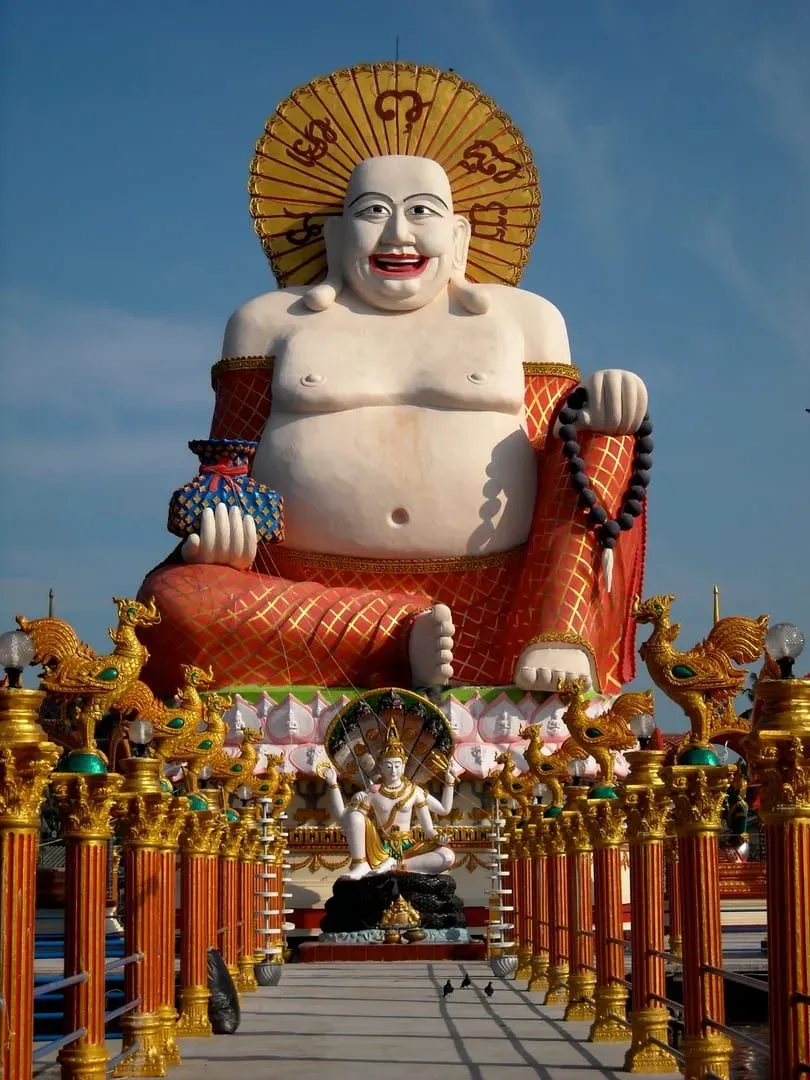
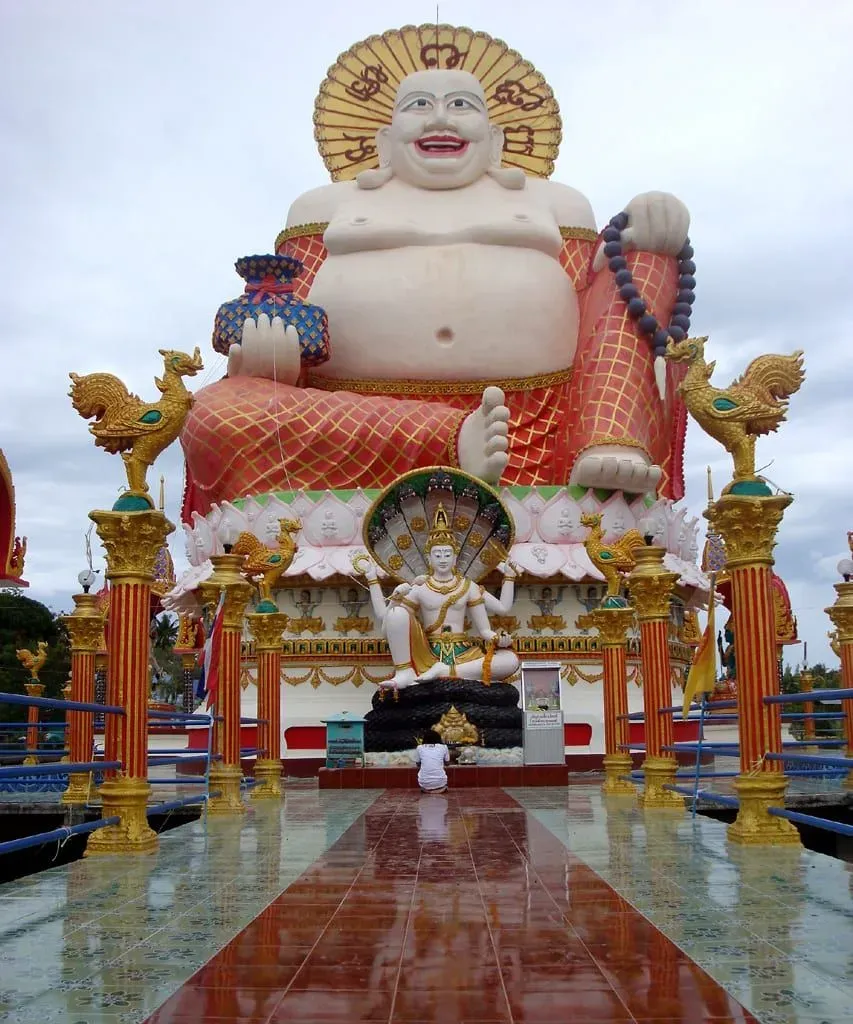
The fourth category is mixed sites that blend more than one tradition under a single roof. Wat Plai Laem is the clearest example: alongside its Guanyin statue stands a 20-metre laughing Buddha (Budai) in Chinese style, and its grounds also carry Hindu-derived figures. Wat Sila Ngu, Samui’s red laterite “Red Temple,” is nominally Theravada but its carved reliefs include Ganesha and other Hindu-derived figures woven into Thai Buddhist cosmology — a reminder that “Thai Buddhism” on the ground is rarely a single, closed system.
The Buddha of Your Birthday — Eight Postures, Eight Days
Thai tradition assigns a specific Buddha posture, a customary colour, and a planet to each day of the week — the Thai week runs Sunday to Saturday and splits Wednesday into a day and a night image, giving eight images in total (Thaizer — Buddha images for each day of the week; buddha-images.com — the seven days). Ask a Thai friend “what day were you born?” at a temple and they will usually know their image on sight. The exact colour-planet pairing varies slightly between sources, so treat the colours below as the customary association rather than a fixed rule.
| Day | Posture | Thai name | Legend |
|---|---|---|---|
| Sunday | Standing, arms crossed at the wrist, eyes closed | Pang Thawai Net | The Buddha stood gazing at the Bodhi tree for seven days out of gratitude, without blinking |
| Monday | Standing, both palms raised forward | Pang Ham Yat / Pang Ham Samut | The Buddha raised both hands to calm a dispute among his kinsmen, or to still a storm at sea |
| Tuesday | Reclining | Pang Sai Yat (Parinipphan) | Depicts the Buddha’s final passing into Nirvana |
| Wednesday (day) | Standing, holding an alms bowl | Pang Umbaat | Commemorates the Buddha’s first morning collecting alms after enlightenment |
| Wednesday (night) | Seated in the forest, flanked by an elephant and a monkey | Pang Pa Lelai | The Buddha withdrew into the forest after his monks quarrelled; an elephant and a monkey brought him food |
| Thursday | Seated in meditation, half-lotus | Pang Samadhi | The moment of enlightenment under the Bodhi tree |
| Friday | Seated, hands crossed over the chest | Pang Ram Pueng | The Buddha reflecting after enlightenment, deciding to teach |
| Saturday | Seated in meditation, shielded by a seven-headed naga | Pang Nak Prok (Naga Prok) | The naga king Mucalinda sheltered the meditating Buddha from a week-long storm |
Sources: Thaizer, buddha-images.com, Naga Prok attitude — Wikipedia. The reclining posture at Wat Khunaram’s neighbouring sites and the seated Buddha sheltered by Mucalinda both connect directly to the naga symbolism covered next.
Guardians and Symbols — A Field Guide
The creatures and motifs carved into Samui’s temples are not decorative filler — each one has a specific role, and most appear at a small, identifiable set of Samui sites.
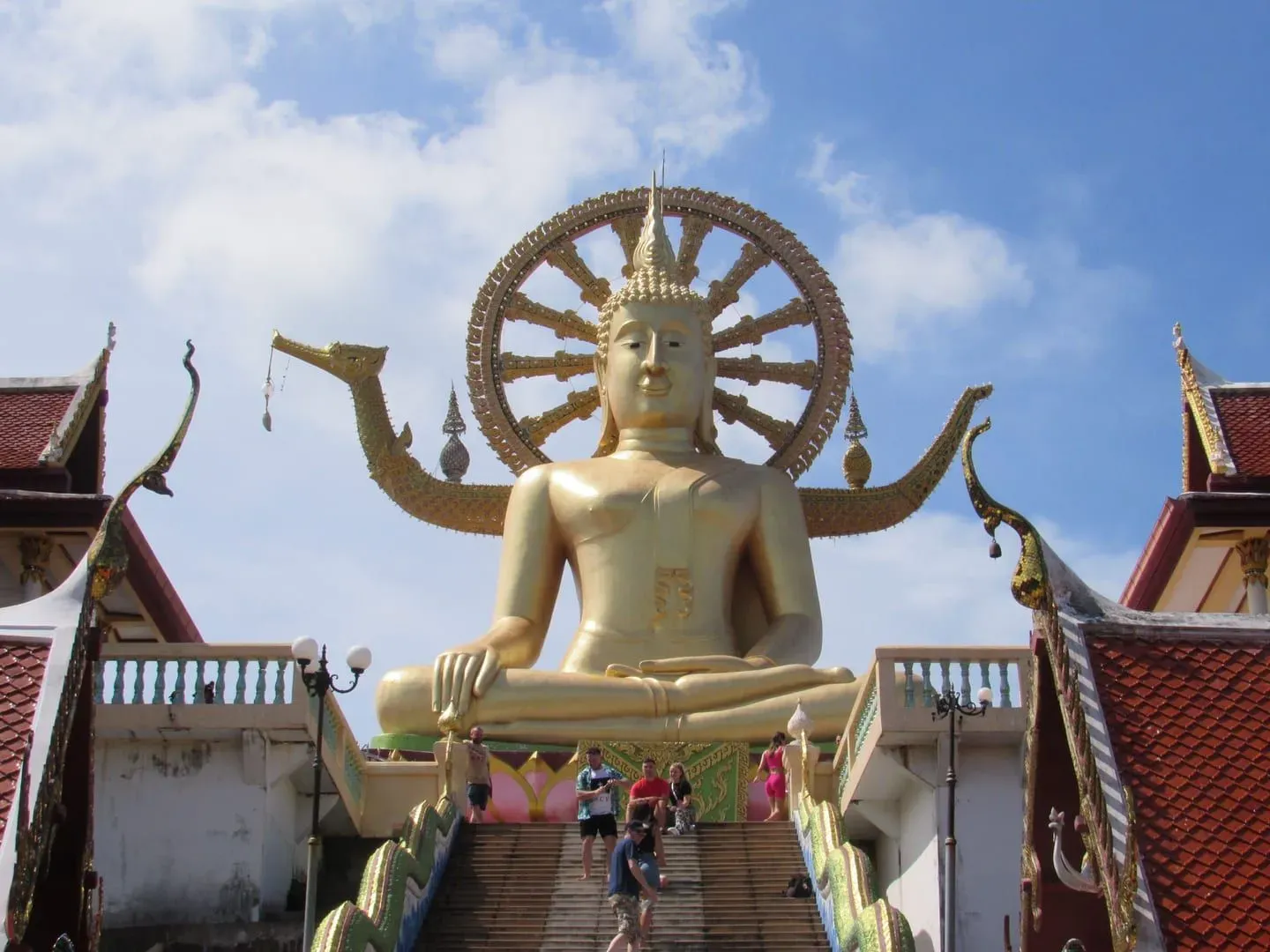
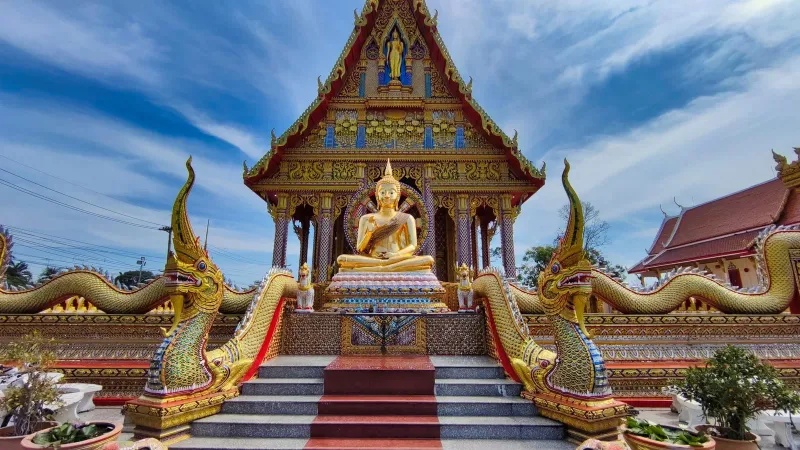
- Naga — a serpent guardian of water and fertility that shelters the meditating Buddha in the Mucalinda story; forms the staircase balustrades at Wat Phra Yai (the Big Buddha’s 73-step approach) and Wat Sila Ngu (Chiang Mai à la Carte — the naga staircase).
- Dragon — a Chinese symbol of rain and prosperity, carved into pillars and roof ridges at the Hainanese-community shrines: the Chinese Temple of Maenam, the Guan Yu Shrine, and the Nathon Hainan Shrine.
- Yak (giant guardian) — armoured warrior statues, up to several metres tall, that fend off evil spirits at temple gates; seen guarding the entrance at Wat Lamai and flanking Laem Sor Pagoda in the south.
- Dharma wheel (dharmachakra) — an eight-spoke wheel representing the Noble Eightfold Path, found on temple gates and signage across the island, and engraved directly onto the stone footprints at the Buddha’s Footprint Shrine.
- Lotus — a symbol of purity and enlightenment rising from mud, used as the pedestal under nearly every Buddha image on the island.
- Buddha’s footprint — a reminder that the Buddha was human and that a path exists to follow; a replica sits at Khao Hua Jook, and four superimposed footprints, said to be over 300 years old, are carved into stone at the separate Buddha’s Footprint Shrine.
- Guanyin’s 18 arms — at Wat Plai Laem, the bodhisattva of compassion is shown with 18 arms and (in the fuller legend) 1,000 eyes, so she can act on and perceive suffering everywhere at once (qilingaura.com — origins of the thousand-armed Avalokiteshvara).
- Ganesha — the elephant-headed remover of obstacles, a Hindu-derived figure carved into the grounds at Wat Plai Laem and Wat Sila Ngu.
Five Stories Behind the Statues
Luang Pho Daeng. In 1973 the monk Luang Pho Daeng entered deep meditation at Wat Khunaram and died sitting upright. His body has shown minimal decay since, and it is displayed seated in a glass case — sunglasses added later to cover the decomposed eye sockets — as a Buddhist lesson on impermanence, not a curiosity (Wikipedia — Luang Pho Daeng).
Why nagas guard the stairs. The naga king Mucalinda sheltered the meditating Buddha from a week-long storm by coiling around him and raising his seven hoods as an umbrella. Temple staircases lined with naga balustrades — as at Wat Phra Yai and Wat Sila Ngu — echo the same idea: the serpent carries visitors from the ordinary world up to the sacred one (Chiang Mai à la Carte).
Why Guanyin has many arms. In the Great Compassion Dharani Sutra, Avalokiteshvara’s body shattered from the strain of trying to save all beings at once. The Buddha Amitabha reassembled her with many arms and eyes so she could act on suffering everywhere simultaneously — Wat Plai Laem’s statue shows 18 of them (qilingaura.com).
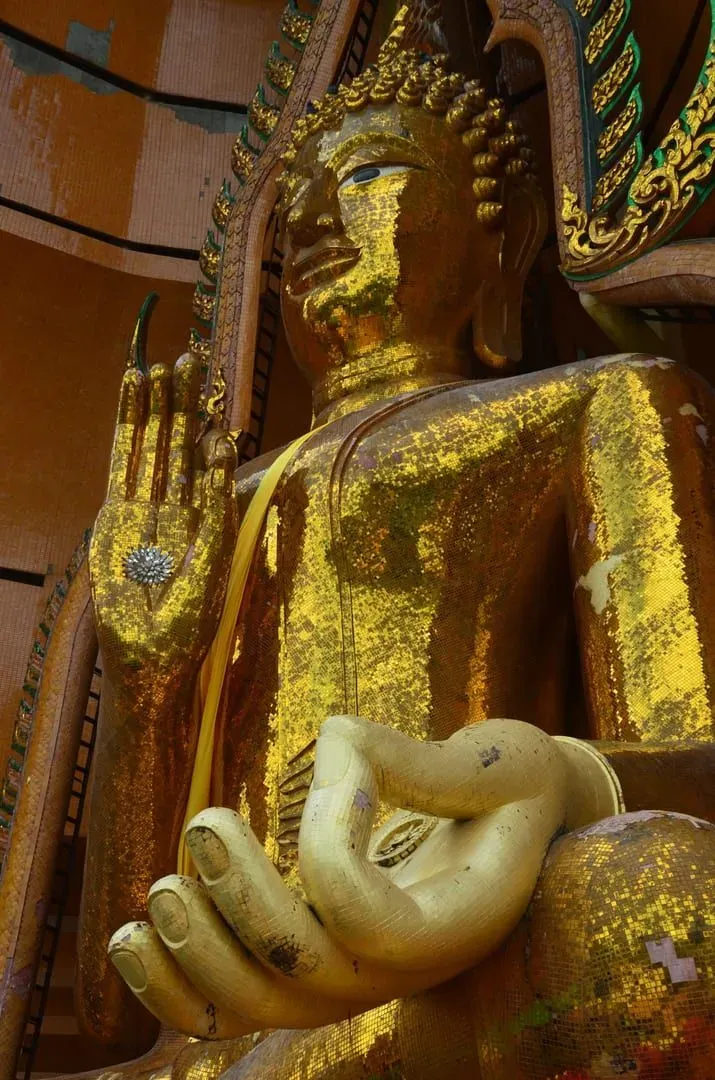
Why the Buddha touches the earth. The demon-king Mara challenged the Buddha’s right to enlightenment. The Buddha touched the ground with his right hand, and the earth itself — personified as the goddess Phra Mae Thorani — rose to bear witness, and in the fuller version wrung a flood from her hair that swept Mara’s army away (Wikipedia — Phra Mae Thorani). This is the Bhumisparsha gesture seen on the Big Buddha at Wat Phra Yai.
The 1907 human chain at Laem Sor. Laem Sor Pagoda, on the southern tip of Samui, was built in 1907 when roughly 1,000 people formed a human chain to haul coral-block bricks up the hill over six months — Sri Lankan relics were installed the following year (renown-travel.com — Laem Sor Pagoda).
Making Merit — What Tham Bun Means
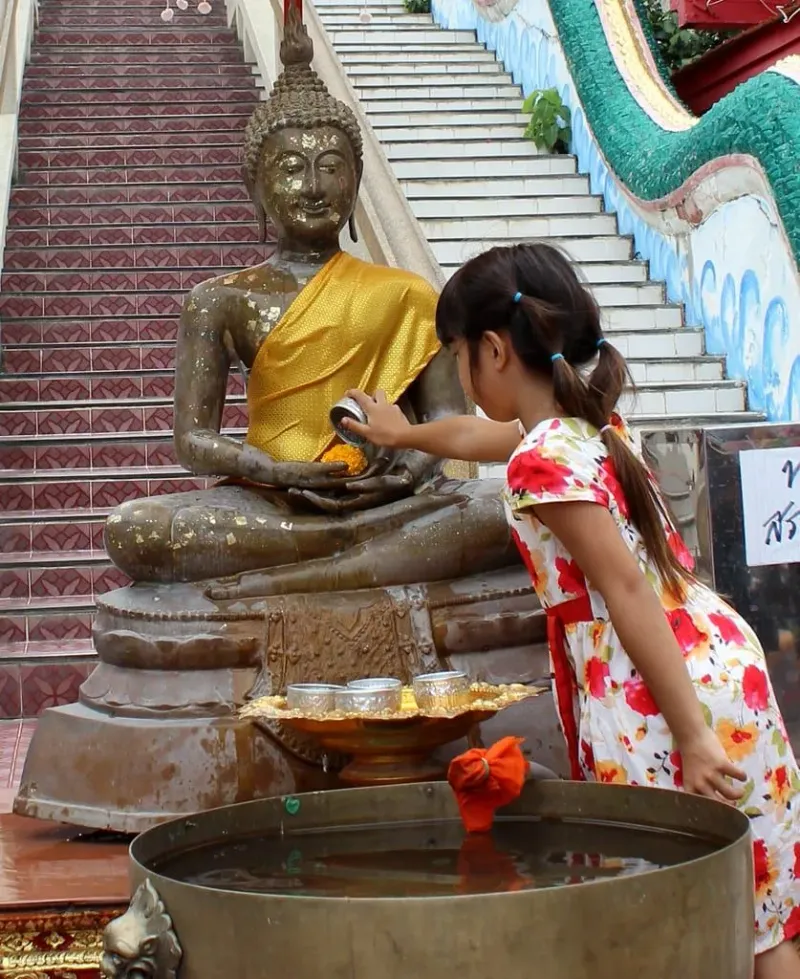
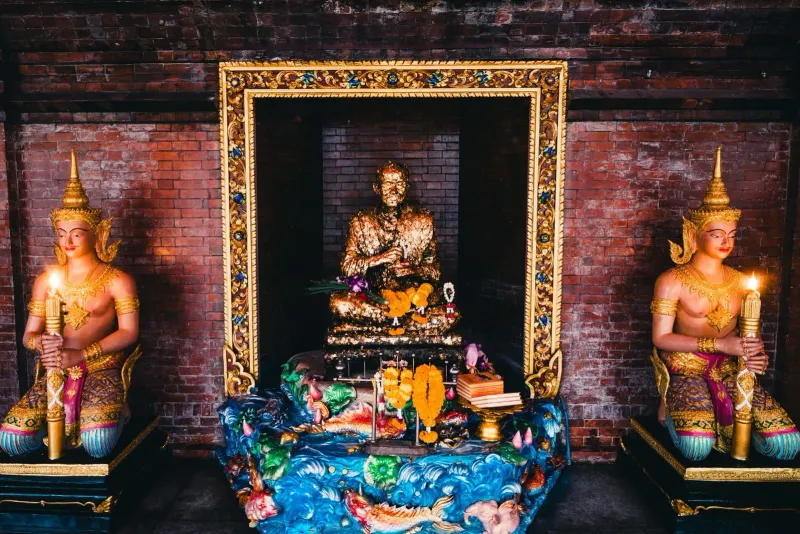
“Tham bun,” making merit, is the everyday reason most Thais visit a temple, and it explains far more of what you will see on the ground than sightseeing does. Merit is accumulated through dana, giving: offering food to monks on their morning alms round, donating to a temple, funding a son’s temporary ordination, listening to a sermon, or releasing a captive animal (Thaizer — releasing animals to make merit). Animal release in particular has drawn criticism from Thai officials in recent years as sometimes ecologically harmful, even though the underlying intent — saving a life in danger — is centuries old. When you see Thai visitors placing coins on a stone footprint, feeding fish at Wat Plai Laem’s lake, or dropping a small note in a donation box, they are making merit, not paying an entry fee; our temple etiquette guide covers how to do the same respectfully as a visitor.
A Day Inside a Wat — The Monastic Rhythm You Can Join
Behind the architecture and the merit-making above, a wat runs on a daily rhythm most visitors never see past the alms round. Timing varies temple to temple, but the pattern typically opens with a pre-dawn bell — rung from the temple’s own bell tower — and chanting, moves into the community for the alms round, then settles into a schedule built around a single meal (Wat Tam Wua — Theravada monastic daily routine).
At the Samui Meditation Center in Bophut, morning chanting opens the day at 5:20am and visitors are welcome to sit in — one of the few points in the routine open to outsiders; our meditation retreats guide covers this and every other place to sit on the island. Barefoot monks then walk out on the alms round, taking rice and food offered silently into the bowl; at Wat Pradoem, a working monastery, this dawn round still happens every morning. The one substantial meal of the day follows around 8am, eaten from what the round brought in, and monastic rule then forbids solid food after roughly 11:30am — water and tea are all that’s left until the next morning.
Afternoons turn inward: scripture study, temple upkeep, and any teaching a monk is asked to give, away from public view. The day closes as it opened, with chanting in the ubosot before lights out across the compound. Back in Bophut, the meditation centre runs a free evening sit from 19:00 to 20:15, no booking needed, before the same rhythm begins again at the next dawn bell.
Where to Go From Here
Fourteen of Samui’s temples are named above with a specific guardian, symbol or story attached to them; our Koh Samui temples guide lists all of the island’s must-see sites with fees, hours and directions, and Wat Laem Sor, the forest monastery beside the pagoda in the human-chain story, Wat Khao Chedi above it, and Wat Lamai’s museum grounds are all good next stops if you want to see the buildings and guardians described here in person. Before you go, read the full temple etiquette guide for dress code and behaviour rules — the difference between being waved in and being turned away at the gate.
FAQ
What is the difference between a wat and a shrine on Koh Samui?
A wat is a Buddhist temple compound centred on one or more Buddha images and staffed by ordained monks; a shrine, in the Hainanese-Chinese sense, honours a deity or ancestor figure like Guan Yu or Mazu and is typically run by the local Chinese-Thai community rather than a monastic order. Both welcome visitors, but a shrine has no ubosot ordination hall and no resident monks.
Which Buddha statue matches my birthday?
Thai tradition assigns a posture to each day of the week: standing for Sunday and Monday, reclining for Tuesday, holding an alms bowl (day) or seated in the forest (night) for Wednesday, meditating for Thursday, hands crossed for Friday, and shielded by the naga king for Saturday. Check your birth weekday against the table above — many Thai temples sell small versions of each day’s image.
Why do naga serpents guard temple staircases?
The naga references the Mucalinda story, in which a seven-headed serpent king shielded the meditating Buddha from a storm with its raised hoods. Temple staircases lined with naga balustrades, like the one leading up to Wat Phra Yai’s Big Buddha, symbolically carry visitors from the everyday world into the sacred space at the top.
Can visitors enter every building in a Thai temple?
No. The viharn (assembly hall) and sala (open pavilion) are generally open to everyone with shoes off and shoulders and knees covered. The ubosot (ordination hall), marked by eight boundary stones, is sometimes locked outside ceremonies, and the kuti, the monks’ private living quarters, is always off-limits to visitors.
What does tham bun (making merit) mean?
Tham bun is the practice of accumulating positive karma through giving — offering food to monks, donating to a temple, funding a son’s temporary ordination, or listening to a sermon. It is the primary reason most Thai visitors go to a temple at all, distinct from sightseeing, and it is why you will see small donations and offerings at almost every shrine and Buddha image on Koh Samui.
Which Samui temple has the statue with 18 arms?
Wat Plai Laem, near Bophut in the island’s northeast, has an 18-armed Guanyin statue roughly 15 metres tall rising from an artificial lake. The extra arms represent the bodhisattva’s ability to perceive and act on suffering everywhere at once, according to the Great Compassion Dharani Sutra legend behind the image.
Can visitors join any part of a monk’s daily routine on Samui?
Yes, at the Samui Meditation Center in Bophut: morning chanting opens at 5:20am and a free evening meditation sit runs 19:00 to 20:15, both open to visitors with no booking needed. Elsewhere the routine isn’t set up as a spectator activity, though watching an alms round respectfully from a distance, as at Wat Pradoem, is welcome.
Published on
About the author

Mike Brochlowski
Travel photographer & writer
Travel photographer and island explorer. Mike has spent years documenting Southeast Asia's hidden gems, from secluded beaches to jungle waterfalls.
Articles by Mike →More in Travel Guides
Next in Travel Guides
Best Yoga & Wellness Retreats in Koh Samui — Kamalaya to Samahita
Compare Koh Samui's top yoga and wellness retreats — Kamalaya, Samahita, Vikasa, Absolute Sanctuary — by price, minimum nights and detox…
Next in Travel Guides
Things to Do in Koh Samui at Night (That Aren't Clubbing)
Koh Samui at night beyond the clubs: night markets, Muay Thai, cabaret, night fishing, stargazing and spas — hours and THB prices for 12…
Chaweng Beach — Samui's 7km White Sand Strip and Nightlife Capital
Chaweng Beach on Koh Samui — 7 km of white sand, beach clubs, Soi Green Mango nightlife, Central Festival shopping, and year-round swimming.