Contents
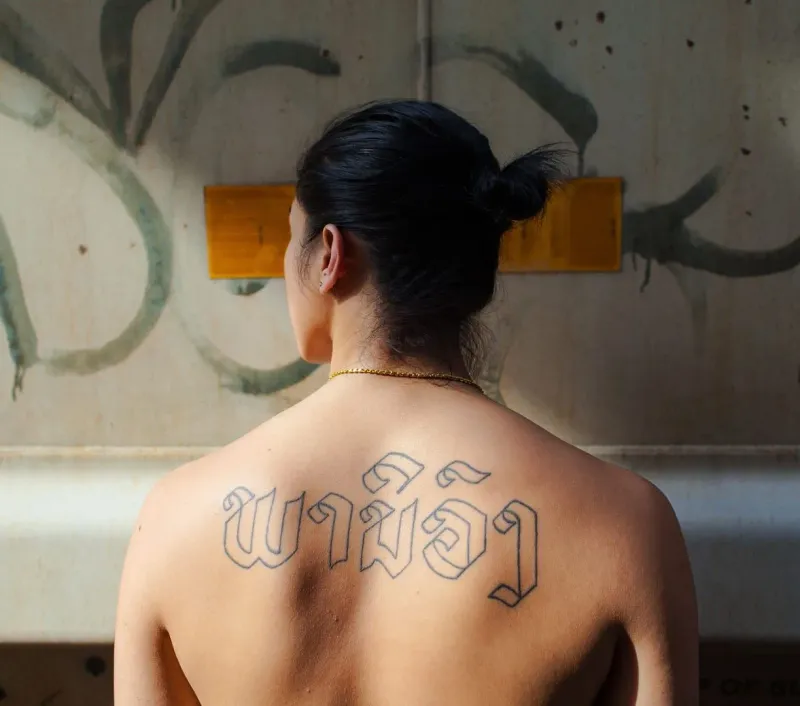
Two different things happen under the word “tattoo” on Koh Samui, and mixing them up is the mistake. A sak yant is a sacred geometric tattoo given by a Buddhist monk or a lay master (an ajarn) with a sharpened steel or bamboo rod, accompanied by a chanted kata and a set of precepts the wearer is expected to keep. A studio tattoo is commercial custom art, done with a machine by a professional artist for a fee. Samui has plenty of the second and almost none of the first — the sak yant tradition is centred two hours north, near Bangkok.
Key takeaways
- Sak yant is a religious act, not a souvenir — it comes with a kata and a set of sila (precepts) the recipient agrees to keep.
- The tradition’s spiritual home is Wat Bang Phra in Nakhon Pathom province, roughly 500 km / a flight-plus-drive from Samui — the island is not a sak yant destination in its own right.
- Studio tattoo hours on Samui run roughly 1,500–4,000 THB (~43–114 USD) depending on artist and design; walk-in flash is cheaper than booked custom work.
- Ask to see a fresh needle opened from its sealed pack and the autoclave in use — a studio that won’t show you either is a studio to leave.
- No sea, pool, or direct sun on a healing tattoo for at least two weeks in Samui’s heat and humidity; infected tattoos are one of the more common reasons tourists end up at a Samui hospital.
What This Actually Is
Samui’s tattoo scene is really two unconnected scenes sharing one word. Sak yant is Thai Buddhist and animist practice: a monk or ajarn hand-taps a yantra design believed to carry protection or luck, reciting a kata as the needle moves. Studio tattooing is the international commercial trade — a client commissions a design, an artist runs an electric machine, and money changes hands for a service. They can look similar in a photo and mean almost nothing alike. Treating a sak yant like a cheap souvenir, or a studio artist like a spiritual guide, disrespects both.
Who Is In It
Sak yant recipients are mostly Thai — soldiers, taxi drivers, market vendors and devout Buddhists seeking protection or merit — plus a smaller stream of foreign visitors who’ve researched the practice and approach it as religious participation, not photo content. Studio tattoo clients on Samui are overwhelmingly tourists: long-stay visitors finishing a sleeve, backpackers marking a trip, and a smaller local clientele that prefers Western-style flash over traditional yantra designs.
How It Works
A sak yant session starts with an offering — flowers, incense, sometimes cigarettes — laid before the master’s teacher, followed by prayer before the master begins tattooing, chanting the kata that activates the design as the rod moves. A studio session starts with a consultation on placement, size and reference images, then stencil and machine work, with breaks for larger pieces. Neither should be rushed; a master or artist who skips the ritual or the consultation skips the part that makes the result worth having.
What It Costs
A sak yant is never priced — the exchange is an offering, not a transaction, and quoting a “price” to a monk is itself disrespectful. A modest cash offering (a few hundred baht) alongside flowers and incense is customary; there is no menu. Studio work is priced conventionally: roughly 1,500–2,500 THB (~43–71 USD) an hour for small-to-mid custom pieces at an established studio, rising to 3,000–4,000 THB (~86–114 USD) an hour for an in-demand artist’s detailed colour or fine-line work, and walk-in flash from a few hundred baht.
How To Join
For a sak yant, the honest starting point is Wat Bang Phra itself, or another temple with a resident master known for the practice — not a stranger on a beach road claiming monk credentials. For studio work, walk past a shop first: a professional studio shows a portfolio of its own completed work, keeps visibly separate clean and dirty work areas, and talks through hygiene practice before you commit to a design.
What the Yants Mean — Hah Taew, Gao Yord and Paed Tidt
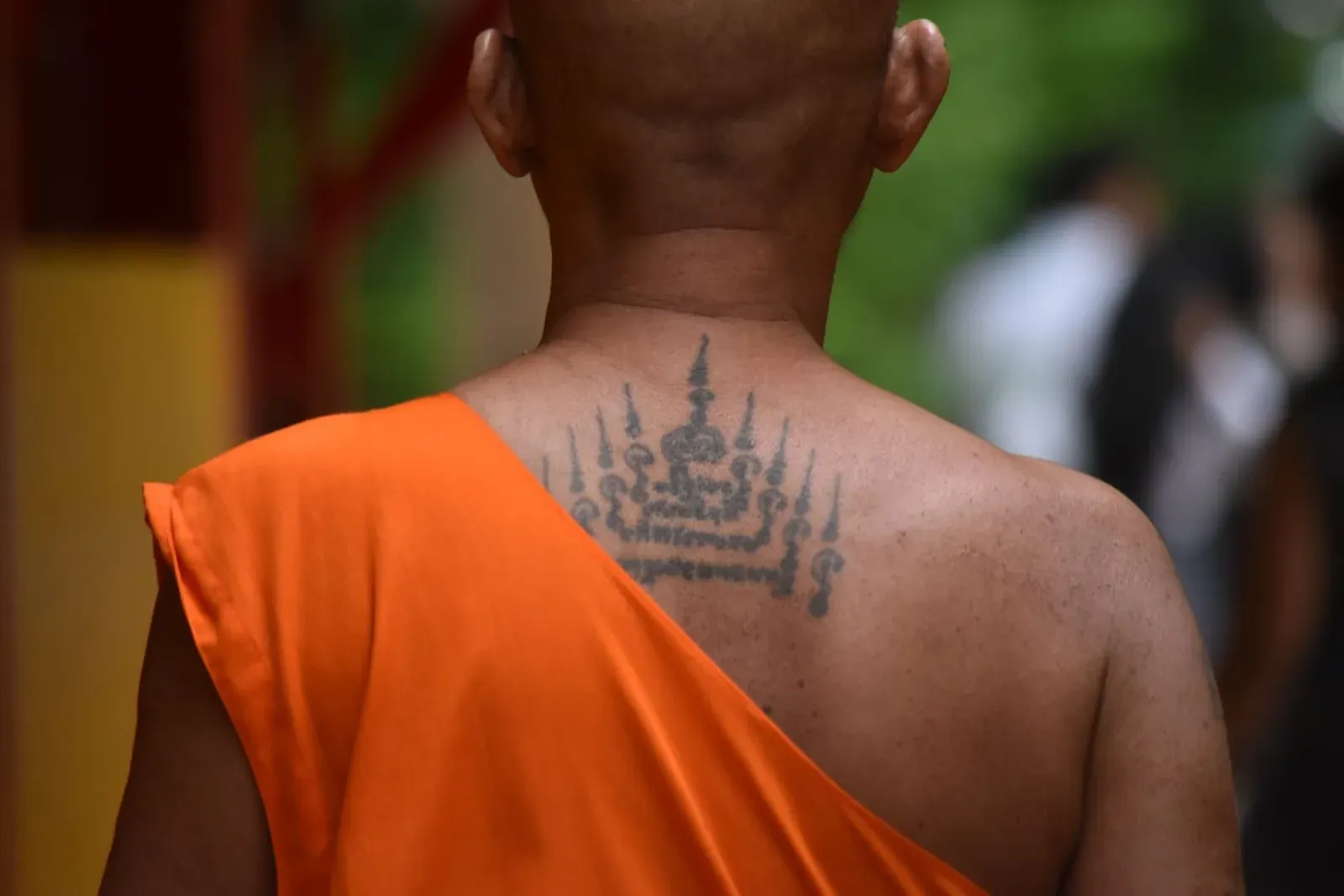
Sak yant designs are not decorative — each layout of script and geometry is chosen for a specific effect, and the same design means the same thing regardless of who wears it. Hah Taew (“five rows”) is the most widely recognised design worldwide: five vertical lines of Khmer script, each carrying a different blessing, commonly read as removing bad luck, warding off black magic, and bringing good fortune, charisma and safe travel. Gao Yord (“nine spires”) is often the first yant a devotee receives at Wat Bang Phra, usually placed on the upper back; it represents nine peaks of Buddhist cosmology tied to the Buddha, the Dhamma and a master’s teachers, offering broad protection. Paed Tidt (“eight directions”) is read in a circular layout representing protection from all eight compass directions at once. None of these are interchangeable with generic “tribal” or “Thai-style” studio flash — a studio can copy the pattern, but without the master, the kata and the sila it’s calligraphy, not a sak yant.
The Kata and the Sila You Accept
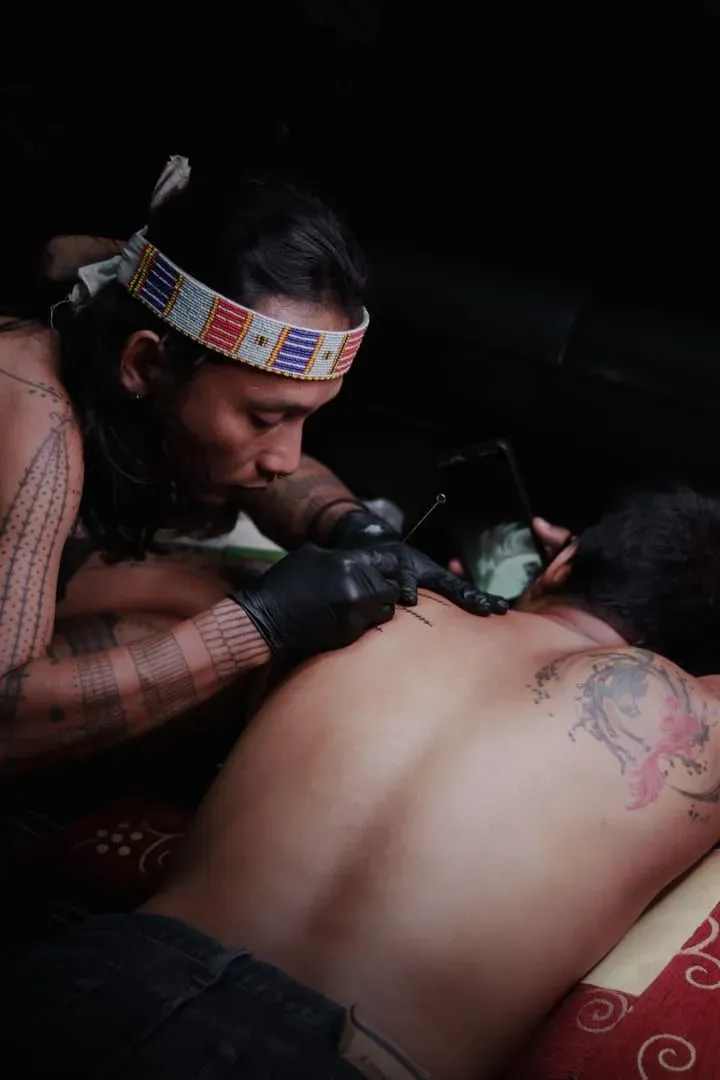
The kata is the incantation a master recites while working, believed to be what actually activates the design — without it, practitioners consider the geometry inert ink rather than a living yant. Alongside it comes a set of sila, precepts the recipient agrees to keep for the design to retain its power: commonly avoiding lying, stealing, adultery and disrespect toward parents or teachers, sometimes extending to specific foods or behaviours the individual master names. This is a real spiritual contract to the Thai devotees who make up most recipients — which is exactly why getting a sak yant “for the design,” with no intention of keeping the conduct, reads to many Thais as taking the form while discarding the substance.
Wai Khru Day and Why Samui Isn’t the Centre
The tradition’s best-known annual event, Wai Khru Wai Sak Yant, happens each March at Wat Bang Phra in Nakhon Pathom province — roughly 500 km from Samui, west of Bangkok — where thousands of devotees gather to have existing yants re-blessed, honouring a tradition tied to the late master Luang Phor Pern. Samui has no equivalent festival or temple in this lineage; the island’s own temples, including Wat Phra Yai and Wat Plai Laem and covered in our temples guide, are worth visiting on their own terms but aren’t where this specific tradition lives. Treating a Samui shop’s “sak yant style” tattoo as equivalent to the real thing at its source is the most common way visitors get this wrong.
Should a Foreigner Get a Sak Yant?
Thai practitioners disagree, and a page pretending there’s one correct answer would be lying to you. One position, common among masters who tattoo foreigners regularly, holds that sak yant is open to any sincere participant willing to make the offering, learn the kata’s meaning and keep the sila — Buddhism doesn’t gatekeep by nationality. The other, held by Thais who see the tradition emptied of meaning, argues mass tourist demand has turned some temples and beach-town copyists into assembly lines, and that most foreign recipients can’t even read the Khmer script on their own skin. Both views are held by devout, informed people; this guide won’t adjudicate, but it will insist on two rules almost nobody on either side contests: placement and contact.
Placement matters absolutely. A sak yant is never placed below the waist or on the feet — the feet are the spiritually “lowest” part of the body in Thai belief, and a yant there would be a contradiction in terms. Traditional placement is the upper back, shoulders, chest or arms.
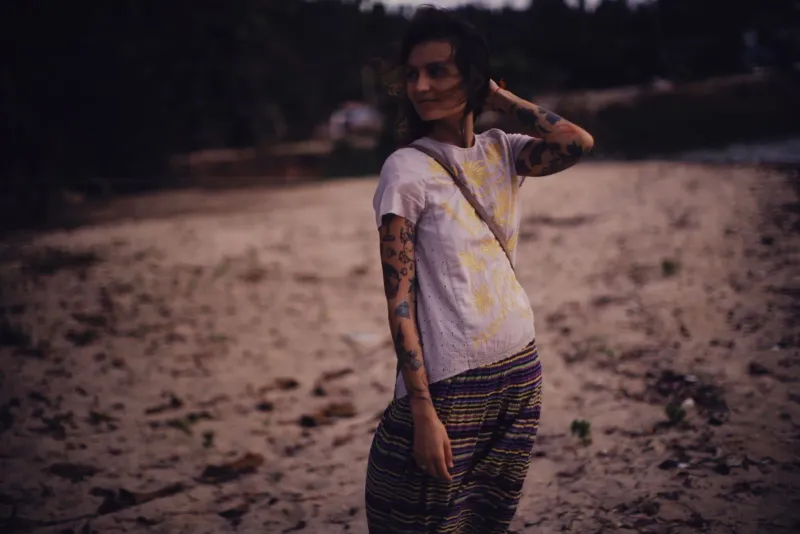
Monk contact carries real rules. A fully ordained monk is traditionally forbidden from physically touching a woman, so a woman receiving a sak yant from a monk is typically tattooed via an indirect method — the monk guides an assistant’s hand, or the temple’s lay ajarn does the work instead — rather than being touched directly. This is the same rule that governs a monk declining to shake a woman’s hand; any monk disregarding it isn’t observing his own tradition correctly, whatever he tells a tourist.
If you go ahead: bring an appropriate offering, dress modestly, follow the master’s instructions without haggling over the design, and treat the kata and the wait with the patience you’d bring to any religious ceremony you were a guest at.
Studio Tattooing on Koh Samui
Samui’s commercial tattoo studios cluster where tourist footfall is — Chaweng and Lamai carry the highest concentration of shops, with a smaller scattering in Bophut and Maenam. Two tiers operate side by side: established studios with a fixed address, a portfolio and appointment-based custom work, versus open-fronted “beach-road” booths doing walk-in flash off a printed sheet at fast turnover. The gap isn’t cosmetic — it shows up in hygiene practice, needle sourcing, and how much say you get over the final design. A studio with a web or Instagram portfolio you can check beforehand, and reviews mentioning hygiene, is a meaningfully safer bet than a booth with no online presence.
Walk-in flash suits a small, pre-drawn design and a short wait; booked custom work suits anything larger, finely lined or shaded, or built around your own idea — expect to arrange a consultation a day or more ahead and pay a deposit applied to the final price.
A few studios publish enough to check before you go, rather than just a shopfront: Ink Inc (Chaweng Beach Road) is a Thailand-wide chain whose own site states single-use needles, machine covers and gloves plus daily clinical-waste collection; BlueBlood Tattoo (Bo Put) runs its own site alongside a public TripAdvisor review history; The Bamboo Rooms (Bophut) does both machine work and hand-tapped bamboo technique as a commercial studio service, also independently reviewed on TripAdvisor. This is a starting list, not an endorsement — Samui’s tattoo scene turns over fast, and the hygiene checklist below is what actually matters once you’re in the chair.
Hygiene — What a Safe Studio Lets You Inspect
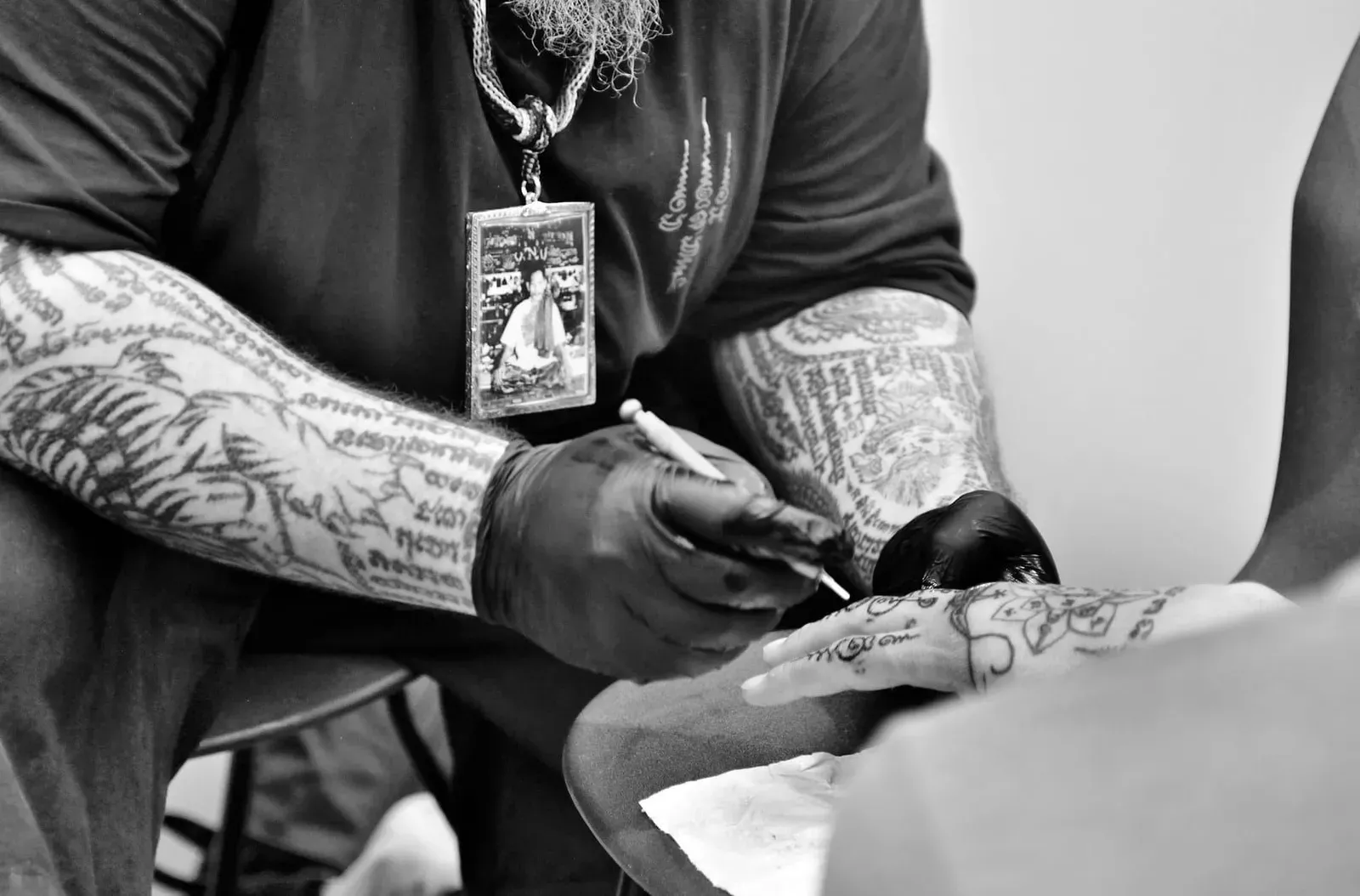
This section matters most, and it applies equally to a studio machine tattoo and a hand-poked or bamboo sak yant — the tool changes, the infection risk from bad practice doesn’t. The World Health Organization states hepatitis B spreads through “needlestick injury, tattooing, piercing and exposure to infected blood and body fluids,” and WHO’s HIV risk factors (updated 2026) explicitly include “medical procedures that involve unsterile cutting or piercing.” Hepatitis C spreads the same way, through reused or inadequately sterilised sharp instruments. None of these viruses care whether the implement was an electric machine or a bamboo rod at a temple — the risk comes entirely from reused or improperly sterilised equipment.
A safe operator, studio or temple alike, will let you see:
- A single-use needle opened from its sealed sterile pack in front of you, immediately before your session starts — not “somewhere in a drawer.”
- An autoclave (steam sterilisation unit) visible in the workspace for reusable equipment like tattoo machine grips, with sterilisation strip indicators you can ask to see.
- Fresh gloves put on in front of you for each client, changed if the artist touches anything else mid-session.
- Ink poured into a small single-use cup, never dipped directly from a shared bottle.
If any operator refuses to show you a needle pack or an autoclave, or reuses a rod or grip between clients without visible sterilisation, walk away — this is the one place on this page where there is no compromise position.
Aftercare in a Hot, Humid, Salty Climate
A tattoo heals through broken skin for roughly two to three weeks, and Samui’s climate works against every stage of that. No sea and no pool for at least two weeks, longer for a large piece — seawater and pool chlorine both introduce bacteria and irritants into open skin, and salt draws moisture out of a healing wound. Sun is the single biggest threat: direct UV on unhealed skin can burn a wound and permanently fades and blurs the ink once healed, so keep a new tattoo covered with clothing (not sunscreen, which shouldn’t touch broken skin) for the first two weeks, then use high-SPF sunscreen on it for months.
Heat and humidity bring their own problems: sweat sitting on a fresh tattoo in Samui’s daytime heat is a bacterial growth medium, so rinse it with clean water and pat — never rub — it dry several times a day, in clean, loose, breathable clothing. Air conditioning helps by slowing overnight sweating, but pair it with a fragrance-free moisturiser, since AC also dries skin and over-dry healing skin cracks more. Dry sand is a specific hazard beyond swimming — even brushing against it on a beach walk can work grit into an open tattoo.
Watch for spreading redness or heat, swelling beyond the tattoo’s edges, pus, red streaking, or fever — signs of bacterial infection, not normal healing (which is mild redness and light peeling that fades within days). Samui’s hospitals, including private hospitals in Chaweng and Bophut, treat infected tattoos routinely with wound cleaning and oral antibiotics; ignoring early signs and continuing to swim on it is what occasionally escalates to IV antibiotics. If in doubt, get it checked within a day or two rather than waiting it out.
FAQ
Is it disrespectful for a foreigner to get a sak yant?
Thai practitioners are split. Some masters welcome sincere foreign recipients who make a proper offering, learn the meaning, and keep the sila; others see mass tourist demand as hollowing the tradition out. There’s no single correct answer — but placement below the waist, treating it as a cheap souvenir, or haggling over the offering are disrespectful under either view.
Where is the real centre of the sak yant tradition?
Wat Bang Phra in Nakhon Pathom province, about 500 km from Koh Samui near Bangkok, is the tradition’s best-known temple and hosts the annual Wai Khru Wai Sak Yant festival each March. Samui has no equivalent temple or festival in this specific lineage.
How much does a studio tattoo cost on Koh Samui?
Established studios typically charge 1,500–2,500 THB (~43–71 USD) an hour for small-to-mid custom work, and 3,000–4,000 THB (~86–114 USD) an hour for detailed or colour pieces from a sought-after artist. Small walk-in flash designs can run a few hundred baht.
What should I check before letting anyone tattoo me on Samui?
Ask to see a single-use needle opened from its sealed pack immediately before your session, an autoclave for reusable equipment, fresh gloves put on in front of you, and ink poured into a single-use cup. Refuse anyone who won’t show you these regardless of price or design quality.
Can I swim after getting a tattoo on Samui?
No — avoid the sea and swimming pools for at least two weeks after any tattoo, longer for larger pieces. Salt water, chlorine and sand all introduce bacteria and irritants into healing skin, and Samui’s heat and humidity slow healing further if the wound stays wet or dirty.
What are the infection warning signs I should watch for?
Spreading redness or heat beyond the tattoo’s edges, swelling that worsens rather than fades, pus, red streaking, or fever are signs of bacterial infection needing medical attention — normal healing is mild redness and light peeling that improves within days. Samui’s hospitals treat infected tattoos routinely with cleaning and antibiotics if caught early.
Turning Up
There’s no booking desk for either version of this. For a sak yant, the honest route is a temple with a resident master in the tradition’s actual home region on the mainland — treat any beach-road claim of “monk-blessed” tattoos on Samui itself with real skepticism, and never let anyone rush the offering or the kata. For studio work, walk Chaweng or Lamai’s tattoo strips in daylight before committing: look at portfolios, ask about needles and autoclaves, and pick whichever studio answers the hygiene questions without flinching. Read Buddhism on Koh Samui and temple etiquette first if this is your introduction to Thai Buddhist practice — the same respect that governs a temple visit governs this.
Published on
About the author
Mike Brochlowski
Travel photographer & writer
Travel photographer and island explorer. Mike has spent years documenting Southeast Asia's hidden gems, from secluded beaches to jungle waterfalls.
Articles by Mike →More in Island Life
Na Muang Waterfalls — Samui's Purple Cascades and Jungle Pools
Explore Na Muang Waterfalls on Koh Samui — the accessible 18m Purple Waterfall with its swimming pool and the 80m jungle trek to the isla…
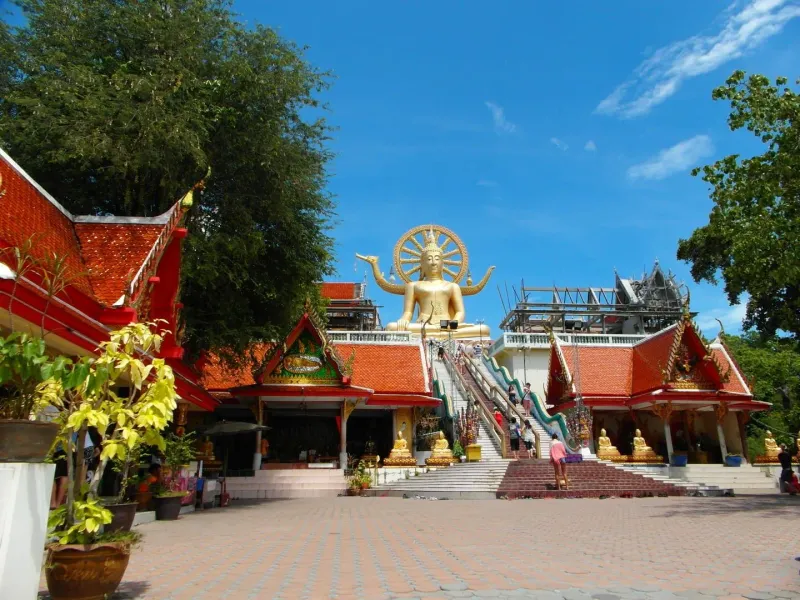
Wat Phra Yai — Big Buddha Temple on Koh Samui
Visit Wat Phra Yai (Big Buddha) on Koh Samui: a 12-meter golden Buddha, naga staircase, panoramic views, and market stalls.
Apirom Viewpoint — Koh Samui's Closed Hillside Lookout Above Ban Tai
Apirom Viewpoint: a ~304m hilltop lookout inland of Ban Tai, Koh Samui, its restaurant closed since the pandemic but the hillside track s…