Contents
Overview
Koh Samui has more than a dozen temples worth a detour, but three come first: Wat Phra Yai (the Big Buddha) for the island’s most iconic photo, Wat Plai Laem next door for its 18-armed Guanyin rising from a lake, and Wat Khunaram in the south for the mummified monk sitting in a glass case, a stark lesson in Buddhist impermanence. Between those three you get architecture, spectacle, and something genuinely unsettling — a fair summary of what temple-hopping on Samui delivers. Most temples are free, open roughly 6 AM to 6 PM, and pair well with a half-day loop by scooter or taxi.
Key takeaways
- Don’t miss: Wat Phra Yai, Wat Plai Laem, Wat Khunaram — all free, all under 15 minutes apart in the northeast.
- Almost every temple on this list is free to enter; a few ask a small ~20-80 THB donation.
- Cover shoulders and knees at every site; sarongs are usually available to borrow at the gate.
- Split visits into a north/northeast half-day and a south half-day — the island’s temples cluster that way.
- Photograph respectfully: never climb on statues, and ask before photographing monks.
Koh Samui’s 12 Best Temples at a Glance
| Temple | Area | Highlight | Entry Fee | Time Needed | Link |
|---|---|---|---|---|---|
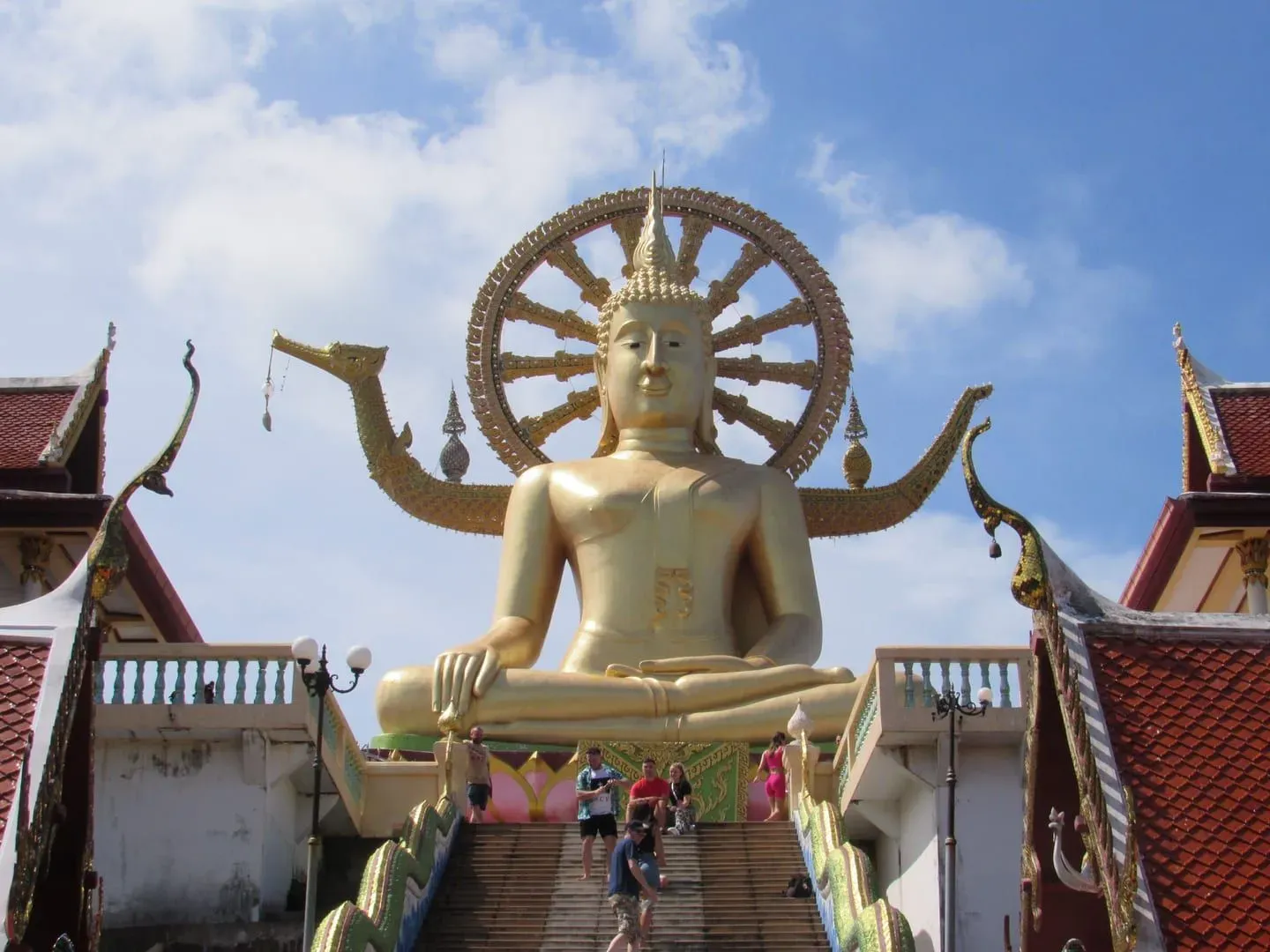
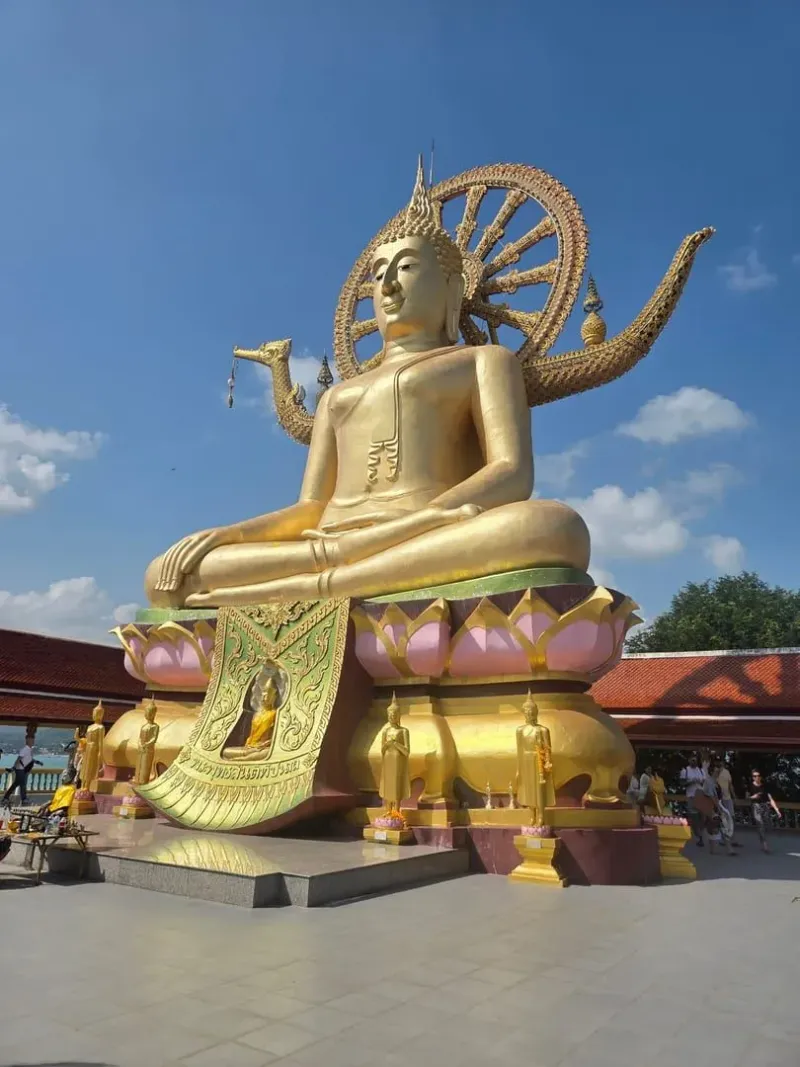
| Wat Phra Yai (Big Buddha) | Northeast (Bang Rak) | 12m golden Buddha on a causeway island | Free | ~30-45 min | Details |
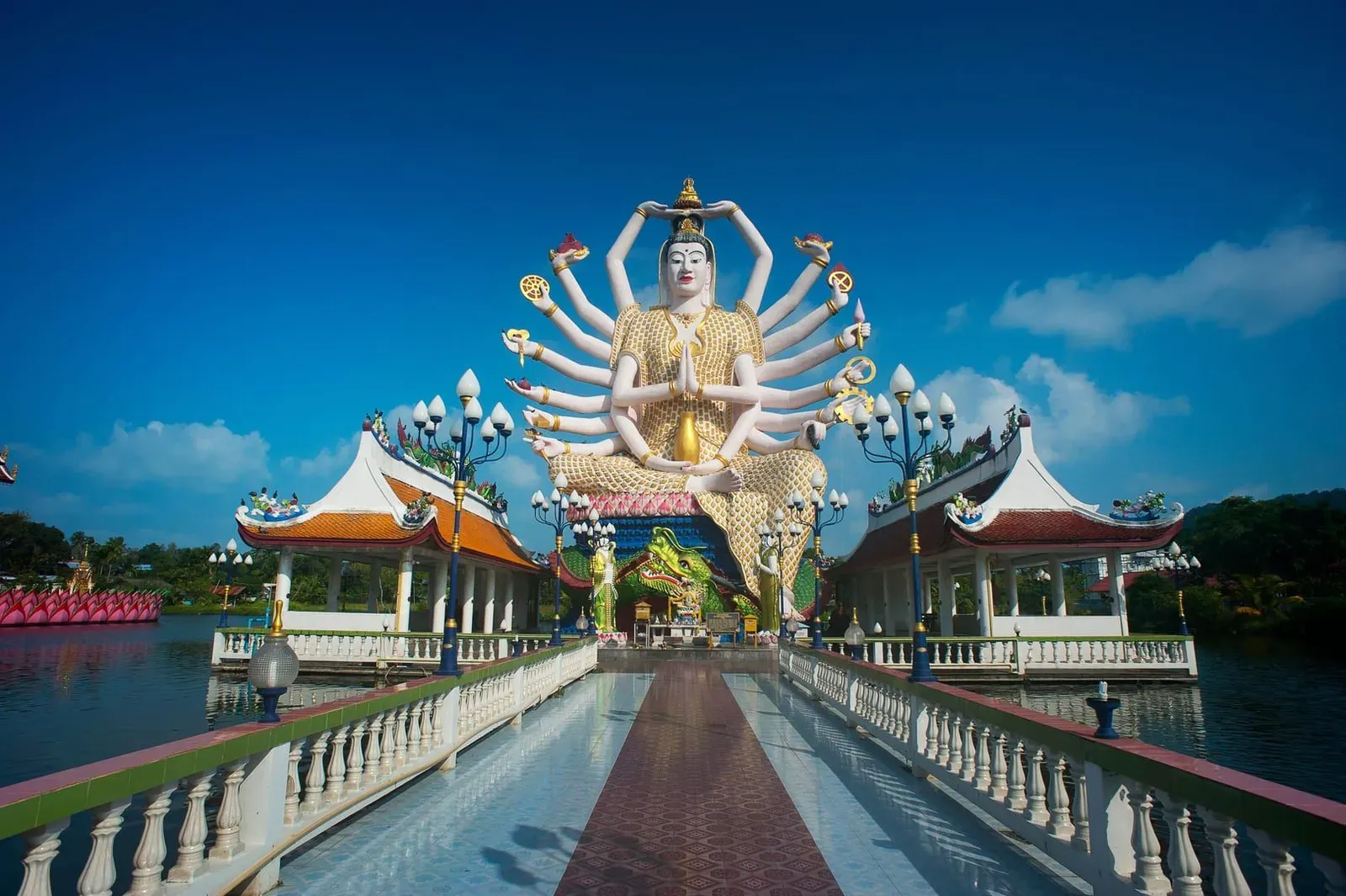
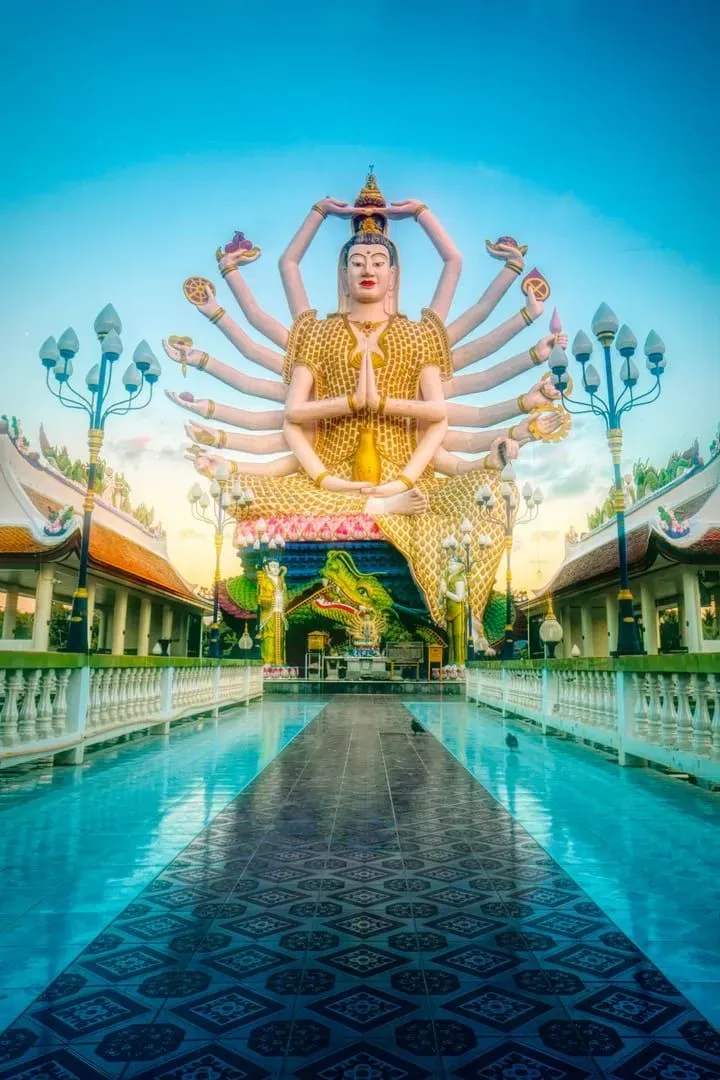
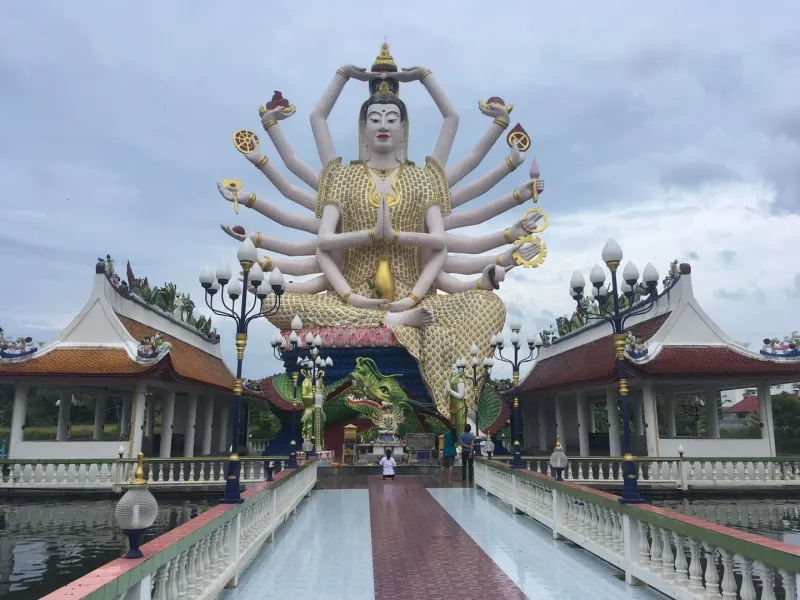
| Wat Plai Laem | Northeast | 15m 18-armed Guanyin over a lake | Free | ~30-40 min | Details |
| Wat Khunaram | Southeast | Mummified monk Luang Pho Daeng | Free (donation) | ~20-30 min | Details |
| Secret Buddha Garden | Central hills | Jungle sculpture garden by a stream | ~80 THB (~2.50 USD) | ~45-60 min | Details |
| Laem Sor Pagoda | South (Bang Kao) | Golden chedi on the shoreline | Free | ~15-20 min | Details |
| Wat Sila Ngu | Southeast (Hua Thanon) | Red sandstone “Red Temple” | Free | ~20-30 min | Details |
| Khao Hua Jook | North (Bophut) | Best 360-degree viewpoint on Samui | ~20 THB (~0.50 USD) | ~20-30 min | Details |
| Wat Khao Chedi | South (Taling Ngam) | White chedi, southwest coast views | Free | ~20-30 min | Details |
| Wat Samret | South interior | Solid marble Buddha from Burma | Free | ~20-30 min | Details |
| Guan Yu Shrine | South (Hua Thanon) | 16m bronze Guan Yu, tallest in Thailand | Free | ~20-30 min | Details |
| Chinese Temple of Maenam | North (Maenam) | Dragon-carved Hainanese shrine | Free | ~15-20 min | Details |
| Wat Bo Phuttharam | North (Bophut) | Giant monk statue on a concrete ship | Free | ~15-20 min | Details |
Wat Phra Yai (Big Buddha)
Wat Phra Yai, better known as the Big Buddha temple, is Koh Samui’s most photographed landmark: a 12-meter golden Buddha in the earth-touching gesture, seated on the small island of Koh Faan and reached by a causeway. Built in 1972 with community donations, it sits about 5 minutes from Samui Airport and is visible from arriving flights. Visitors climb a 73-step naga staircase to reach the statue’s base, then browse market stalls selling souvenirs and street food back on the mainland side. Entry is free, and the temple opens daily from roughly 7 AM to 6 PM. Go early morning or late afternoon to avoid tour-bus crowds and harsh midday light.
Best for: first-time visitors, photographers. Con: can be crowded 10 AM-2 PM with tour groups. Full details on Wat Phra Yai.
Wat Plai Laem
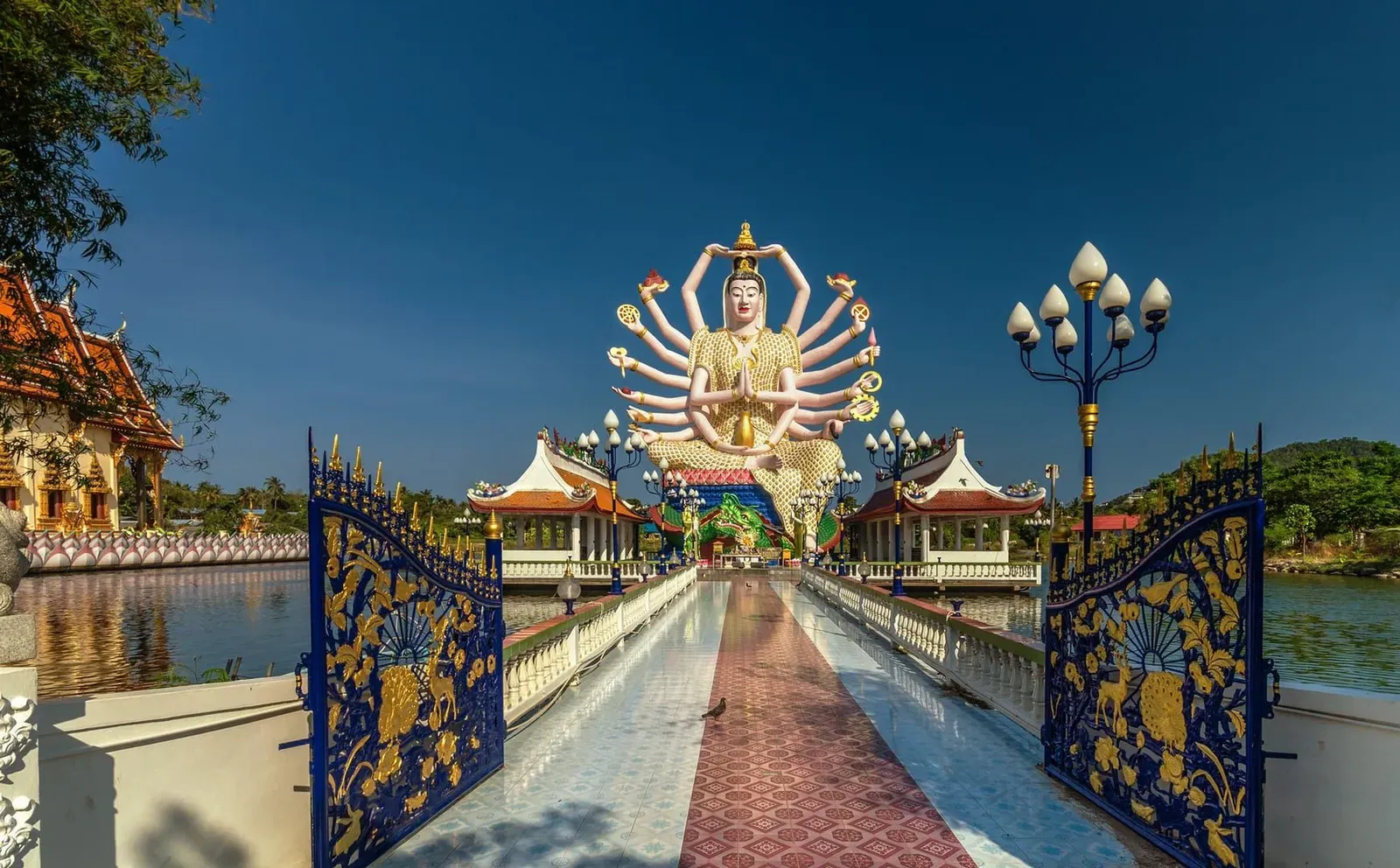
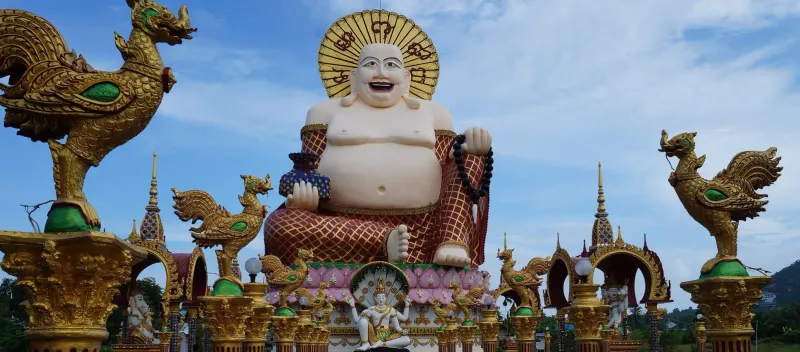
Two minutes past Big Buddha, Wat Plai Laem trades solemnity for spectacle. Its centerpiece is a 15-meter white Guanyin statue with 18 arms rising straight out of a lake, joined by a 20-meter laughing Buddha (Budai) in an ornate pavilion nearby. Built between 2004 and 2009 and partly designed by artist Jarit Phumdonming, the complex blends Chinese Mahayana and Thai Theravada styles with Hindu touches — a mix found nowhere else on the island. Entry is free, hours run roughly 6 AM to 6 PM, and there’s a small kiosk selling fish food for the lake’s resident carp and catfish. Pair it with Wat Phra Yai; they’re a single stop by taxi or scooter.
Best for: photography, families feeding the fish. Con: limited shade around the lake at midday. Full details on Wat Plai Laem.
Wat Khunaram
Wat Khunaram, on the southern Route 4169 ring road near Na Muang, holds Koh Samui’s most unusual sight: the preserved body of Luang Pho Daeng, a monk who died in 1973 while meditating and whose body has shown minimal decomposition ever since, displayed seated in a glass case. Thai Buddhists treat the site with deep respect — it’s presented as a physical lesson in anicca (impermanence), not a curiosity. Entry is free (donations welcome), and dress code is strictly enforced: shoulders and knees covered, no exceptions. The temple grounds are quiet and rarely crowded, making it an easy add-on to a Na Muang Waterfall trip nearby.
Best for: cultural and spiritual travelers. Con: the sight can be unsettling for some visitors. Full details on Wat Khunaram.
Secret Buddha Garden
Also called the Tarnim Magic Garden, the Secret Buddha Garden is the lifelong project of durian farmer Nim Thongsuk, who began hand-carving stone statues into his mountain property in 1976 at age 77 and kept working until his death at 91. Dozens of weathered deity, angel, and animal statues now sit half-swallowed by jungle around a freshwater stream on Pom Mountain, one of Samui’s highest points. It’s less a temple than a spiritual sculpture park, and it’s reached via a steep, partly unpaved access road — a 4WD or a confident scooter rider is recommended. Entry runs about 80 THB (~2.50 USD).
Best for: photographers, nature lovers. Con: rough access road, not ideal in heavy rain. Full details on Secret Buddha Garden.
Laem Sor Pagoda
Laem Sor Pagoda sits directly on the rocky shoreline at the end of Bang Kao Beach in south Samui, its three-tiered chedi covered in thousands of small yellow tiles that catch the light and appear to glow gold from a distance. It’s one of the few Samui temples built right at the water’s edge, and the setting — turquoise Gulf of Thailand water against the shimmering structure — makes it a favorite for sunset photography. Entry is free. The temple compound of Wat Laem Sor, with its distinctive Boat Hall honoring the monk Luang Por Dang, sits right alongside it and is worth the extra five minutes.
Best for: couples, photographers, quiet coastal escapes. Con: remote — a 45-60 minute drive from Chaweng. Full details on Laem Sor Pagoda.
Wat Sila Ngu
Known locally as the “Red Temple,” Wat Sila Ngu (officially Wat Ratchathammaram) breaks from Thailand’s usual white-and-gold temple palette with a clifftop ordination hall carved entirely from deep terracotta-red sandstone. Intricate bas-reliefs cover nearly every wall, and a naga staircase leads down toward the Gulf of Thailand at Hua Thanon. It’s one of the most photogenic — and least crowded — temples in the southeast. Entry is free, dress modestly (shoulders and knees covered), and the strongest light for photos is mid-afternoon when the sun hits the red stone directly.
Best for: photographers, religious-art fans. Con: limited signage in English on-site. Full details on Wat Sila Ngu.
Khao Hua Jook
Perched on a hilltop just north of Chaweng Lake in Bophut, the golden chedi at Khao Hua Jook is widely considered Samui’s best 360-degree viewpoint — Chaweng’s coastline, the airport runway, and Koh Phangan are all visible at once. Planes take off directly below the hill, making it a favorite for plane-spotters, and the same vantage point turns into one of the island’s best sunset spots after 5 PM. A small ~20 THB donation is typical. The site also holds a replica of the Buddha’s footprint, though most visitors come for the view.
Best for: sunset watchers, aviation enthusiasts, photographers. Con: short but steep final approach on foot. Full details on Khao Hua Jook.
Wat Khao Chedi
At Samui’s southern tip in Taling Ngam, Wat Khao Chedi (Rattanakosin Chedi) is an immaculate white stupa on a hilltop directly above Laem Sor Pagoda, offering 360-degree views over the island’s least-developed southwestern coast. Its “Baby Buddha” statue and collection of golden guardian figures make the hilltop worth the climb even without the panorama. Entry is free. Unlike the northeast cluster, this corner of Samui sees relatively few tourists, so expect a quiet, unhurried visit.
Best for: view hunters, meditation, escaping crowds. Con: far from the main resort areas — best combined with Laem Sor Pagoda. Full details on Wat Khao Chedi.
Wat Samret
One of Samui’s least commercialized temples, Wat Samret sits in the southern interior away from Chaweng and Lamai’s tourist trails. Founded more than a century ago, it houses a rare solid marble Buddha statue transported from Burma, plus a “secret” hall packed with dozens of smaller Buddha images collected over generations. The shaded, wooden-structure grounds feel more like a working village temple than an attraction, which is exactly the appeal for travelers who’ve already seen the headline sites. Entry is free.
Best for: culture seekers wanting an authentic, uncrowded temple. Con: little to no English signage, no dedicated parking area. Full details on Wat Samret.
Guan Yu Shrine
In Hua Thanon, the Guan Yu Shrine honors the legendary Chinese general Guan Yu with a 16-meter bronze statue — taller than the Big Buddha itself and the largest of its kind in Thailand. Built by the island’s Hainanese-Chinese community (the original shrine dates to 1872; the current complex to 2016), it’s a striking break from Samui’s Buddhist temple circuit, with red facades, dragon murals, and a genuinely lively atmosphere rather than hushed reverence. Entry is free, and the surrounding Hua Thanon streets have some of the best seafood on the south coast.
Best for: photography, cultural history, food lovers. Con: busy roadside location with heavy traffic noise. Full details on Guan Yu Shrine.
Chinese Temple of Maenam
The Chinese Temple of Maenam, officially the Chao Eng Sae Shrine, anchors Maenam village’s small “Chinatown” district on the north coast, just steps from the beach. Dragon-wrapped pillars, red facades, and paper lanterns mark it as the spiritual center of the local Hainanese community, and it becomes a focal point during Chinese New Year and the Thursday Maenam Walking Street market held nearby. Entry is free, and a visit takes 15-20 minutes — easily combined with the Maenam Beach walking street.
Best for: photography, festival timing, north-coast itineraries. Con: small site, best paired with the night market rather than visited alone. Full details on Chinese Temple of Maenam.
Wat Bo Phuttharam
A few minutes from Bophut’s Fisherman’s Village, Wat Bo Phuttharam is built around a striking jet-black statue of the revered monk Luang Pu Thuad, seated atop a concrete ship that appears to float in a tranquil pond. Founded in 1934, it’s quieter and far less commercial than its famous neighbor, making it a good stop for visitors who want a genuine local temple without the tour-bus energy. Entry is free, dress modestly, and feeding the pond’s fish is a popular activity for kids.
Best for: families, quiet local temple experience. Con: modest scale compared to the island’s headline temples. Full details on Wat Bo Phuttharam.
Dress Code and Etiquette
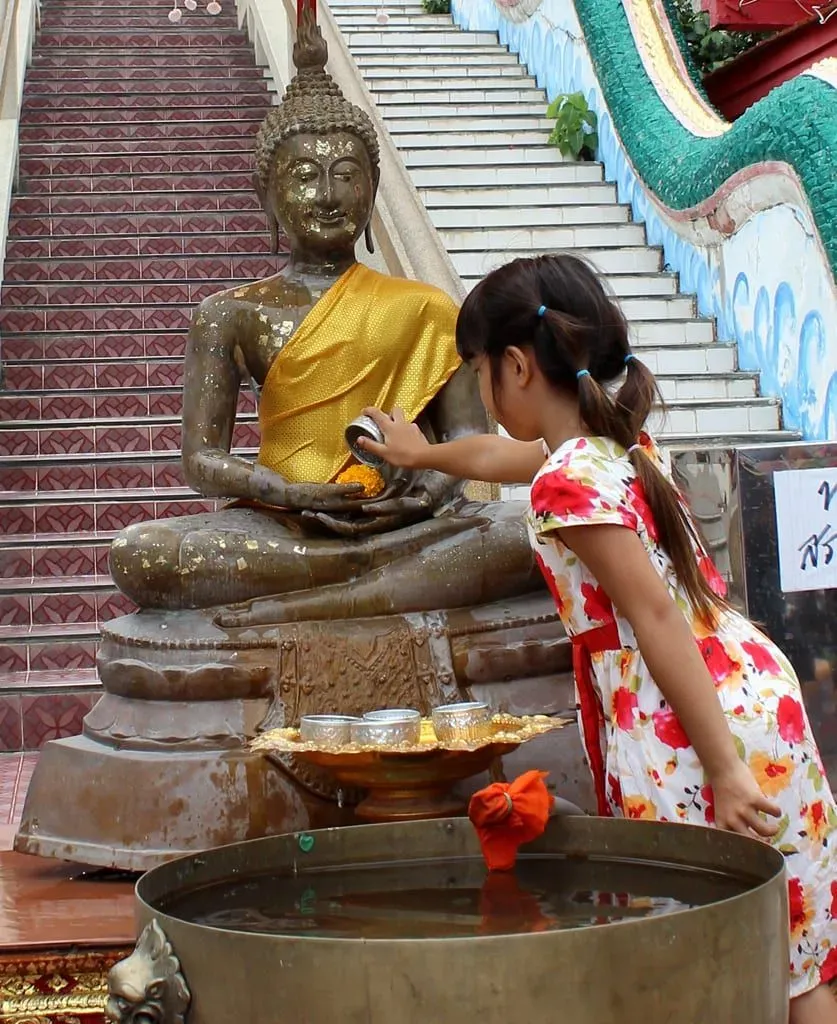
Every working temple on Koh Samui expects shoulders and knees covered — for both men and women — before you’re allowed past the main gate. Tank tops, short shorts, and swimwear are turned away at busier sites like Wat Phra Yai and Wat Plai Laem, though most temples keep a basket of loaner sarongs near the entrance for anyone underdressed. For dos and don’ts beyond dress code, see our full temple etiquette guide.
- Shoes: Remove footwear before stepping into any prayer hall or ubosot (ordination hall); sandals make this easier than lace-up shoes.
- Feet: Never point the soles of your feet toward a Buddha statue or a monk when sitting; tuck your legs to the side instead.
- Women and monks: Women should not touch a monk or hand him anything directly — place items on a cloth or table for the monk to pick up instead.
- Photos: Photography of statues and temple grounds is generally welcome, but ask permission before photographing monks, and never climb on statues or religious structures for a photo.
- Behaviour: Keep voices low inside prayer halls, silence phones, and avoid pointing at Buddha images with your feet or a raised finger.
- Donations: Even at free temples, a small donation (20-100 THB) in the collection box is appreciated and often funds temple upkeep directly.
Suggested Temple Route by Area
Samui’s temples cluster into two natural loops, so the most efficient way to see several in one day is to pick a side of the island rather than crisscross it.
North & Northeast Cluster (Half Day)
Start in Maenam at the Chinese Temple of Maenam, then head east to Wat Bo Phuttharam in Bophut. Climb the hill to Khao Hua Jook for the island’s best viewpoint, then finish at Wat Phra Yai and Wat Plai Laem, which sit two minutes apart near Big Buddha. The whole loop covers roughly 20 km and takes about 4-5 hours including stops, doable by scooter or a half-day taxi charter — see getting around Koh Samui for fares. With extra time, detour to the ocean-facing Guam Im Shrine in nearby Choeng Mon.
South Cluster (Half Day to Full Day)
From Hua Thanon, visit the Guan Yu Shrine and the red-stone Wat Sila Ngu, then head inland to Wat Samret. Continue south to Wat Khunaram for the mummified monk, then finish on the southwest coast at Laem Sor Pagoda and the hilltop Wat Khao Chedi directly above it. This loop is more spread out — budget a full day if you add the steep drive up to the Secret Buddha Garden in the central hills. Travelers with extra time can also fold in the forest temple Wat Namtok Hin Lad near Nathon or the hilltop Buddha’s Footprint Shrine on the return leg.
Whichever loop you pick, this guide connects into the wider island plan on things to do in Koh Samui.
Go deeper:
- Buddhism on Koh Samui — temple anatomy, guardians and the stories behind the statues
- Meditation retreats on Koh Samui — where to sit, from drop-in evenings to silent retreats
- Koh Samui’s Chinese shrines — Guan Yu, the Maenam and Nathon shrines, and Guam Im
- Buddhist holidays and alcohol-ban days — 2026 dates, Wan Phra and when bars can’t sell alcohol
FAQ
What are the must-see temples in Koh Samui?
The three must-sees are Wat Phra Yai (the Big Buddha, a 12m golden statue on a causeway island), Wat Plai Laem (an 18-armed Guanyin over a lake, two minutes away), and Wat Khunaram (the mummified monk Luang Pho Daeng, in the south). All three are free to enter. Together they take about 90 minutes to see, not counting drive time between the north and south clusters.
Is there an entry fee for Koh Samui’s temples?
Most Koh Samui temples are free, funded by donations rather than ticket sales. A handful ask for a small contribution — the Secret Buddha Garden charges around 80 THB (~2.50 USD), and Khao Hua Jook typically asks for a ~20 THB (~0.50 USD) donation at the entrance. Bring small cash notes since donation boxes rarely give change.
What is the dress code for Koh Samui temples?
Shoulders and knees must be covered for both men and women at every active temple. Tank tops, shorts above the knee, and swimwear are turned away at busy sites like Wat Phra Yai. Most temples keep loaner sarongs at the entrance, but bringing a light scarf or long trousers avoids the wait, especially on hot afternoons.
Where is the mummified monk on Koh Samui?
The mummified monk, Luang Pho Daeng, is displayed in a seated glass case at Wat Khunaram on the southern Route 4169 ring road, near Na Muang. He died in 1973 while meditating, and his body has shown minimal decomposition since, which Thai Buddhists interpret as a teaching on impermanence rather than a curiosity to gawk at.
How many days do I need to see Koh Samui’s temples?
Two half-days cover the 12 temples in this guide comfortably: one loop through the north and northeast (Chinese Temple of Maenam, Wat Bo Phuttharam, Khao Hua Jook, Wat Phra Yai, Wat Plai Laem) and one through the south (Guan Yu Shrine, Wat Sila Ngu, Wat Samret, Wat Khunaram, Laem Sor Pagoda, Wat Khao Chedi, Secret Buddha Garden). A single full day is possible if you skip the Secret Buddha Garden’s steep access road.
Can you visit Koh Samui temples on a scooter?
Yes — most temples on this list have on-site or roadside scooter parking, and a scooter is the easiest way to link the north or south clusters in one loop. The Secret Buddha Garden’s final approach road is steep and partly unpaved, so confident riders only; everyone else should take a taxi or rent a car for that stop. See getting around Koh Samui for rental prices and road conditions.
Published on
About the author

Mike Brochlowski
Travel photographer & writer
Travel photographer and island explorer. Mike has spent years documenting Southeast Asia's hidden gems, from secluded beaches to jungle waterfalls.
Articles by Mike →More in Travel Guides
Also in 25 Best Things to Do in Koh Samui (2026)
Koh Samui Events Calendar 2026-2027 — Dates, Prices & Crowds
Koh Samui events calendar 2026-2027: Songkran, Loy Krathong, Full Moon Party dates, the Samui Regatta and Chaweng's NYE countdown, with p…
Also in 25 Best Things to Do in Koh Samui (2026)
18 Free Things to Do in Koh Samui (2026)
18 free things to do in Koh Samui — temples, beaches, waterfalls and viewpoints — plus the real costs some 'free' spots hide.
Also in 25 Best Things to Do in Koh Samui (2026)
Golf in Koh Samui — Santiburi Green Fees, Football Golf & Mini Golf
Golf in Koh Samui: Santiburi's hillside 18-hole course (3,550-5,800 THB green fee), Football Golf near Big Buddha, and what's confirmed f…