Overview
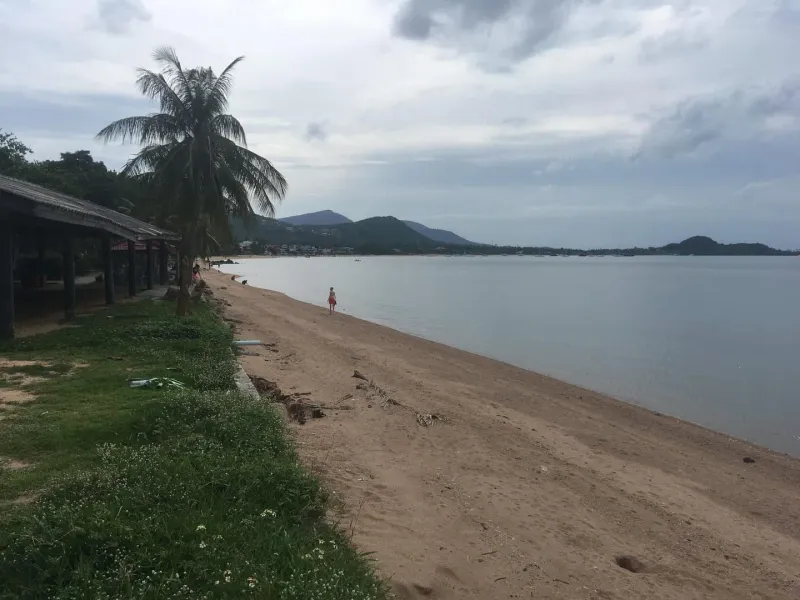
Bophut Beach is a 2-3 km crescent-shaped bay on the north coast of Koh Samui, Thailand. While other Samui beaches compete on sand quality or nightlife, Bophut wins on character. Its centerpiece, Fisherman’s Village, is a preserved strip of 19th-century Chinese shophouses turned into boutique restaurants, galleries, and bars. The beach stretches between Bang Rak (Big Buddha Beach) to the east and Maenam Beach to the west, with views of Koh Phangan across the strait.
Bophut is one of the closest beaches to Samui International Airport: just 8 minutes by car. It draws families, couples, and digital nomads who want a walkable village atmosphere without the noise of Chaweng. The Friday Night Market (Fisherman’s Village Walking Street) is the island’s most popular weekly event.
History: Hainanese Heritage
Bophut’s story begins with Hainanese fishermen from southern China who settled on Koh Samui’s north coast centuries ago. The island appeared on Chinese navigation maps as early as the 17th century, and Hainanese traders established one of Samui’s first permanent communities here.
The wooden shophouses lining Fisherman’s Village today date back to the 19th and early 20th century. Built from dark teak, many sit directly over the water: a blend of Chinese merchant architecture and Southeast Asian coastal design. Red Chinese lanterns still hang throughout the village, a quiet reminder of the Hainanese families who built this place.
From fishing port to boutique village
For over a century, Bophut Pier served as Koh Samui’s main connection to the Thai mainland. Merchants traded coconut oil, dried fish, and spices. When tourism arrived on Samui in the 1970s and 80s, the fishing village adapted. Old medicine shops became art galleries. Fishermen’s homes became guest villas. But the transformation was gradual: Bophut never bulldozed its heritage the way Chaweng did.
Today, descendants of those original Hainanese families still live and work in Bophut. The village approach has been to keep the “bones” (the teak structures, the narrow lanes, the waterfront character) while renewing what’s inside. The result is one of the most authentic historic neighborhoods on any Thai island.
The Beach: Sections and Swimming
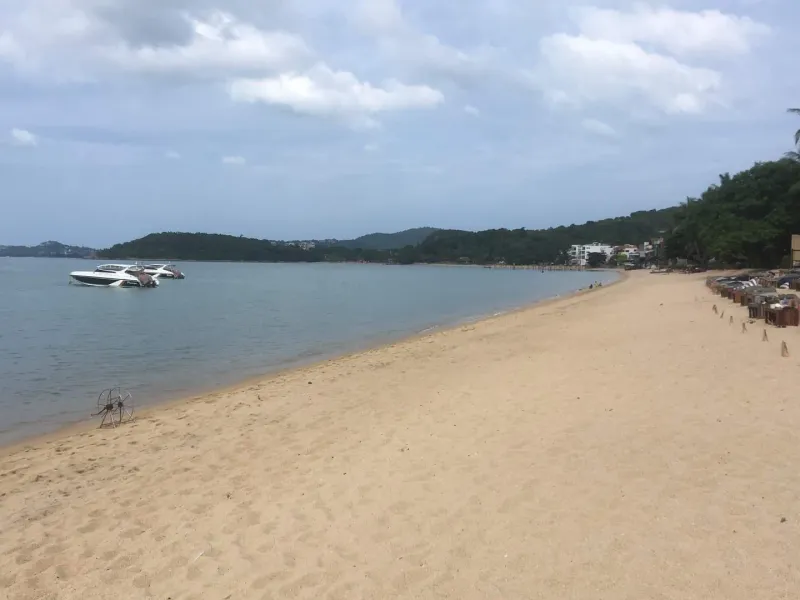
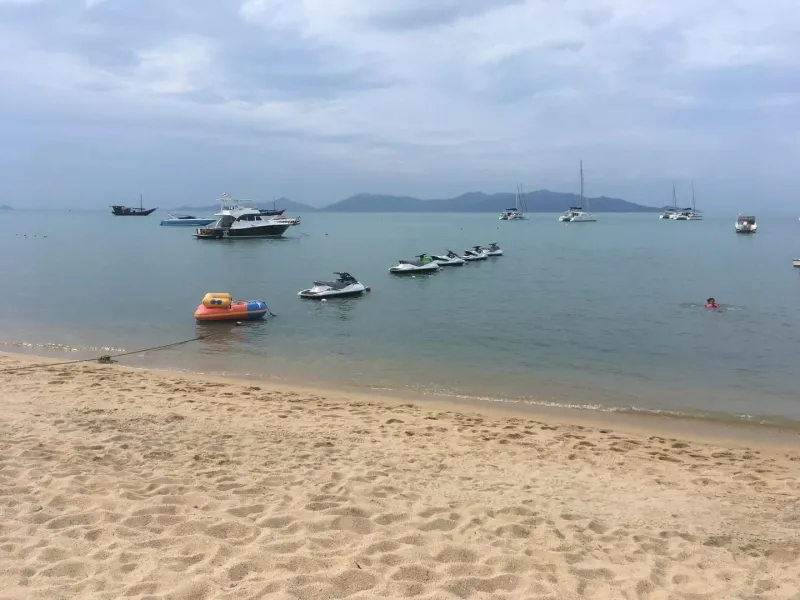
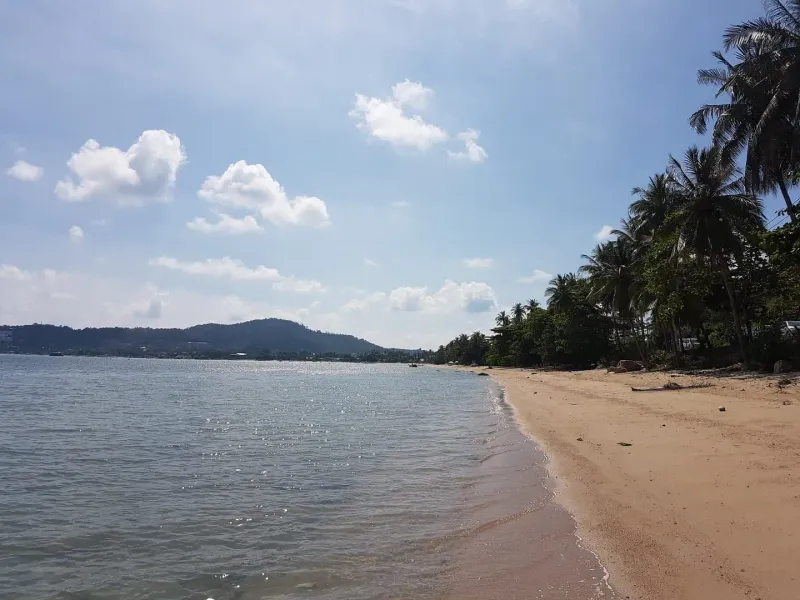
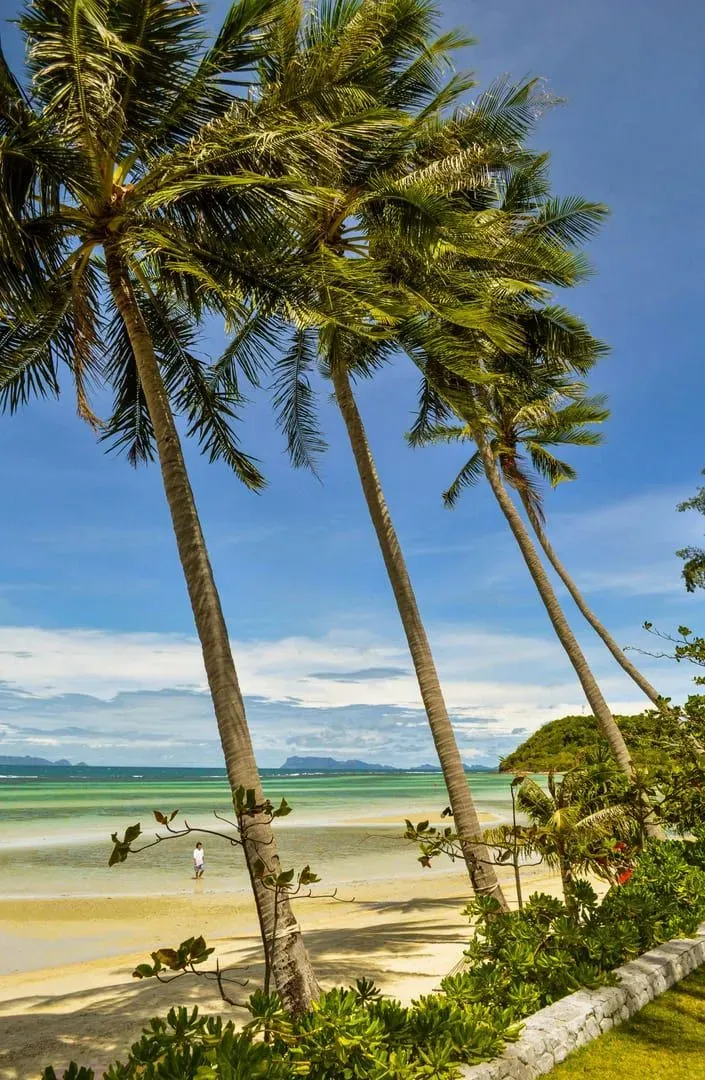
Bophut Beach is not Samui’s best for swimming. It’s honest to say that upfront. The sand is coarse and amber-yellow (not powder-white like Chaweng), and longtail boats moored in the shallows can obstruct parts of the waterfront. But the beach has a charm that compensates: it’s the backdrop to Fisherman’s Village life, not a purpose-built resort strip.
Eastern section (toward Big Buddha)
The eastern end connects to Bang Rak Beach and the Big Buddha area. Most hotels cluster here. The sand is wider, swimming conditions are better, and the water reaches swimmable depth (about 2 meters) within 10-15 meters from shore.
Central section (Fisherman’s Village)
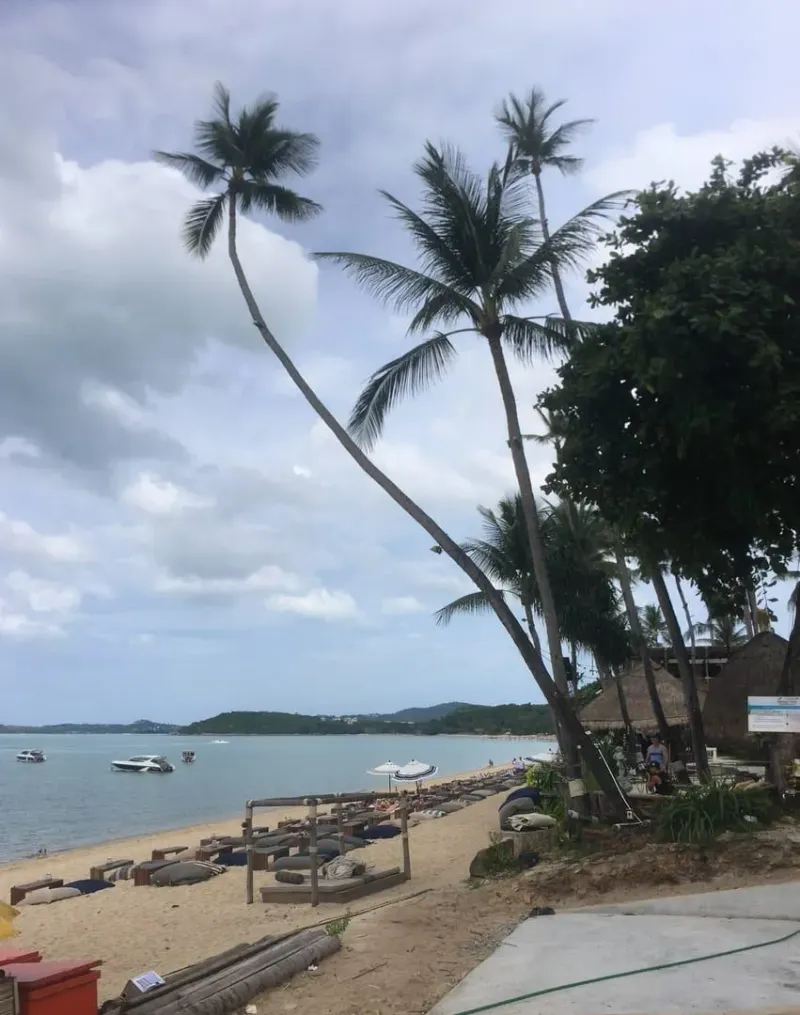
The heart of Bophut. About 1 km of oceanfront lined with restaurants, bars, and shops. Swimming here is secondary to dining and walking: tables spill onto the sand, and the beach functions as the village’s front yard. At sunset, this stretch becomes the most atmospheric spot in Bophut.
Western section (resort strip)
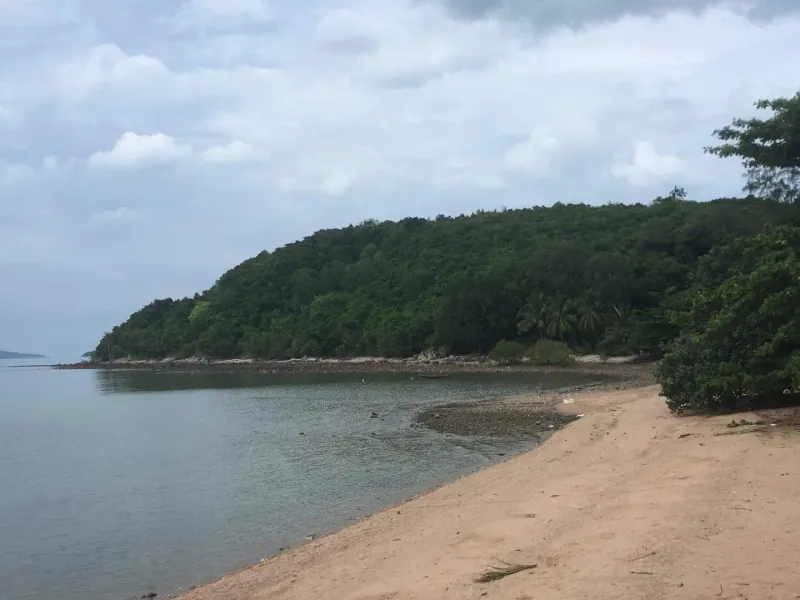
West of the village, the beach extends another 1-2 km toward Maenam. Luxury resorts and private villas line this quieter stretch. The far western end becomes rocky and shallow: not suitable for swimming. Ironically, this is where actual working fishermen still operate today.
Tide conditions
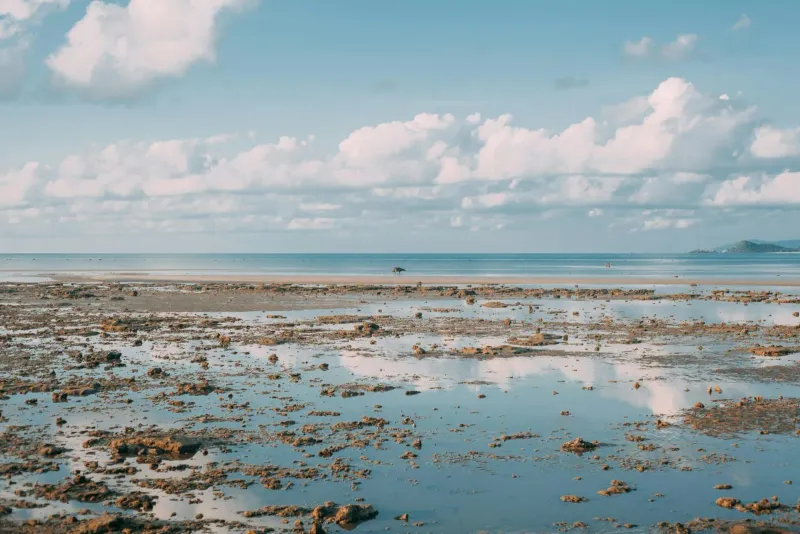
Unlike many Samui beaches that empty completely at low tide, Bophut maintains enough water for swimming at most tide levels. The western section is more affected by tides than the east. Koh Samui’s tidal range varies from approximately 1.0 m to 2.1 m.
Fisherman’s Village
Fisherman’s Village is the reason most visitors choose Bophut over other Samui beaches. It’s a roughly 1 km stretch of narrow lanes and weathered teak shophouses that has been converted into a walkable dining-and-shopping district without losing its historic character.
What makes it special
- Architecture: Dark teak shophouses with faded paint, some built directly over the water. The aesthetic is lived-in, not manicured, which is exactly the point.
- Scale: Compact enough to explore on foot in 30 minutes, deep enough to spend an entire evening.
- Mix of old and new: A Chinese medicine shop next to a French bistro next to a contemporary jewelry gallery. The contrasts work.
- Beachfront integration: Restaurants open directly onto the sand. You can eat dinner with your feet on the beach.
Shopping
Independent boutiques dominate: no chain stores or mall brands. You’ll find handmade jewelry, Thai silk, local art, coconut oil products, and one-of-a-kind clothing designs. Quality is noticeably higher than typical Thai tourist markets.
The Wharf Samui
Adjacent to Fisherman’s Village, The Wharf is a small waterfront shopping complex with additional dining options and retail. It’s more modern than the village proper but blends into the area.
Friday Night Market
The Fisherman’s Village Walking Street market runs every Friday from 5 PM to 11 PM and is Koh Samui’s signature weekly event. The village’s main road closes to traffic and fills with 100+ stalls, street performers, and thousands of visitors.
What to eat
- Thai classics: Pad thai (50-80 THB), mango sticky rice, som tam (papaya salad), banana roti
- Grilled seafood: Prawns, squid, whole fish, cooked over charcoal at roadside stalls
- Fusion bites: Beef tenderloin skewers, churros with chocolate dipping sauces
- Drinks: Fresh coconut water, fruit shakes, Thai iced tea
Budget about 200-400 THB (6-12 USD) per person for a full street food dinner.
What to buy
Handicrafts, herbs and spices, musical instruments, handmade jewelry, local fabrics, and Thai fashion. The quality and uniqueness of goods here is a step above most Thai night markets.
Entertainment
Live music stages, buskers, and fire show performances along the beachfront. The atmosphere is vibrant but not overwhelming: families, couples, and solo travelers all mix comfortably.
Tips for the Friday market
- Arrive before 6 PM to beat the biggest crowds and get first pick at stalls
- Bring cash: most vendors don’t accept cards
- Parking fills fast: arrive early or take a songthaew/taxi
- Bargaining is acceptable at craft stalls but not at food stalls
- Walk the full length first, then double back for purchases
Activities and Water Sports
Bophut isn’t an adrenaline beach. Its activities lean toward relaxation, culture, and gentle water sports.
On the water
- Kayaking & paddleboarding (SUP): Gear rentals available on the beach. Best in late afternoon when the water goes glass-calm before sunset.
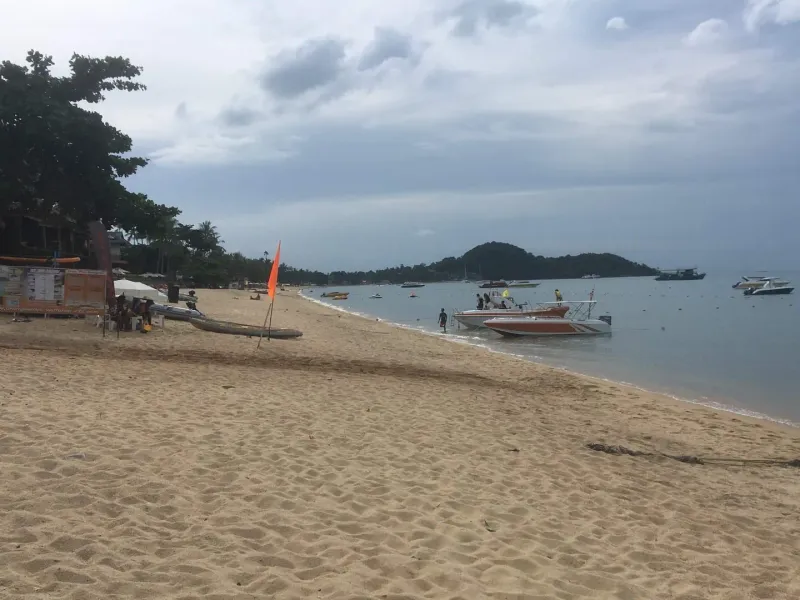
- Snorkeling: Basic gear rented cheaply from beach kiosks. Bophut’s own waters are average for snorkeling: for better reefs, take a short drive to Choeng Mon Beach or a day trip to Koh Tao or Ang Thong National Marine Park.
- Jet skiing: Available seasonally from operators on the eastern section.
On land
- Yoga: Sunrise sessions at Zazen Boutique Resort (Le Spa Zen). Several other studios offer drop-in classes.
- Thai massage: Available everywhere, from 200 THB beach-side massages to luxury spa treatments at resort spas.
- Village walking: Fisherman’s Village is best experienced on foot, slowly. The architecture and details reward those who linger.
Day trips from Bophut
- Ang Thong National Marine Park: Full-day boat trip (1,500-2,500 THB). Kayaking, snorkeling, and the famous Emerald Lake viewpoint.
- Koh Phangan: Boats depart from nearby Bang Rak Pier. 30 minutes by speedboat. Visit Thong Nai Pan beaches or Bottle Beach.
- Koh Tao: Day trips for diving and snorkeling (2,000-3,500 THB including gear).
Where to Eat
Bophut has the best dining concentration on Koh Samui outside of Chaweng, with a stronger emphasis on quality over quantity.
Beachfront dining
| Restaurant | Cuisine | Price Range | Known For |
|---|---|---|---|
| Coco Tam’s | Thai, pizza, cocktails | $$-$$$ | Fire shows at 7:15 PM & 9 PM, beanbag seating on the sand |
| Happy Elephant | Thai, seafood, jazz | $$-$$$ | Live jazz evenings, Bangkok-inspired dishes |
| 2 Fishes | Italian, seafood | $$-$$$ | French oysters, Australian steaks, ocean views |
| The Hut Cafe | Thai, grilled seafood | $ | Family-owned, grilled seafood ~300 THB, curries ~100 THB |
Fine dining
- Chez Francois: 4-course French-Thai fusion by Chef Francois Porte-Garcia. Bophut’s most upscale dining experience.
- Classico: Italian fine dining with a tapas menu. Elegant waterfront setting.
Casual & street food
- Barracuda Bar: Thai tapas, swing seats, live music, doubles as a bar and casual eatery.
- Gusto: Wood-fired pizzas in the village center.
- Friday market stalls: The best budget eating in Bophut (see Friday Night Market).
Price guide
- Budget: Thai stir-fries and curries from 100 THB (~3 USD)
- Mid-range: Seafood plates 300-500 THB (~8.50-14 USD)
- Upscale: Multi-course dinners 1,500-3,000 THB (~43-86 USD)
Nightlife and Evening Scene
Bophut’s nightlife is the polar opposite of Chaweng’s, and that’s the point. No thumping clubs, no neon-lit bar streets, no chaos. Instead: fire shows on the sand, live jazz, craft cocktails, and the sound of waves.
Key venues
- Coco Tam’s: The anchor of Bophut evenings. Beanbags on the beach, projector screen, shisha, and nightly fire-dancer performances at 7:15 PM and 9:00 PM against the Gulf of Thailand backdrop. Lines start forming at 5:30 PM: arrive early. Opens 1 PM-midnight.
- Barracuda Bar: Live music, Thai tapas, swing seats. International crowd, laid-back energy.
- Happy Elephant: Live jazz in the evenings with beachfront atmosphere.
- The Deck: Low-key spot with beanbags, sushi, good for couples or small groups.
Bophut vs. Chaweng nightlife
If you want dance floors and late nights, go to Chaweng. If you want a sunset cocktail followed by a fire show on the beach and a quiet walk home, stay in Bophut.
Nearby Attractions
Bophut’s central north-coast location puts several major Samui attractions within a short drive.
Under 10 minutes
- Big Buddha Temple (Wat Phra Yai): Samui’s most iconic landmark, a 12-meter golden Buddha on a small island connected by causeway. 5-10 min east.
- Wat Plai Laem: Colorful temple complex with an 18-arm Guanyin statue over a lake. 2 min further east from Big Buddha.
- Choeng Mon Beach: Quiet, sheltered bay with good snorkeling. 10 min northeast.
- Bang Rak Beach: Adjacent east, pier for boats to Koh Phangan.
Under 20 minutes
- Maenam Beach: Borders Bophut to the west. Long, quiet, palm-lined: the quieter alternative.
- Chaweng Beach: Samui’s main strip. 15 min drive via the ring road.
- Khao Hua Jook Pagoda: Hilltop golden pagoda with 360° views of the north coast. 10 min south.
Where to Stay
Bophut leans mid-range to luxury, with boutique hotels as its strength. Over 1,400 properties are available in the area.
By budget
| Category | Average Price | Examples |
|---|---|---|
| Budget | 420-875 THB (~12-25 USD)/night | Us Hostel Samui (13-min walk from beach) |
| Mid-range (3-star) | ~3,500 THB (~100 USD)/night | Dreamcatcher Boutique Hotel, Cielo Boutique Hotel & Spa |
| Upscale (4-star) | ~11,200 THB (~320 USD)/night | Bo Phut Resort & Spa, Peace Resort Samui |
| Luxury (5-star) | ~15,750 THB (~450 USD)/night | Anantara Bophut, Zazen Boutique Resort & Spa |
Notable properties
- Zazen Boutique Resort & Spa: 26 private villas, infinity pool, Le Spa Zen with sunrise yoga, acclaimed restaurant. From ~3,675 THB (~105 USD)/night: arguably Bophut’s best value for quality.
- Bo Phut Resort & Spa: Beachfront 4-star with consistently high ratings.
- Holiday Inn Koh Samui: Newer property with a 9.4 rating, surprisingly impressive for the brand.
Where to book
Fisherman’s Village properties put you steps from dining and the Friday market. Eastern Bophut is closer to the airport and Big Buddha. Western Bophut suits those wanting resort quiet with village access.
Getting There
From Samui Airport (USM)
Bophut is one of the closest beaches to the airport: about 4 miles / 8 minutes by car.
- Airport taxi: 200-300 THB (~5.50-8.50 USD). Fixed-rate prepaid at airport counter.
- Shared minivan: From 130 THB (~3.50 USD).
- Note: Grab (ride-hailing app) cannot pick up inside the airport but works elsewhere on the island.
From other beaches
- From Chaweng: 15 min by taxi (~200-300 THB) or songthaew (~100 THB)
- From Lamai: 25-30 min by taxi (~300-400 THB) or songthaew (~150-200 THB)
- From Nathon: 20 min via the ring road
Songthaew (shared taxi)
The Pink Route serves Bophut: Airport → Bang Rak Pier → Bophut → Maenam → Nathon Pier. Flag one down on the ring road.
Getting around Bophut
Fisherman’s Village is entirely walkable. For exploring the rest of the island, rent a scooter (200-300 THB/day), but make sure your travel insurance covers motorcycle riding.
Best Time to Visit
Season breakdown
| Season | Months | Conditions | Rating |
|---|---|---|---|
| Peak / Dry | Dec - Feb | Sunny, calm seas, minimal rain | ★★★★★ |
| Hot | Mar - May | Hotter, occasional short downpours | ★★★★ |
| Inter-monsoon | Jun - Aug | Mixed weather, generally OK | ★★★ |
| Monsoon | Sep - mid-Nov | Heavy rain, flooding risk, strong winds | ★★ |
Bophut-specific notes
- The north coast is often calmer than east-coast beaches during monsoon, as southwest winds hit the east coast harder.
- Water temperature stays warm year-round: 28-30°C.
- Friday market runs year-round regardless of weather (stalls have covers).
- December-February is peak season: best weather, highest prices, most crowded.
Practical Tips
Essentials
- Parking: Large car park at the Fisherman’s Village entrance. Fills up on Friday nights: arrive early or take a taxi.
- ATMs & shops: ATMs, 7-Elevens, pharmacies, and mini-marts all within the village.
- WiFi: Strong coverage in restaurants and cafes. Coworking spaces available (see below).
- Safety: Generally very safe at all times. Standard precautions: keep valuables out of sight, lock your scooter.
For families
Bophut is one of the most family-friendly areas on Samui. Calm shallow water for small children, multiple family restaurants, kids clubs at several hotels, no seedy nightlife. The Friday market is entertainment for all ages.
For digital nomads
Growing nomad community with dedicated coworking spaces:
- Khan Space (Bo Phut): 900 Mbps WiFi, free entry with cafe purchase
- Mantra Work Lounge (central Bophut): Fast WiFi, ergonomic seating, quiet zone, organic cafe, networking events
- Greenlight Hub (Elysia Boutique Resort, Fisherman’s Village): Affordable day passes, reliable WiFi
Scooter safety
Renting a scooter is the most practical way to explore Samui beyond Bophut. Get proper motorcycle travel insurance before you ride: Thai hospitals will treat you regardless, but the bills add up fast without coverage.
Who Is Bophut Best For?
| Traveler Type | Fit | Why |
|---|---|---|
| Families | ★★★★★ | Safe beach, kids clubs, walkable village, family restaurants |
| Couples | ★★★★★ | Romantic sunsets, beachside dining, boutique hotels, fire shows |
| Digital nomads | ★★★★ | Coworking spaces, walkable lifestyle, reliable WiFi, village cafes |
| Culture seekers | ★★★★ | Hainanese heritage, historic architecture, temples nearby |
| Luxury travelers | ★★★★ | Boutique resorts, fine dining, spa culture |
| Budget travelers | ★★ | Pricier than Lamai or Maenam; some budget options exist but fewer |
| Party seekers | ★ | Go to Chaweng instead |
FAQ
Is Bophut Beach good for swimming?
The eastern section near the hotels has swimmable depth within 10-15 meters from shore. The central village section is more for dining than swimming, and the far western end is too rocky and shallow. For the best swimming on Samui, head to Chaweng or Chaweng Noi.
When is the Fisherman’s Village Walking Street market?
Every Friday from 5 PM to 11 PM, year-round. Arrive before 6 PM for fewer crowds and better parking. Bring cash: most vendors don’t accept cards.
How far is Bophut Beach from the airport?
About 8 minutes by car (4 miles). It’s one of the closest beaches to Samui International Airport. A prepaid airport taxi costs 200-300 THB (~5.50-8.50 USD).
Is Bophut Beach good for families with kids?
Bophut is one of the best family areas on Samui. The beach has calm, shallow water suitable for small children. Hotels offer kids clubs, the village is walkable, restaurants are family-friendly, and there’s no rowdy nightlife.
What is the best time to visit Bophut Beach?
December to February offers the best weather: sunny skies, calm seas, and minimal rainfall. The north coast stays calmer than east-coast beaches even during monsoon season (September-November), though heavy rain is possible.
How does Bophut compare to Chaweng?
Bophut is laid-back, cultural, and romantic. Chaweng is energetic, commercial, and party-oriented. Bophut has better dining quality and historic character. Chaweng has better sand, more nightlife, and more shopping. Choose Bophut for charm, Chaweng for action.
About the author

Migues Ferfumoz
Writer, Koh Samui resident since 2019
Freelance writer and Koh Samui resident since 2019. Migues covers local culture, food, and the best off-the-beaten-path destinations on the island.
Articles by Migues →Mentioned in Island Life
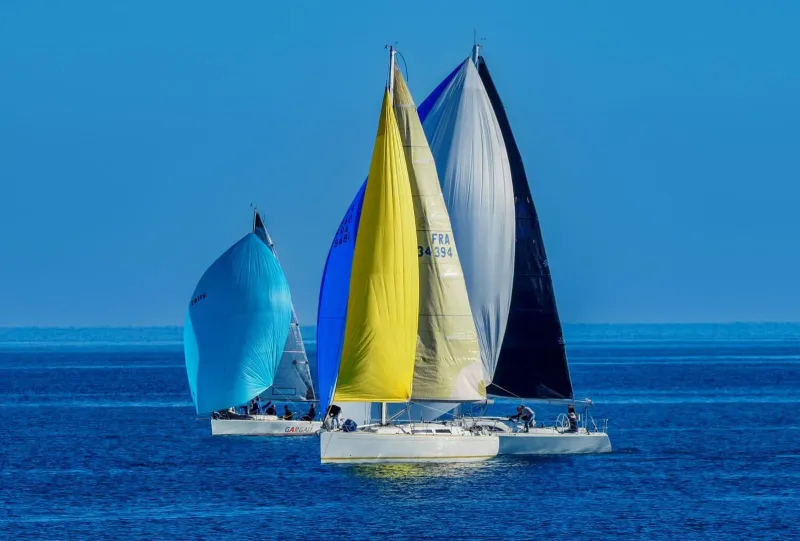
Getting on a Boat: Samui's Sailing Community and Crew Boards
How an ordinary traveler with no boat gets on one from Koh Samui: crew boards, the Samui Regatta, Gulf passages to Phangan and Tao, and v…
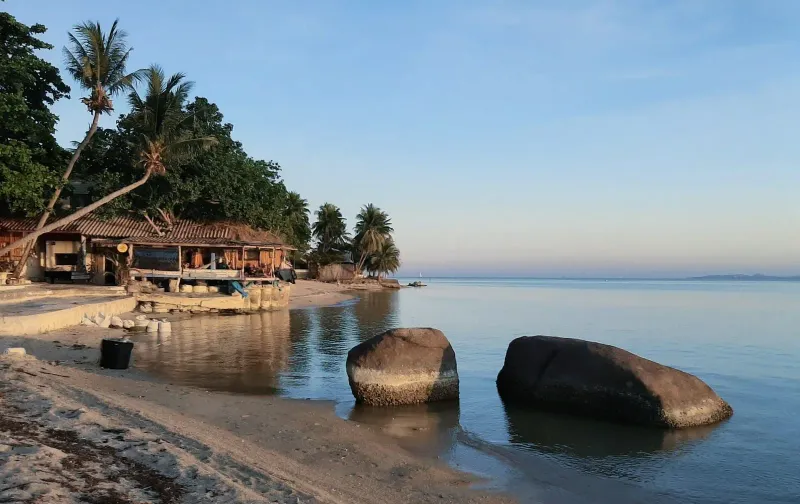
Open-Water Swimming on Koh Samui: Safe Lines, Boats and the Crew
Water stays 28-30°C year-round, with safe lines marked by beach, monsoon swell, jellyfish season and the tow-float rules that keep swimme…
Finding a Muay Thai Trainer on Koh Samui: What Good Looks Like
How to find a good muay thai trainer on Koh Samui: real private-session rates, what good pad work looks like, gym etiquette, and the safe…