Overview
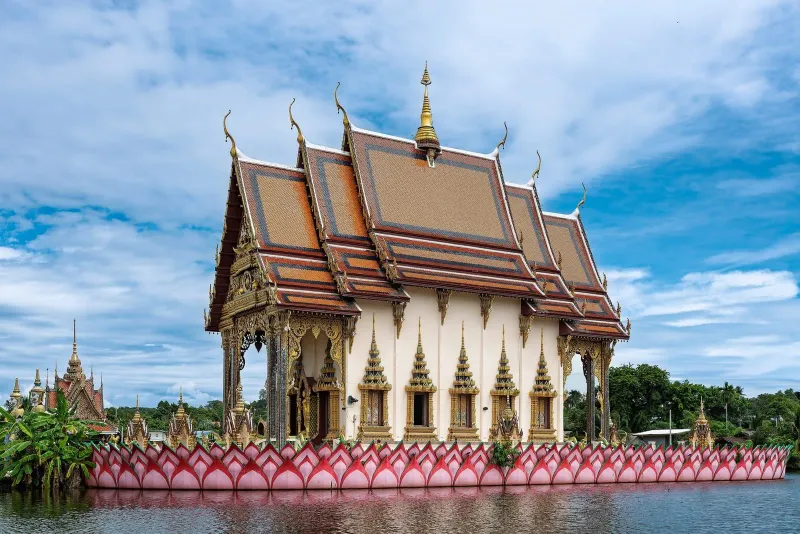
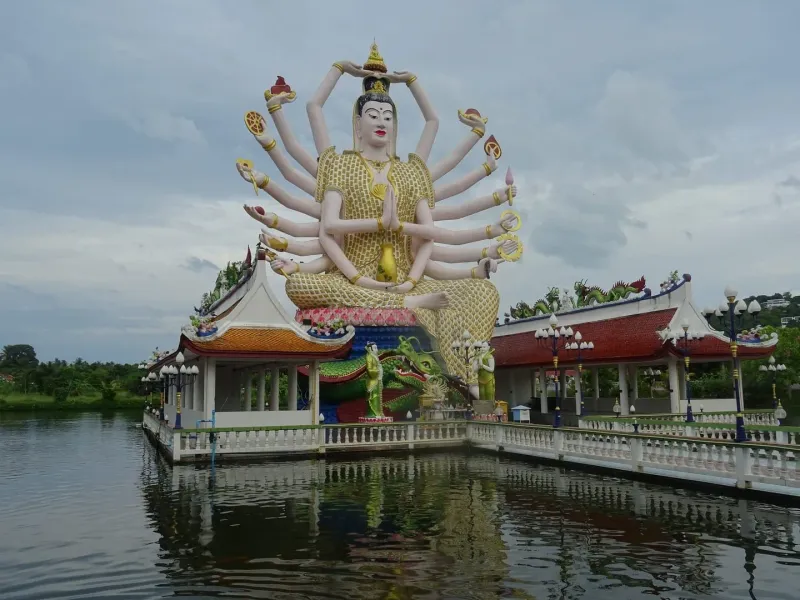
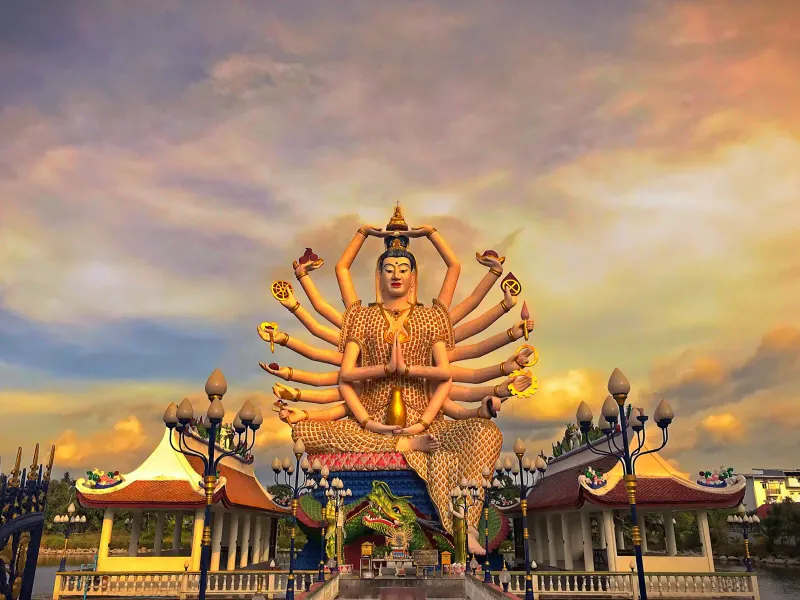
Wat Plai Laem is one of the most visually striking temples in Thailand: a vibrant complex built on a lake at Koh Samui’s northeast tip. Its centerpiece is a 15-meter white Guanyin statue with 18 arms rising from the water, representing the Cundi manifestation of the goddess of mercy. Nearby, a 20-meter laughing Buddha (Budai) sits with his famous belly and broad smile inside an ornate pavilion.
Unlike Samui’s older Thai-style wats, Plai Laem blends Chinese Mahayana and Thai Theravada Buddhist traditions with Hindu elements, creating something unique on the island. The complex was built between 2004 and 2009, partially designed by Thai artist Jarit Phumdonming, and it’s completely free to visit.
History and Design
Wat Plai Laem (also known as Wat Laem Suwannaram) was constructed between 2004 and 2009 on Koh Samui’s northeast coast. While some sources suggest the site may have older temple roots going back roughly 100 years, the current complex is entirely modern.
The artist
Distinguished Thai artist Jarit Phumdonming was involved in the temple’s design, incorporating intricate murals, carved teak doors, and gold accents that evoke traditional aesthetics through contemporary techniques. The result is a temple that feels both ancient and new: rich with cultural references but built with modern materials and engineering.
Architectural fusion
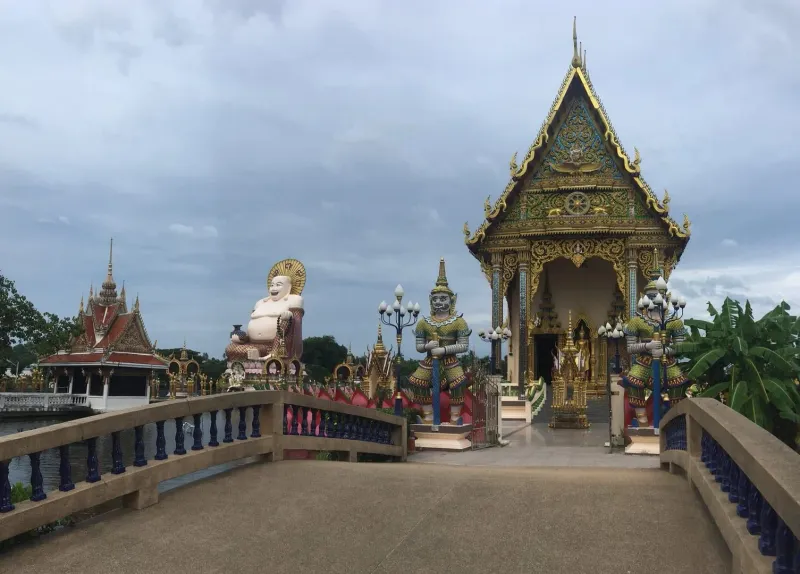
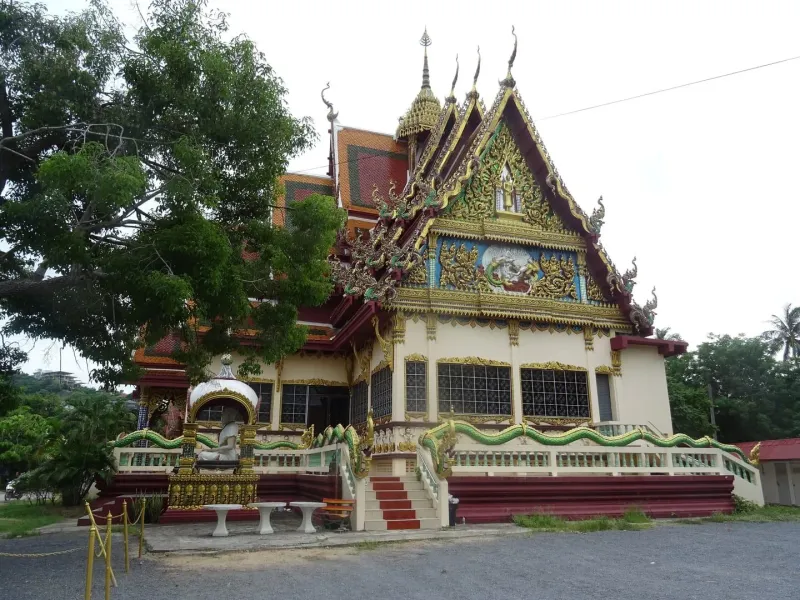
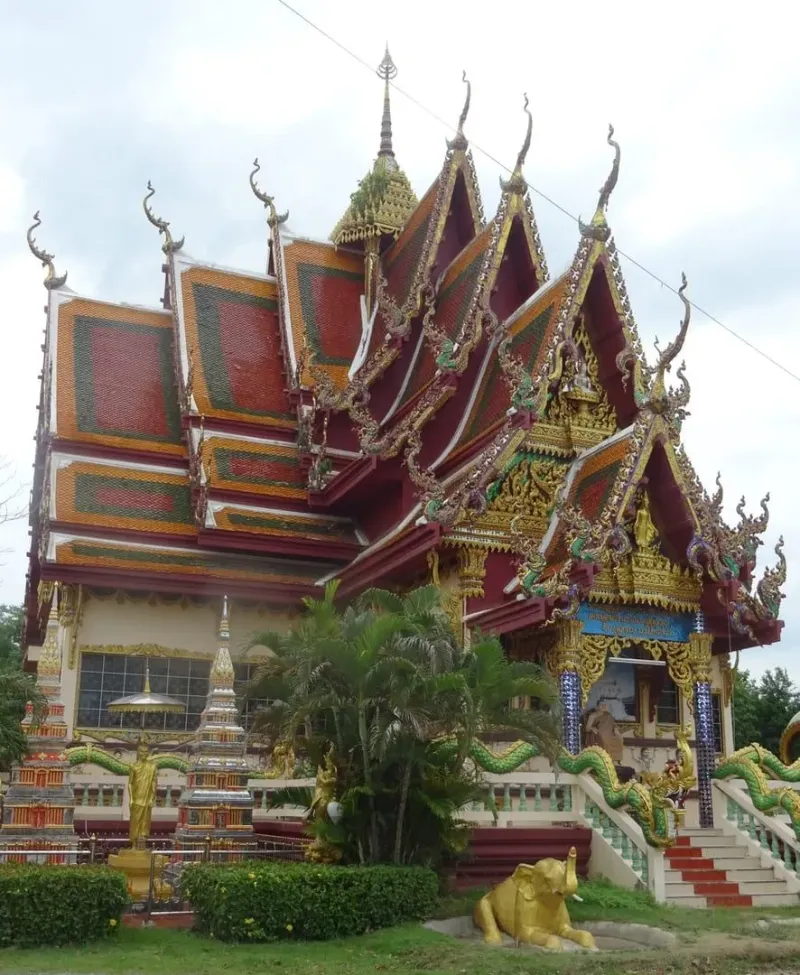
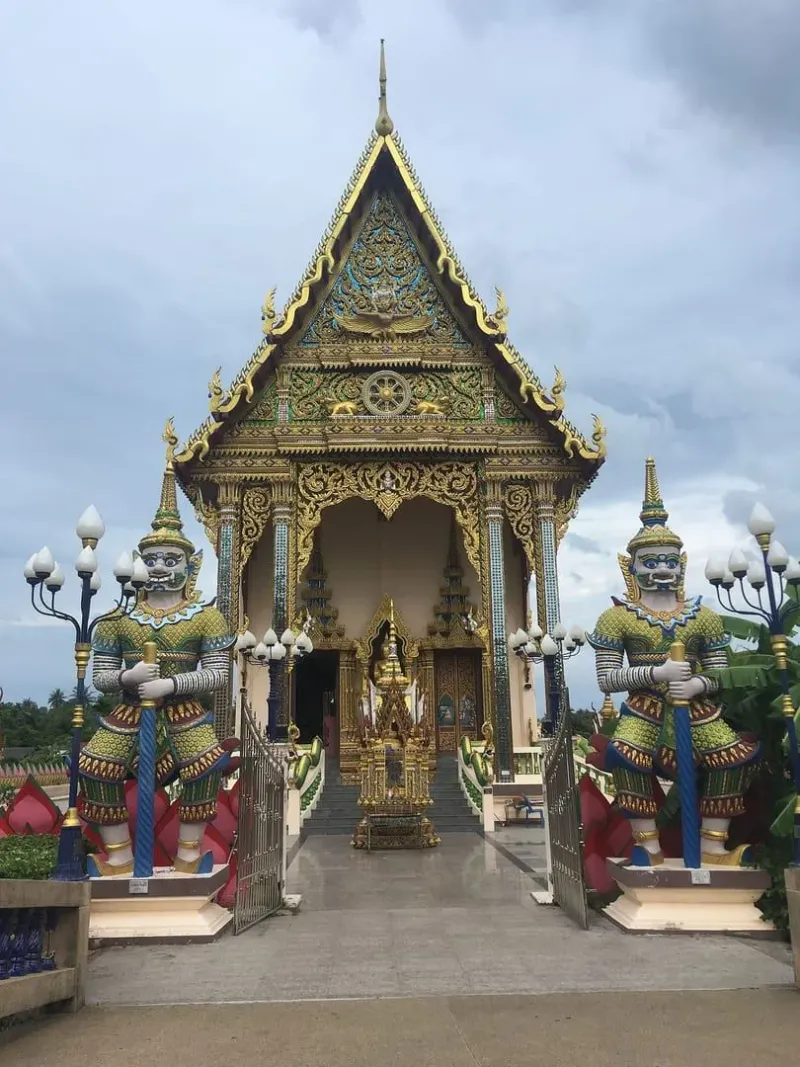
What makes Plai Laem architecturally special is its syncretism. Traditional Thai roof lines and ubosot structure sit alongside Chinese Mahayana Buddhist statuary and Hindu shrine elements. This blend reflects the diverse religious influences that have shaped island culture: from Theravada monks to Hainanese Chinese immigrants to ancient Indian traders.
The entire complex is built on and around a man-made lake, with ornate bridges connecting shrines, pavilions, and the central ordination hall. This water-based layout gives the temple a floating quality unlike any other wat on Samui.
The 18-Armed Guanyin
The most photographed feature of Wat Plai Laem is the 15-meter white Guanyin statue seated on a lotus throne in the lake. This is specifically the Cundi manifestation of Guanyin (Avalokitesvara): the Chinese bodhisattva of mercy and compassion.
Why 18 arms?
The 18 arms represent the 18 paths to attaining Buddhahood. Each arm holds a different dharma instrument:
- Vajra hook: the power to magnetize and attract all phenomena
- Wish-fulfilling vase: manifesting treasures and scriptures
- Sword: cutting through ignorance
- Dharma wheel: setting the wheel of law in motion
- Mani pearl: a luminous, flawless, pure state of mind
- Lotus flower, rope, axe, prayer beads: and other implements of compassion
The overall symbolism: Guanyin’s ability to reach out and help multiple beings simultaneously across the world. She represents mercy, protection for sailors (fitting for an island temple), and fertility.
The Laughing Buddha
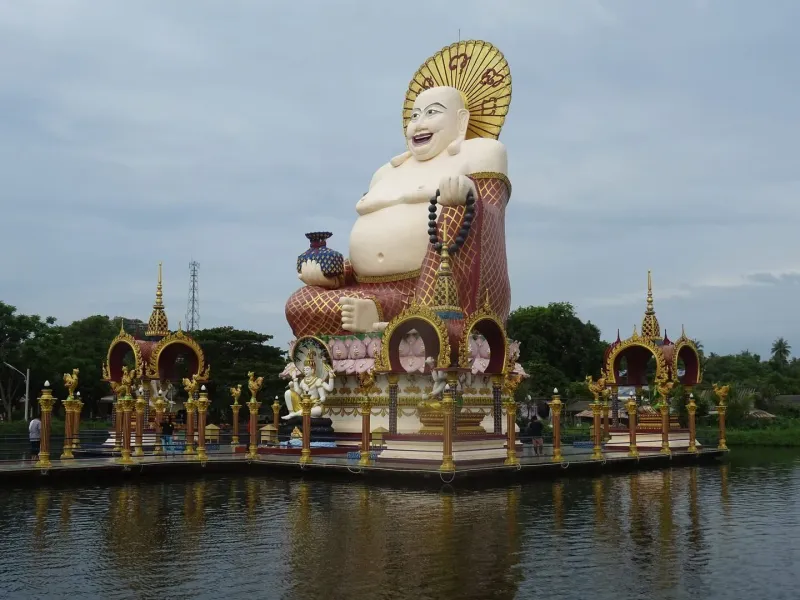
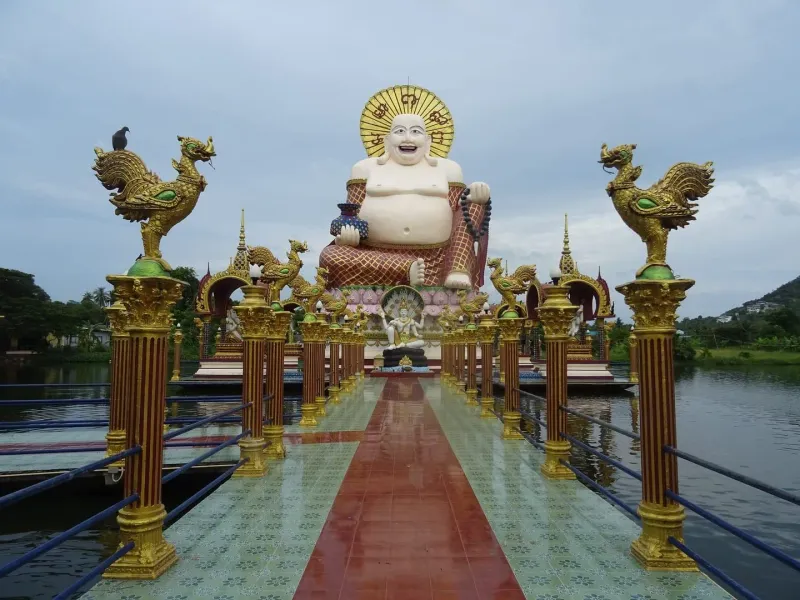
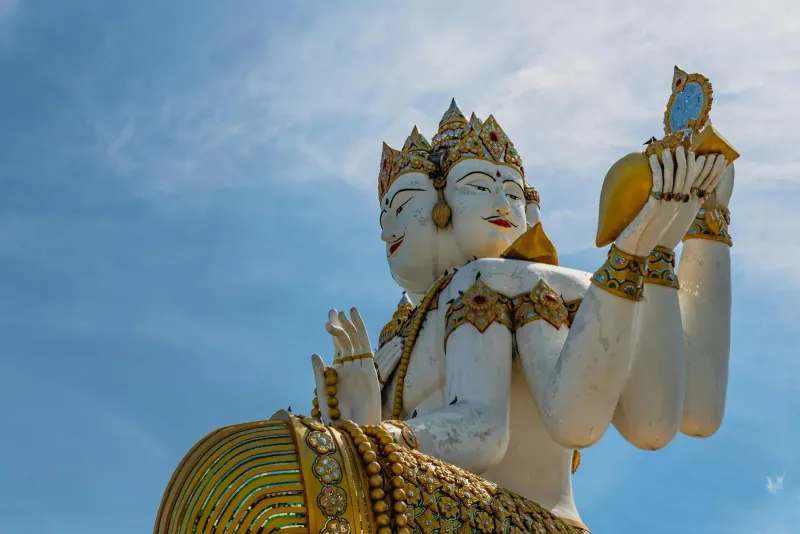
Across from the Guanyin stands an even larger figure: a 20-meter white laughing Buddha (Budai), one of the most recognizable Buddhist icons in the world. He sits with his famous exposed belly, broad smile, and earlobes stretching down, inside an elaborate pavilion on the lake.
Who is the laughing Buddha?
Despite common perception, the laughing Buddha is not Siddhartha Gautama (the historical Buddha). He’s believed to represent Qieci, a real wandering Zen monk who lived during China’s Later Liang Dynasty in the 10th century CE. The name “Budai” means “cloth sack”: from the bag he carried filled with food and gifts for the poor.
In Chan/Zen Buddhism, Budai is identified with Maitreya: the future Buddha who will appear when the current teachings are forgotten. In Japan, he’s known as Hotei, one of the Seven Lucky Gods.
The belly tradition
Rubbing the laughing Buddha’s belly is believed to bring luck, prosperity, and good fortune. At Wat Plai Laem, visitors can approach the statue’s base to make this gesture: one of the temple’s most popular activities.
The Lake and Fish Feeding
The man-made lake surrounding the temple is as much a part of the experience as the statues themselves. Walkways and ornate bridges cross the water, connecting various shrines and pavilions. The surface is dotted with pink lotus flowers, and the still water creates mirror-like reflections of the colorful buildings.
Fish feeding
The lake teems with giant koi fish, catfish, and turtles that crowd the surface wherever visitors gather. Fish food is available from vending machines around the complex for 10 THB per bag.
This isn’t just entertainment: in Buddhist tradition, feeding fish is a form of merit-making (tam boon), symbolic of caring for all living beings. It’s especially popular with families, and children love watching the fish swarm.
The Main Hall and Murals
The ubosot (ordination hall) sits on its own island in the center of the lake, connected by bridges. It houses a seated Buddha image and features beautifully carved teak entry doors.
The murals
The interior walls are covered with intricate mural paintings: among the finest on Koh Samui. They depict:
- Scenes from the life of the Buddha
- Jataka stories (tales of the Buddha’s previous lives)
- Lessons on karma and compassion
- Elements from both Buddhist and Hindu mythology
The murals use vivid, saturated colors (rich reds, golds, and blues) and reward close inspection. The detail work by artist Jarit Phumdonming’s team is exceptional.
Flanking halls
Two long halls on either side of the Guanyin statue contain additional murals and frescoes, extending the visual narrative throughout the complex.
Hindu Shrines
One of Wat Plai Laem’s most interesting features is its inclusion of Hindu deity shrines alongside Buddhist imagery: a reflection of the ancient Indian influences that persist in Thai religious practice.
Smaller shrines around the complex are dedicated to:
- Ganesha: the elephant-headed remover of obstacles
- Vishnu: the preserver god
- Shiva: the destroyer and transformer
- Sakka (Indra): king of the gods
These shrines are a reminder that Thai Buddhism has never been purely Theravada: it has always absorbed Hindu, Brahmanical, and Mahayana elements into a uniquely Thai synthesis.
Dress Code and Etiquette
Wat Plai Laem is an active monastery: monks live and practice here. While the temple is welcoming and relaxed, basic respect is expected.
Rules
- Cover shoulders and knees: no beachwear. Sarongs are available at the entrance for those who need them.
- Remove shoes before entering any temple building, especially the ubosot
- Never point feet at people or religious images: deeply offensive in Thai culture
- Photography: No flash inside temple buildings. Never pose with your back to a Buddha statue.
- Speak quietly and behave respectfully
- Drones are prohibited without special permits
Nearby Attractions
Under 5 minutes
- Big Buddha Temple (Wat Phra Yai): Just 1 km west, Samui’s most iconic landmark with its 12-meter golden Buddha. The two temples are almost always combined in a single visit.
- Plai Laem Beach: A quiet, shallow beach right next to the temple: good for a post-temple cool-down.
- Bang Rak Beach: Adjacent area with views of Koh Phangan across the strait.
Under 15 minutes
- Choeng Mon Beach: Upscale, sheltered bay with calm water and good snorkeling. 5-10 min east.
- Bophut Fisherman’s Village: Historic walking street with restaurants, shops, and the Friday night market. 5-10 min west.
Getting There
Location
On the northeast tip of the island, just off Route 4171 between Choeng Mon and Big Buddha. Well-signed with ample free parking.
From different areas
| Starting Point | Drive Time | Taxi Cost |
|---|---|---|
| Big Buddha | 2 min | Walk (1 km) |
| Bophut | 5-10 min | 150-300 THB |
| Chaweng | 15-20 min | 200-400 THB |
| Lamai | 25-30 min | 350-500 THB |
| Airport | 5-10 min | 150-250 THB |
Transport options
- Scooter: Easiest and cheapest. Well-signed from the ring road.
- Songthaew: Shared pickups from Chaweng heading toward Choeng Mon/Bophut pass the temple entrance. 100-150 THB per person.
- Taxi: Negotiate fare in advance. Always agree on price before boarding.
- Combine with Big Buddha: Walk or drive the 1 km between the two temples: most visitors do both in one trip (1.5-2 hours total).
Best Time to Visit
| Season | Months | Conditions | Rating |
|---|---|---|---|
| Dry season | Dec-Apr | Sunny, best for photography, most crowded | ★★★★★ |
| Hot season | May-Jul | Hotter, occasional showers, fewer crowds | ★★★★ |
| Monsoon | Aug-Nov | Overcast skies, rain, but atmospheric and empty | ★★★ |
Timing tips
- Best light: Early morning (before 9 AM): soft light, fewer crowds, calm lake reflections. The temple faces roughly east, so morning sun illuminates the Guanyin beautifully.
- Golden hour: Late afternoon (4-5:30 PM): warm light on the colorful architecture and lake reflections.
- Avoid: Midday (11 AM-2 PM): harsh light and heat with little shade on the walkways.
- Thai holidays: The temple gets very crowded during Songkran, Loy Krathong, and other major festivals. Beautiful but packed.
Practical Tips
Essentials
- Entry fee: Free. Donations welcome and appreciated.
- Opening hours: 6:00 AM to 6:00 PM daily
- Time needed: 45 minutes to 1 hour (2-3 hours if combining with Big Buddha)
- Fish food: 10 THB per bag from vending machines
- Parking: Free, ample space
What to bring
- Camera: This is one of the most photogenic temples in Thailand. The lake reflections are the star: shoot from bridge angles.
- Cash: For fish food vending machines and donation boxes.
- Modest clothing: Or use the free sarongs at the entrance.
- Sunscreen: Limited shade on the walkways.
- Water: No drinking fountains on site; buy from stalls at the entrance.
Photography tips
The lake reflections are Wat Plai Laem’s signature shot. Morning calm water gives the best mirror effects. Shoot from the bridges to capture statues reflected in the lake. The vivid colors make this temple exceptionally photogenic: it was featured on the “Accidentally Wes Anderson” account for its symmetry and color palette.
Who Is Wat Plai Laem Best For?
| Traveler Type | Fit | Why |
|---|---|---|
| Photographers | ★★★★★ | Lake reflections, vivid colors, monumental statues: featured on Accidentally Wes Anderson |
| Families | ★★★★★ | Fish feeding, free entry, open spaces, kids love the statues |
| Cultural travelers | ★★★★★ | Chinese-Thai-Hindu syncretism, murals, religious symbolism |
| First-time Samui visitors | ★★★★★ | Easy to combine with Big Buddha for a half-day cultural itinerary |
| Couples | ★★★★ | Serene lakeside setting, romantic morning light |
| Budget travelers | ★★★★★ | Completely free: one of Samui’s best free attractions |
| Mobility limited | ★★★ | Mostly flat walkways, but some bridges are narrow |
FAQ
Is Wat Plai Laem free to visit?
Yes: completely free. There’s no entrance fee. Donations are welcome to support the temple’s maintenance. The only cost is fish food (10 THB per bag) from vending machines if you want to feed the koi and catfish.
How far is Wat Plai Laem from Big Buddha?
Just 1 km apart: a 2-minute drive or 15-minute walk. Most visitors combine both temples in a single trip, which takes 1.5-2 hours total. They’re both on the northeast tip of the island.
What is the 18-arm statue at Wat Plai Laem?
The 15-meter white statue is Guanyin in her Cundi manifestation: the Chinese bodhisattva of mercy and compassion. The 18 arms represent the 18 paths to Buddhahood, and each arm holds a different dharma instrument symbolizing aspects of spiritual practice.
Can you feed the fish at Wat Plai Laem?
Yes: it’s one of the most popular activities. The temple lake is filled with giant koi, catfish, and turtles. Fish food costs 10 THB per bag from vending machines. In Buddhist tradition, feeding fish is a form of merit-making.
What should I wear to Wat Plai Laem?
Cover your shoulders and knees: no beachwear. If you arrive underdressed, free sarongs are available at the temple entrance. Remove shoes before entering any temple building.
What is the best time to photograph Wat Plai Laem?
Early morning (before 9 AM) when the lake is calm for reflections and the east-facing Guanyin is lit by soft morning sun. Late afternoon golden hour (4-5:30 PM) also produces beautiful warm light on the colorful architecture.
About the author
Samui69 Editorial Team
Editorial team
Guides researched and fact-checked by the Samui69 editorial team: residents and frequent visitors who verify opening hours, prices and directions on the ground.
About the author →Mentioned in Island Life
Rainy-Day Dates on Koh Samui: What to Do When It Pours
Koh Samui rainy day dates: real rainfall numbers, what's better wet, fully indoor and covered picks, and why most storms only run an hour…
Proposing on Koh Samui: Spots, Timing and Keeping It Quiet
A proposal koh samui guide: private and semi-private spots, ring-through-customs advice, photographer vetting and honest weather timing.

How Information Moves on Samui: Groups, Boards and Word of Mouth
Koh Samui has 70,000 residents and no real newspaper.