Overview
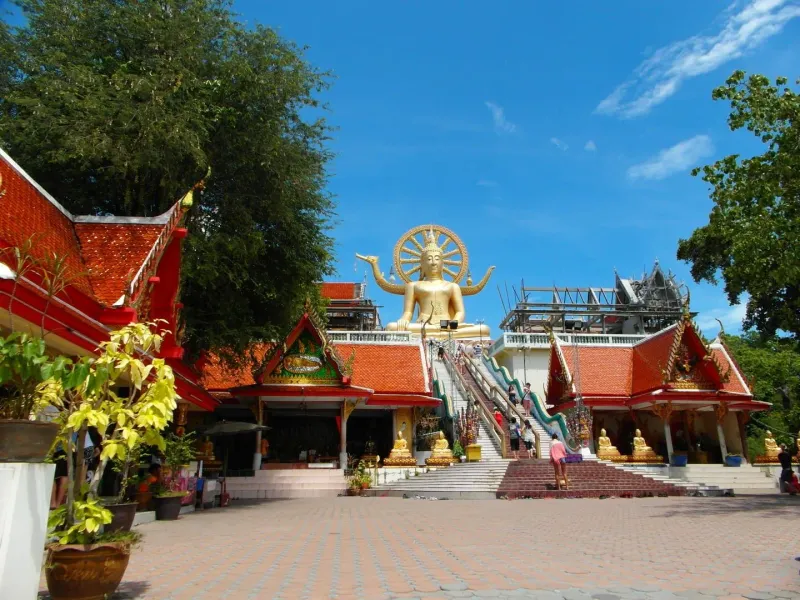
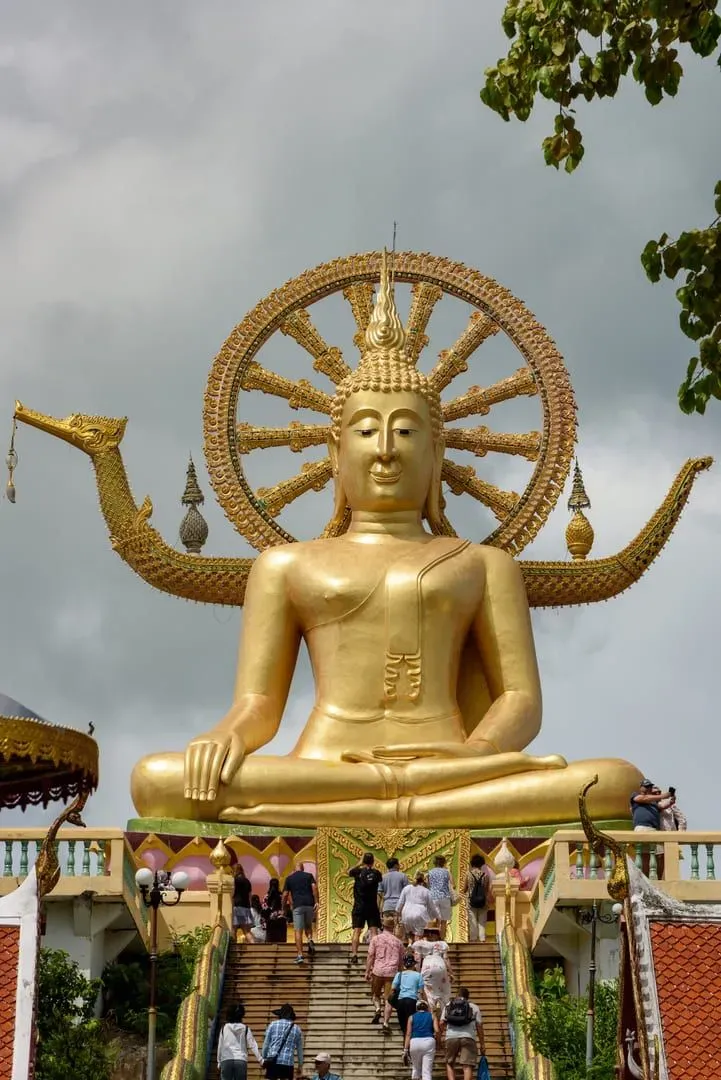
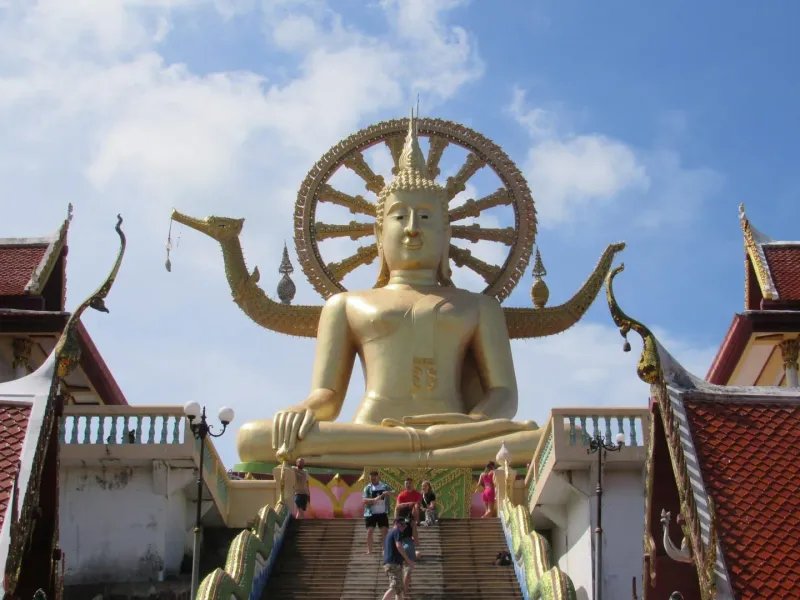
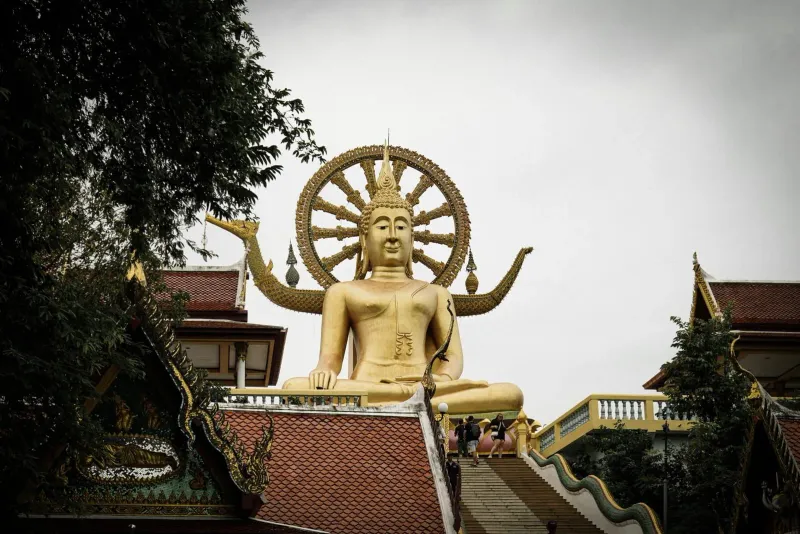
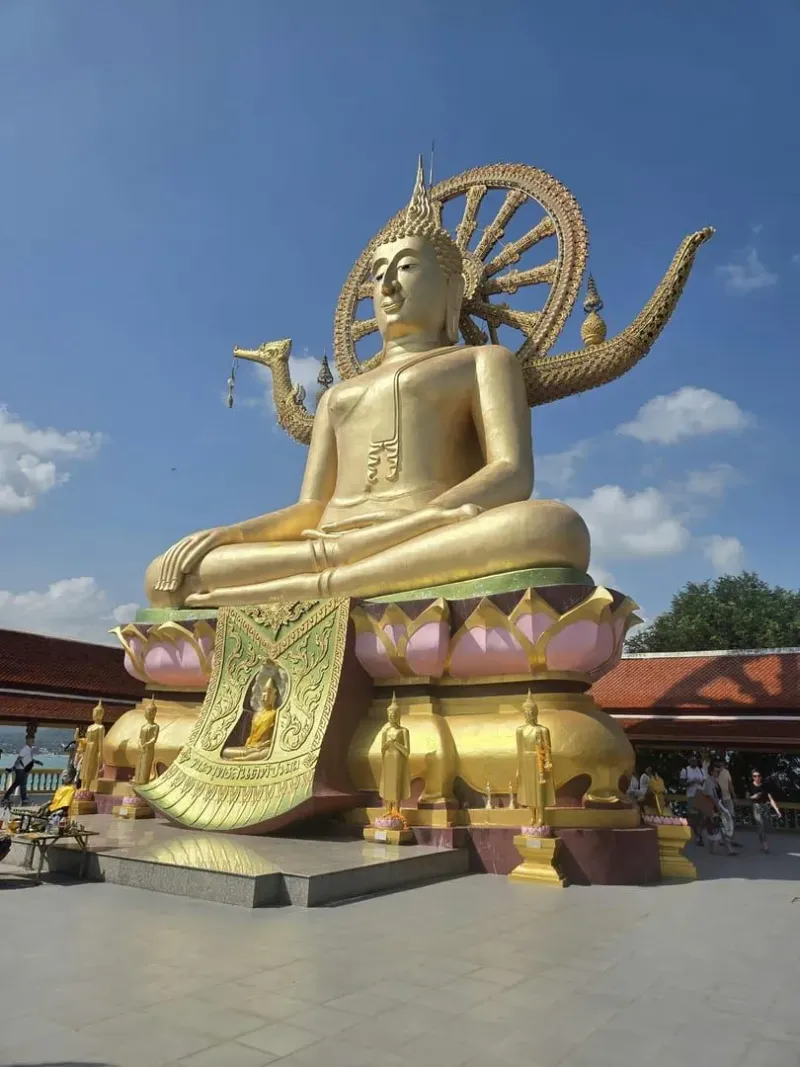
Wat Phra Yai (the Big Buddha Temple) is Koh Samui’s most iconic landmark. A 12-meter golden Buddha statue sits atop Koh Faan, a small rocky island connected to the northeast coast by a causeway. Visible from incoming flights to Samui Airport (just 5 minutes away), it’s often the first thing visitors see of the island.
Built in 1972 and funded entirely by community donations, the temple remains an active place of Buddhist worship while also being Samui’s most-visited cultural attraction. The statue depicts Buddha in the Bhumisparsha Mudra (earth-touching gesture), gazing eastward over the Gulf of Thailand toward Koh Phangan.
History
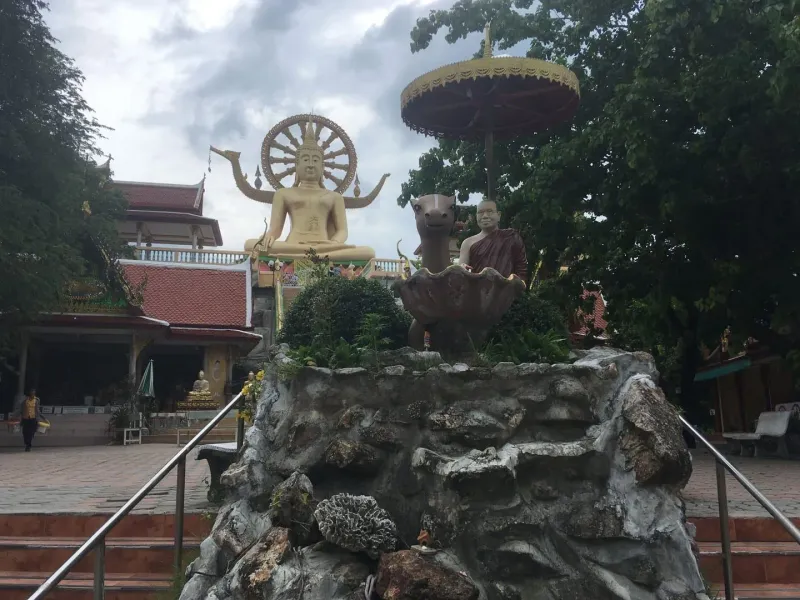
Wat Phra Yai was built in 1972 through a community-driven effort. Local monks led the project, with construction funded entirely by donations from Samui’s residents and visitors. The temple was conceived as both a spiritual center for the island and an act of merit-making (tham bun), one of the most important concepts in Theravada Buddhism.
Since its completion, the Big Buddha has become inseparable from Koh Samui’s identity. For locals, it remains a symbol of faith and cultural continuity. For visitors, it’s the definitive Samui landmark: featured on postcards, airline magazines, and travel guides for over five decades.
The Golden Buddha
The seated Buddha stands 12 meters (approximately 39 feet) tall. The statue has a concrete core structure covered in gold paint, giving it a gleaming appearance visible from the sea, the air, and much of the northeast coast.
The Bhumisparsha Mudra
The statue depicts one of Buddhism’s most significant moments, the Mara Vijaya (Victory over Mara):
- The left hand rests palm-open and facing upward in the lap
- The right hand is placed facing downward over the right knee, fingers pointing toward the ground
This gesture represents the moment when the Buddha, having overcome temptation and fear sent by Mara (the Lord of Illusion), called upon the Earth to witness his enlightenment. The mudra symbolizes unwavering determination and the understanding that enlightenment comes not from escaping the world but from knowing our place within it.
Facing east
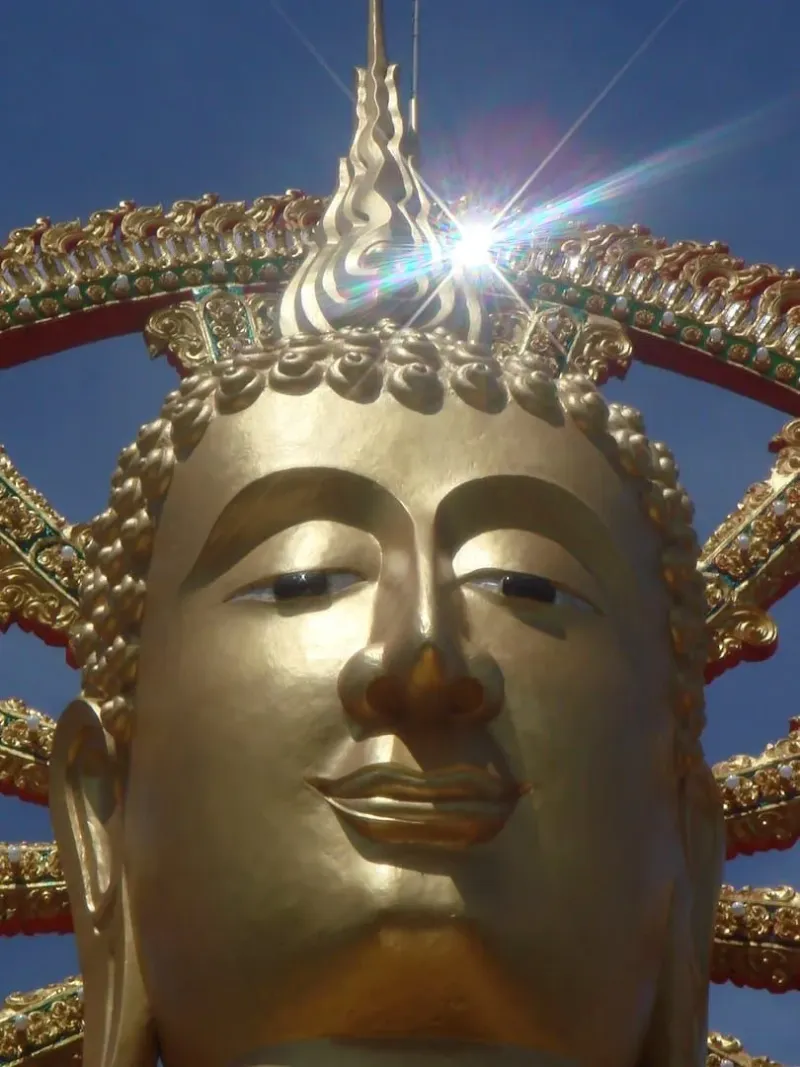
The Buddha gazes eastward over the Gulf of Thailand. On clear days, Koh Phangan is visible across the strait. The east-facing orientation means morning sunlight directly illuminates the golden face: the best time for photography.
Koh Faan and the Causeway
The temple sits on Koh Faan (also spelled Ko Phan), a small rocky island just offshore from the northeast coast near Bang Rak Beach. A short paved causeway connects the island to the main road, making it accessible by car, scooter, or on foot.
The causeway itself is part of the experience: lined on both sides with market stalls and vendors selling everything from Buddha amulets to coconut drinks (see The Causeway Market below).
The Naga Staircase
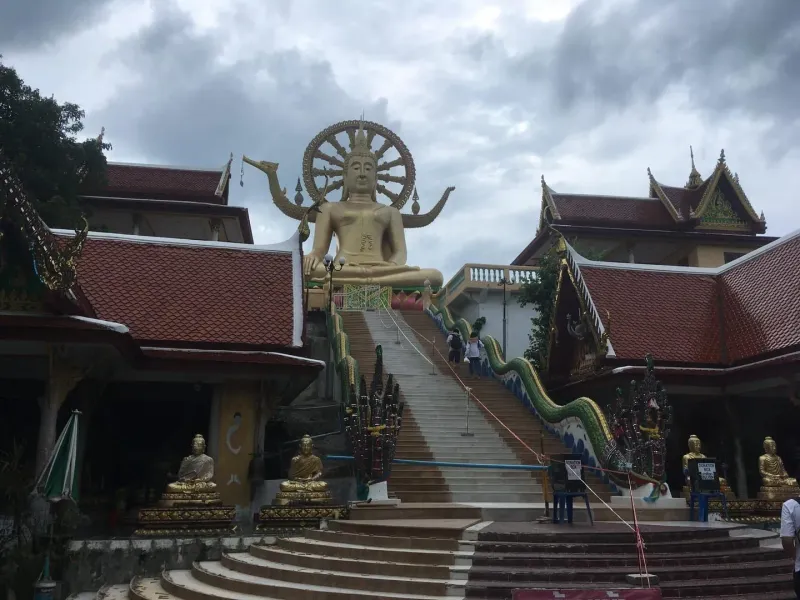
The approach to the Big Buddha is one of the temple’s most photographed features: a grand staircase of 73 steps flanked by ornate Naga serpent figures. These mythical serpent guardians from Buddhist and Hindu mythology line both sides, their scaled bodies undulating up the hillside, symbolically guiding pilgrims upward toward enlightenment.
The staircase is wide and well-maintained but steep. There is no elevator or alternative access: the 73 steps are the only way up.
Photography tip: Shoot from the bottom looking up for dramatic perspective, with the golden Buddha framed between the nagas at the top.
What Else to See
The Big Buddha statue is the main event, but the temple complex includes several other features worth exploring.
Surrounding shrines
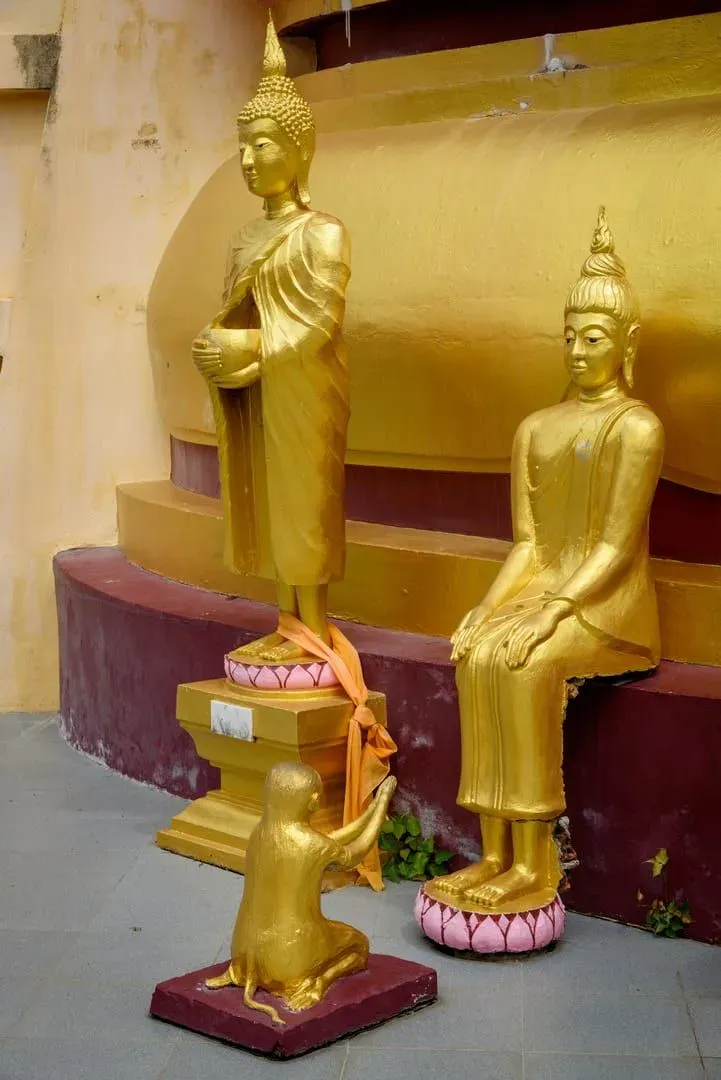
A ring of smaller shrines and Buddha images in different postures surrounds the base of the main statue. These offer quieter spots for contemplation away from the central viewing area.
Bells and gongs
At the rear of the complex, a collection of large bells and gongs invites visitor participation. For a small donation, you can strike the gongs with a wooden stick, considered an act of merit-making. The deep sound carries across the water.
Merit-making
Visitors can make offerings of fruit, flowers, or incense sticks at several points around the complex. Donation boxes are placed throughout: a contribution of 50-100 THB is appreciated and goes toward temple maintenance.
Panoramic views
From the top of the staircase, the platform offers 360-degree views: the Gulf of Thailand to the east, Koh Phangan in the distance, the Samui coastline sweeping south, and the airport runway below where you can watch planes land and take off.
The Causeway Market
The causeway connecting Koh Faan to the mainland is lined with a vibrant market of stalls and vendors. You’ll find:
- Buddha amulets and lucky charms: from simple pendants to ornate collectibles
- Traditional Thai clothing and sarongs: useful if you need to cover up for the dress code
- Handmade jewelry and souvenirs: postcards, magnets, carved figurines
- Religious artifacts: incense, candles, offering supplies
- Food and drinks: coconut drinks, Thai snacks, fruit shakes, and a small restaurant area
The market is most active between 10 AM and 4 PM. Prices are tourist-oriented but reasonable by Samui standards.
Dress Code and Etiquette
Wat Phra Yai is an active place of worship. Monks will turn away visitors who are not properly dressed.
Dress code
- Cover shoulders and knees: no tank tops, short shorts, or beachwear
- Sarongs are available to rent at the entrance for a small fee
- Remove shoes before entering any temple building
Behavior
- Speak quietly and behave respectfully
- Never point feet toward the Buddha or any sacred objects
- Do not touch or climb on religious statues or artifacts
- Do not point directly at Buddha images with your finger
- Women should never touch a monk or hand anything directly to one
- Photography is permitted but be discreet: avoid irreverent poses with the statue
Nearby Attractions
Under 5 minutes
- Wat Plai Laem: Vibrant lake temple with 18-arm Guanyin and laughing Buddha. Just 1 km east, easily combined with Big Buddha in a single visit (1.5-2 hours total for both).
- Bang Rak Beach: Calm, relatively quiet beach directly adjacent to the Big Buddha area. Views of Koh Phangan.
- Samui Airport: Only 5 minutes away, convenient for last-day sightseeing before a flight.
Under 15 minutes
- Choeng Mon Beach: Beautiful crescent bay with calm, shallow water and upscale resorts. 10 min east.
- Bophut Fisherman’s Village: Historic walking street with restaurants, boutique shops, and the famous Friday Night Market. 5-10 min west.
Suggested half-day itinerary
Big Buddha (45-60 min) then Wat Plai Laem (30-45 min) then lunch at Fisherman’s Village in Bophut, followed by Choeng Mon or Bang Rak Beach.
Getting There
Location
Northeast coast, in the Bang Rak / Big Buddha area. The causeway turnoff is well-signed from Route 4171. Free parking at the base.
From different areas
| Starting Point | Drive Time | Taxi Cost |
|---|---|---|
| Airport | 5 min | 150-250 THB |
| Bophut | 5-10 min | 150-300 THB |
| Chaweng | 15 min | 250-500 THB |
| Choeng Mon | 10 min | 200-350 THB |
| Lamai | 30-40 min | 400-600 THB |
| Nathon | 40-50 min | 600-800 THB |
Transport options
- Scooter: Cheapest and most flexible. 200-300 THB/day rental. Well-signed from the ring road.
- Songthaew: Shared pickups run along the northeast coast. 50-100 THB per person from Chaweng.
- Grab: Available on Samui and generally cheaper than negotiating with taxi drivers.
- Half-day tour: Many island tours include Big Buddha (800-1,500 THB per person with hotel pickup).
Best Time to Visit
| Time | Conditions | Rating |
|---|---|---|
| Sunrise (6-7 AM) | Spectacular: east-facing statue lit by first light. Very few visitors. | ★★★★★ |
| Early morning (7-9 AM) | Peaceful, cool, soft light. Best for photography. | ★★★★★ |
| Mid-morning (9-11 AM) | Tour groups begin arriving. Still pleasant. | ★★★★ |
| Midday (11 AM-2 PM) | Avoid: exposed staircase is extremely hot. Peak crowds. | ★★ |
| Late afternoon (4-5:30 PM) | Golden hour light, cooling temperatures, thinning crowds. | ★★★★ |
Seasonal notes
- Nov-Feb (cool/dry): Most comfortable conditions
- Mar-May (hot): Very hot on the exposed platform; bring water
- Jun-Oct (monsoon): Possible rain; overcast skies reduce the golden statue’s visual impact
Practical Tips
Essentials
- Entry fee: Free (donations of 50-100 THB welcome)
- Opening hours: 7:00 AM to 6:00 PM daily
- Time needed: 30-45 minutes for Big Buddha alone; 1.5-2 hours if combining with Wat Plai Laem
- Parking: Free at the causeway base
What to bring
- Modest clothing (or use rental sarongs at entrance)
- Sunscreen and water: the platform has almost no shade
- Camera with wide-angle: the statue is large up close; wide-angle captures the full scene
- Cash: for market stalls, donations, and sarong rental
Accessibility
The 73-step staircase is the only way to reach the statue. There is no elevator or ramp. Not suitable for wheelchairs or visitors with significant mobility limitations. The market area and causeway are flat.
Who Is Big Buddha Best For?
| Traveler Type | Fit | Why |
|---|---|---|
| First-time visitors | ★★★★★ | THE iconic Samui landmark: your trip isn’t complete without it |
| Photographers | ★★★★★ | Golden statue, naga staircase, panoramic views, colorful market |
| Families | ★★★★ | Free, short visit, interesting visuals, market keeps kids engaged |
| Spiritual seekers | ★★★★ | Active temple with merit-making, meditation, morning chanting |
| Budget travelers | ★★★★★ | Free admission, cheap songthaew access, affordable market food |
| Couples | ★★★★ | Sunrise visits are romantic; combine with Wat Plai Laem for a cultural date |
| Mobility limited | ★★ | 73 steep steps with no alternative access to the statue |
FAQ
Is Big Buddha Koh Samui free?
Yes: completely free. There is no entrance fee. Donations of 50-100 THB are welcome and go toward temple maintenance. The only costs are optional: sarong rental at the entrance and purchases at the market stalls.
How many steps to Big Buddha?
73 steps up the naga staircase. The staircase is wide and well-maintained but steep. There is no elevator or alternative access. Allow 5-10 minutes to climb at a comfortable pace.
What should I wear to Big Buddha?
Cover your shoulders and knees. No tank tops, short shorts, or beachwear. If you arrive underdressed, sarongs are available to rent at the entrance for a small fee. Remove shoes before entering temple buildings.
How far is Big Buddha from Chaweng?
About 15 minutes by car or scooter. By taxi, expect 250-500 THB. By songthaew (shared pickup), 50-100 THB per person. The temple is well-signed from Route 4171.
Can you combine Big Buddha with Wat Plai Laem?
Yes: they’re only 1 km apart (2-minute drive or 15-minute walk). Most visitors do both in a single trip. Allow 1.5-2 hours total. Start with Big Buddha early morning for the best light, then walk or drive to Plai Laem.
What time does Big Buddha open?
The temple grounds are open 7:00 AM to 6:00 PM daily. For the best experience, visit at sunrise (6-7 AM for spectacular light on the east-facing statue) or early morning (7-9 AM for fewer crowds and cooler temperatures).
About the author
Samui69 Editorial Team
Editorial team
Guides researched and fact-checked by the Samui69 editorial team: residents and frequent visitors who verify opening hours, prices and directions on the ground.
About the author →Mentioned in Island Life
Skating on Koh Samui: the Park, the Spots, the Crew
Skateboarding on Koh Samui: no confirmed public skatepark, what the 2020-21 surfskate boom left behind, real street spots, and safety on…
Proposing on Koh Samui: Spots, Timing and Keeping It Quiet
A proposal koh samui guide: private and semi-private spots, ring-through-customs advice, photographer vetting and honest weather timing.
Art on Koh Samui: Galleries, Resident Artists and Temple Murals
Koh Samui's real art scene: a thin gallery layer, resident painters, oil-copy shops, temple murals and the antiques export law that catch…