Contents
Koh Samui’s resorts, villas, kitchens and fishing boats run on two migrant workforces: Thai citizens who travel from Isaan and the upper south for island wages, and Myanmar, Cambodian and Lao nationals who arrive under Thailand’s cross-border labour system. Neither group appears in the island’s marketing, but together they build, clean, cook, farm and crew most of what a visitor or resident uses.
Key takeaways
- Thailand’s bilateral MoU migrant-labour system, in place with Myanmar since 2003, ties a worker’s legal status to one named employer through a work permit and “pink card” registration — a structure Human Rights Watch has documented as reducing a migrant’s ability to leave a bad job.
- HRW’s 2018 fishing-industry investigation documented workers paying 8,000–25,000 baht in recruitment fees, employers retaining identity documents, and wages withheld — the pattern behind the EU’s 2015–2019 “yellow card” warning on Thai fishing.
- Myanmar’s 2024 conscription law changed who leaves the country and why: enforcement began in April 2024, and by January 2025 the junta had added rules restricting draft-age people from leaving at all.
- Thai schools often require migrant children to be Thai-language proficient and to have already attended a learning centre before public-school enrolment — which is why non-formal learning centres exist alongside the state system.
- No wage survey specific to Koh Samui’s construction or hospitality labour market is publicly published. Where this page cannot cite a Samui-specific figure, it says so rather than estimating one.
What This Actually Is
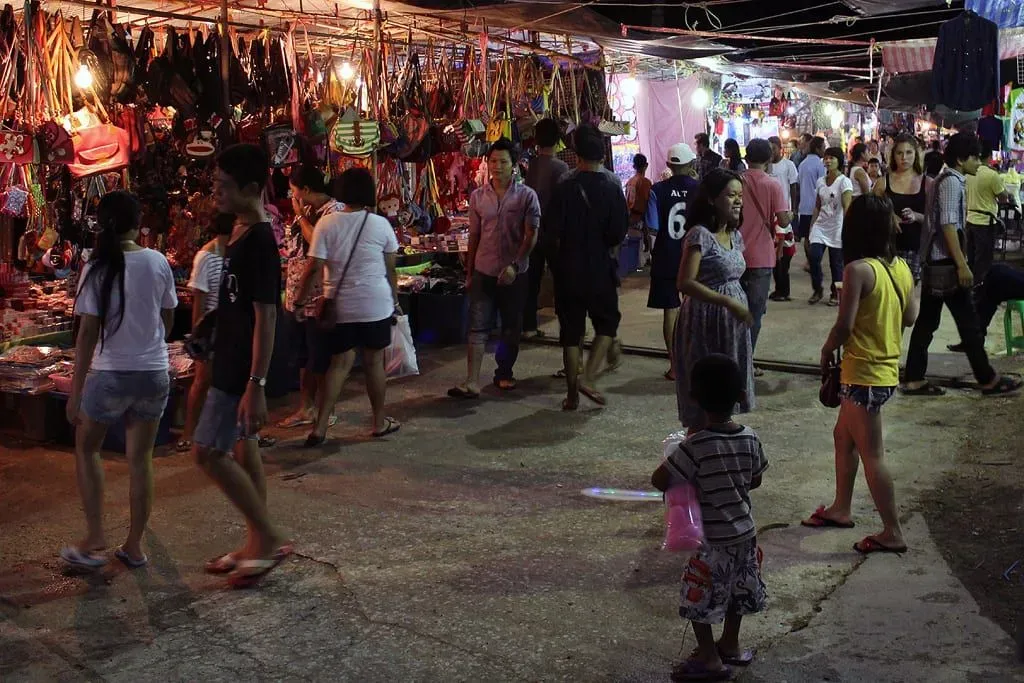
Koh Samui’s tourism economy needs far more construction, cleaning, kitchen and boat labour than the island’s own registered population can supply, so it draws on two separate migrant streams that rarely appear in the same conversation. The first is domestic: Thai nationals from Isaan and the upper south who move within their own country for better pay, needing no visa or work permit because Thailand has no internal border to cross. The second is international: workers from Myanmar, Cambodia and Laos who cross an actual border and enter a specific bilateral legal system — the Memorandum of Understanding (MoU) framework — that governs almost everything about how long they can stay and under what conditions. This page treats both seriously and keeps the two systems distinct, because conflating them (as “Samui’s Burmese and Isaan workforce,” one line, one paragraph) is exactly what erases how differently the law treats each group.
Who Is In It
Thai internal migrants and international migrant workers are concentrated in different, sometimes overlapping, corners of Samui’s economy. Isaan and upper-south Thai workers fill much of the island’s hotel front-of-house, kitchen and retail work, moving for wages that beat home-province rates without needing any migration paperwork. Myanmar nationals make up a large share of the island’s construction crews and are also present in kitchens, cleaning, landscaping and informal domestic work in private homes — nationally, Myanmar migrants are concentrated in “fishing and seafood processing, construction, garment, and domestic service industries,” according to Wikipedia’s overview of the roughly 1.4 million Myanmar-born people the 2014 Myanmar census counted as living in Thailand (Burmese in Thailand, accessed Sep 2026). Cambodian and, to a lesser extent, Lao nationals appear in the same MoU system and in the same lower-paid sectors, though no Samui-specific breakdown by nationality is published anywhere this report could find. Samui’s fishing fleet has its own distinct structure: Hua Thanon’s Thai Muslim boat owners and crews run the island’s largest working fleet, a community covered in full at Samui’s Fishing Families, while national data shows migrant labour making up a large share of Thailand’s wider commercial fishing crews. Agricultural work — coconut and rubber smallholdings inland — draws a mix of Thai day labour and, less visibly, migrant workers, though this is the thinnest-documented corner of the island’s labour picture and this page will not guess at numbers no source publishes.
How It Works
Thailand manages its Myanmar, Cambodian and Lao workforce through a bilateral MoU system that has governed migration from Myanmar since 2003, when the two governments signed an agreement letting workers obtain “a temporary passport, an identity certificate, a visa to remain in Thailand for two years, and a change of work status to legal” (Burmese in Thailand). In practice, a worker registers, receives a work permit and a pink card (the migrant registration identity card), and that permit is tied to one specific, named employer — not to the worker as a free agent in the Thai labour market. Human Rights Watch’s 2018 fishing-sector investigation, drawing on interviews with 248 workers (174 Burmese, 70 Cambodian, 4 Thai), documented what that employer-tied structure enables: employers “frequently retain, and sometimes seize” identity documents; workers arrived carrying debts from recruitment fees typically running 8,000–25,000 baht (roughly USD 244–762); and pink-card registration was often marked up 500–1,000 baht above the official fee by brokers (Hidden Chains, Human Rights Watch, 2018). None of this is a claim about any named Samui employer — this report found no reporting tying a specific Samui business to these practices — but it is the system every MoU worker on the island enters, with the same incentive structure wherever they work.
The scale shows up in national labour inspections too: a 2012 ILO survey found forced-labour indicators affecting 16% of workers on long-haul fishing vessels, against 3% on short-haul boats (Fishing industry in Thailand), and the US State Department downgraded Thailand to its lowest Trafficking in Persons ranking, Tier 3, in 2014, citing the fishing sector (Human trafficking in Thailand). Thailand also periodically reopens registration windows — amnesty rounds — letting undocumented migrants already in the country register retroactively; these recur every few years with a fee and fine schedule set at the time, which this report could not confirm for the current round and will not estimate.
What It Costs
Thailand does not set one national minimum wage — a tripartite wage committee sets a separate daily rate for each province, a structure confirmed on the Ministry of Labour’s own minimum-wage page (Ministry of Labour, Thailand), though its public English pages carried no current province-by-province rate table this report could verify, so it states plainly that it cannot cite Surat Thani’s exact current daily minimum. What is documented is the gap between the legal floor and the worst end of the labour market: HRW’s fishing-sector interviews described extreme cases of workers “working nearly 24-hour days for around $10 per month” (Fishing industry in Thailand) — figures from documented abuse cases, not typical pay, cited as what the legal floor exists to prevent. No comparable wage survey exists for Koh Samui’s construction sites or hotel back-of-house; this report found none and will not substitute a national figure for a local one it cannot verify. What is measurable is the remittance flow the system depends on: researchers at Macquarie University estimate annual remittances from Thailand to Myanmar at over USD 300 million, with Myanmar migrant labour contributing an estimated 5–6.2% of Thailand’s GDP (Burmese in Thailand) — money leaving every province with a migrant workforce, Samui included.
The Fishing Fleet’s Yellow Card
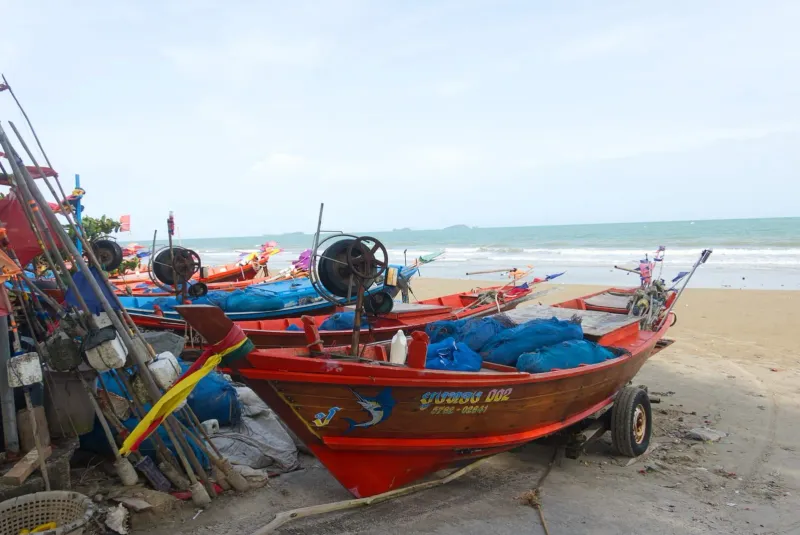
The European Union issued Thailand a “yellow card” warning over illegal, unreported and unregulated (IUU) fishing on 21 April 2015, and lifted it on 8 January 2019 after Thailand introduced vessel monitoring and inspection reforms (Fishing industry in Thailand). The warning was inseparable from labour conditions — international reporting on Thai fishing in this period consistently linked IUU fishing to forced labour aboard the same vessels. Even after the card was lifted, Human Rights Watch’s January 2018 “Hidden Chains” report — researched while the card was still active — found 20 forced-labour situations among 90 employed fishers interviewed, and noted Thai authorities had inspected 474,334 workers in 2015 and found zero forced-labour cases, a gap HRW attributed to inspections relying on paper records rather than worker interviews. Samui’s own Hua Thanon fleet, detailed at Samui’s Fishing Families, is a small-boat, day-trip operation quite different from the long-haul vessels these reports focus on, and this page found no reporting connecting any specific Samui vessel to the abuses documented nationally.
Myanmar Since 2021
Myanmar’s 2021 military coup and the civil conflict that followed reshaped who leaves the country and why, and a second shift arrived in 2024. On 10 February 2024, Myanmar’s junta announced it would enforce a mandatory military service law — two years for men aged 18–35 and women aged 18–27, covering roughly a quarter of the population — with enforcement beginning after the Burmese New Year in mid-April 2024 and a monthly conscription quota of around 5,000 people (Conscription in Myanmar). That announcement is documented as having triggered young people leaving the country specifically to evade conscription or join resistance groups, though the source consulted does not quantify how many crossed into Thailand, and this page will not attach a number to it. The pressure escalated on 23 January 2025, when the junta formalised bylaws barring draft-eligible young people from leaving without permission and allowing prosecution of relatives of draft evaders abroad (same source). The documented effect on Thailand’s migrant labour market is a change in composition, not a quantified scale: a workforce of economic migrants now also includes people whose departure is tied to conscription avoidance specifically — but this report has no Samui-specific data on how that shows up in the island’s own construction sites or kitchens, and says so rather than assuming it.
Life on the Island
Housing, schooling, healthcare and worship are where this workforce’s presence on Samui is most visible day to day, and where the documentation is thinnest. On housing, this report found no published survey of migrant worker accommodation specific to Koh Samui and will not describe conditions it cannot cite. On schooling, the barrier is better documented nationally: Wikipedia’s overview of Thai education notes that “Thai schools often required migrant students to be proficient in the Thai language and to have gone through a learning center before enrolling into a public school,” and that public-school grade placement is age-based in a way that can strand older migrant children in early grades regardless of their actual schooling level (Education in Thailand) — which is the documented reason non-formal migrant learning centres exist as a parallel track rather than a replacement for state school. This report could not confirm whether a dedicated learning centre currently operates on Koh Samui itself, and states that gap rather than assuming one exists. On healthcare, Thai policy requires migrant workers not covered by the Social Security Fund to hold a government-administered migrant health insurance scheme, but this report could not confirm the current premium, enrolment numbers or coverage terms against a live official source this session, so no figure is given here. On language, Thai functions as the working lingua franca between employers, customers and staff regardless of a worker’s first language, whether that is Isaan Lao, Burmese, or a language from Myanmar’s ethnic minority regions. On community structure, Hua Thanon’s Muslim fishing community — covered fully at Samui’s Fishing Families — is centred on Masjid Nurul Ihsan, a mosque built in 1984 that anchors the village’s religious and social life alongside its fish market (Hua Thanon, Ko Samui); Buddhist temples elsewhere on the island serve the same anchoring role for Thai and migrant Buddhist workers, a pattern consistent with how Thai communities generally organise around a local wat.

FAQ
Do migrant workers on Koh Samui need a work permit?
Myanmar, Cambodian and Lao nationals do, issued under Thailand’s bilateral MoU system and tied to one named employer. Thai nationals from Isaan or the upper south need no permit at all — moving for work within Thailand requires no visa, since it isn’t a border crossing.
What is a “pink card” in Thailand’s migrant worker system?
It’s the migrant worker registration identity card issued alongside a work permit under the MoU system. Human Rights Watch has documented brokers marking up its registration fee by 500–1,000 baht above the official government rate in some cases.
Why did Thailand’s fishing industry get an EU “yellow card”?
The EU warned Thailand over illegal, unreported and unregulated (IUU) fishing on 21 April 2015, a warning tied to international reporting linking IUU fishing to forced labour aboard Thai vessels. It was lifted 8 January 2019 after monitoring and inspection reforms.
How has Myanmar’s political crisis changed migration to Thailand?
Myanmar’s junta began enforcing a conscription law in April 2024, requiring military service from men 18–35 and women 18–27. Reporting has documented young people leaving specifically to evade the draft, though no source quantifies how many reached Thailand as a result.
Can migrant workers’ children attend school on Koh Samui?
Nationally, Thai public schools often require migrant children to be Thai-language proficient and to have attended a non-formal learning centre first, with age-based grade placement that can disadvantage older students. Whether a dedicated learning centre currently operates on Samui itself is not confirmed here.
Where do Koh Samui’s Thai migrant workers come from?
Mostly Isaan in Thailand’s northeast and provinces in the upper south, moving for island wages that beat home-province pay. As Thai citizens they need no work permit, only standard ID and household registration paperwork.
Turning Up
There’s no event to attend here, no stall to visit — the point of this page is who’s already there. The person who cleans a hotel room came from somewhere with a name: Isaan, or Myanmar, under a permit tied to the resort that hired them. The person building the villa next door likely did too. The crew on a longtail boat out of Hua Thanon or Nathon works inside a national system that international organisations have spent a decade documenting, for better and worse. None of that is a reason to feel guilty about a holiday or a move to the island — it’s just the actual shape of who Koh Samui runs on, which the cost of living a visitor or resident pays and the choices covered in responsible travel on Koh Samui both connect to whether anyone asks or not. The island’s other tribes — expats, nomads, retirees — are mapped at The Tribes of Koh Samui; this page is the half of the picture that story leaves out.
Published on
About the author

Mike Brochlowski
Travel photographer & writer
Travel photographer and island explorer. Mike has spent years documenting Southeast Asia's hidden gems, from secluded beaches to jungle waterfalls.
Articles by Mike →More in Island Life
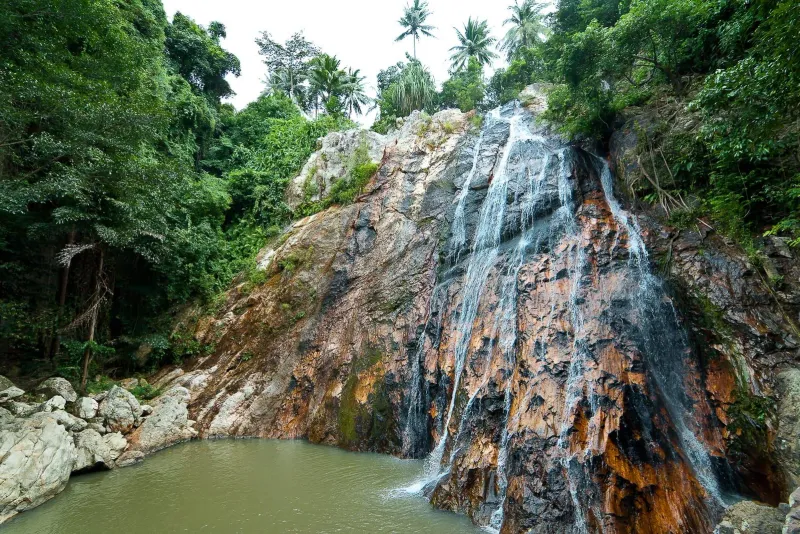
Na Muang Waterfalls — Samui's Purple Cascades and Jungle Pools
Explore Na Muang Waterfalls on Koh Samui — the accessible 18m Purple Waterfall with its swimming pool and the 80m jungle trek to the isla…
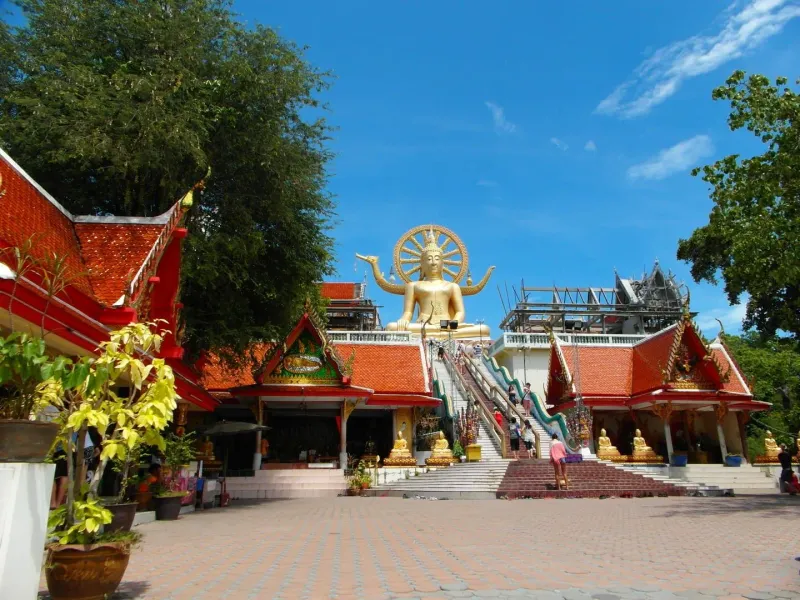
Wat Phra Yai — Big Buddha Temple on Koh Samui
Visit Wat Phra Yai (Big Buddha) on Koh Samui: a 12-meter golden Buddha, naga staircase, panoramic views, and market stalls.
Apirom Viewpoint — Koh Samui's Closed Hillside Lookout Above Ban Tai
Apirom Viewpoint: a ~304m hilltop lookout inland of Ban Tai, Koh Samui, its restaurant closed since the pandemic but the hillside track s…