Contents
A koh samui private guide can mean six different jobs wearing one hat: a licensed tour guide, a driver who talks, a fixer, a certified activity specialist, an interpreter, or a hotel booking desk. Only one of those is legally allowed to guide you for a fee, and knowing which is which is what keeps a good day from becoming an expensive lesson.
Key takeaways
- Professional tour guiding in Thailand is a licensed, Thai-nationals-only profession under the Tourism Business and Guide Act — a foreigner guiding for pay on Samui is working illegally and without guide insurance.
- A real guide’s Department of Tourism licence card shows a photo, a licence number, an expiry date and a printed area of coverage — ask to see it even if nobody offers.
- A car-and-driver day runs roughly 1,800-2,800 THB (~51-80 USD); a full day with an actual licensed guide roughly 2,000-3,500 THB (~57-100 USD) on top, as of 2026.
- No licence shown, cash-only with no receipt, and steering you toward a gem shop are the three fastest tells that something is wrong.
What This Actually Is
“Getting a local guide” on Samui usually means one of six different arrangements, and they are not interchangeable. Knowing the difference before you agree a price is most of the vetting.
| Role | What they actually do | Licence or certification needed |
|---|---|---|
| Licensed tour guide | Narrates history, culture, temples and nature; plans a route; answers questions in depth | Department of Tourism (DOT) guide licence, Thai national only |
| Driver-guide | Drives you between sights and points things out; usually not trained to interpret them in depth | Thai driving licence; guiding itself is a legal grey zone if paid separately as “guiding” |
| Fixer | Arranges tickets, restaurant tables, translation, logistics; rarely present all day | None required by law; reputation is the only check |
| Specialist (dive, trail, fishing) | Leads a specific activity: reef dive, jungle trek, fishing charter | Activity certification — PADI/SSI instructor card, National Park guide registration, boat licence |
| Interpreter | Translates language only, with no guiding content | None; a language skill, not a tourism credential |
| Resort concierge | A hotel employee who books tours and drivers through agencies, usually on commission | Employed by the hotel, not a personal guide |
A licensed tour guide is the only one of these legally allowed to interpret Samui’s history, temples and culture for a fee. Everyone else is selling transport, logistics or a specific skill — all useful, but not the same product, and not all of them are being honest about which one they are.
Thai Guide Licensing, Explained
Thailand licenses tour guides as a protected profession, and understanding this one rule explains almost every other section on this page. Under the Tourism Business and Guide Act B.E. 2551 (2008), amended B.E. 2559 (2016) and administered by the Department of Tourism (DOT) under the Ministry of Tourism and Sports, professional guiding for payment is reserved for Thai nationals. A foreign passport holder cannot legally hold a Thai tour-guide licence, full stop — regardless of language skill, years on the island, or how good the tour actually is.
The Ministry of Tourism and Sports oversees the Department of Tourism, which issues and registers every guide licence in the country. Licences are also scoped geographically and by tourist type rather than issued as one blanket credential. DOT card categories run roughly: a general/nationwide licence, a regional licence valid across a defined group of provinces, and a local or specialised licence tied to one province or one activity type (nature, culture, and so on). Card colour is used to distinguish these categories, but the printed scope on the card — not the colour alone — is what actually tells you where a guide is legally allowed to work; treat colour as a hint and read the text.
A genuine licensed guide will show you, without being asked twice: a DOT-issued photo ID card carrying their photo, a licence number, an expiry date, and the region or activity type the licence covers. If a “guide” cannot produce this, or produces something that is clearly a business card or a hotel ID instead, you are not dealing with a licensed guide. The regional restriction matters in practice — a guide licensed for Bangkok or Chiang Mai does not automatically cover Surat Thani province, which includes Koh Samui; ask directly whether their card lists this area.
This is also why a foreigner offering paid guiding on Samui is not a harmless workaround. It is unlicensed practice of a reserved profession, it sits outside any guide-insurance or DOT-registration scheme, and if a client is hurt or shortchanged there is no institutional body to complain to. None of this stops it from happening — informal foreign “guides” are a known feature of the wider Thai islands market — but it does mean the client is carrying all of the risk.
What a Day Actually Costs
Expect three different price bands depending on which role from the table above you are actually hiring, and expect fuel and entry fees to sit outside all three. These are typical asking-rate ranges as of 2026 — confirm the exact figure before the day starts, since nothing here is a fixed or government-set fee.
| Arrangement | Typical day rate | Usually excludes |
|---|---|---|
| Car and driver (no formal guiding) | ~1,800-2,800 THB (~51-80 USD) | Fuel beyond a set radius, parking, entry fees |
| Licensed guide, full day | ~2,000-3,500 THB (~57-100 USD), plus a vehicle if the guide doesn’t drive | Guide’s lunch (customary to cover), entry tickets |
| Specialist half-day (dive/trek/fishing) | ~1,200-2,500 THB (~34-71 USD) for the guiding or instruction component | Equipment, boat charter or park fees, which are billed separately |
A guide’s own meal is a small, standard courtesy on a full day out, not a hidden fee — it is worth confirming upfront rather than being surprised at lunch. National park entry (for hiking trails and marine parks), temple donation boxes, and any boat or park fee are almost always billed on top of the guiding rate itself, not folded into it.
Questions to Ask Before You Book
Ask these before you hand over a deposit or agree a meeting point — they take thirty seconds and they are the whole vetting process.
- Can I see your DOT guide licence or activity certification card?
- Does your licence cover Surat Thani province and Koh Samui specifically?
- Is the price per day or per person, and exactly what does it include?
- Who pays for fuel, park or temple entry fees, and your lunch?
- What happens if weather or a boat trip is cancelled — refund or reschedule?
- Do you and the vehicle carry valid insurance?
- Can I get a receipt or a written price confirmation before the day?
- Have you worked with my hotel or guesthouse before?
Red Flags That Mean Walk Away
A short list of tells is more useful here than a long one, because these six cover almost every version of the scam.
- No licence or certification card shown, or a vague answer when you ask to see one.
- Cash-only, with no receipt and no willingness to confirm the price in writing beforehand.
- A “friend” who appears at the pier or the hotel lobby offering to take over your day.
- Steering, however gently, toward a gem shop, a jewellery outlet or a timeshare presentation.
- No visible insurance paperwork for the vehicle, or a vehicle in visibly poor condition.
- A price roughly half of every other quote you’ve had for the same day — underpricing this hard almost always means something is being skipped, most often insurance.
Where to Find One Legitimately
The three legitimate starting points are a licensed operator, your own accommodation, and the government tourism office — not a stranger who approaches you first. A registered tour operator or travel agency will have a public business registration number you can ask for and look up, which is a meaningfully different footing from a driver who found you at the ferry terminal. Most hotels and guesthouses on the island keep a short preferred-supplier list of drivers and guides they have used repeatedly and would not want to damage their own reputation by recommending badly — asking at the front desk costs nothing and filters out a lot of risk. For a neutral third option, the Tourism Authority of Thailand (TAT) maintains a regional office in Nathon, Samui’s port town, which can point you toward registered operators without having any commercial stake in which one you pick.
None of these three routes require anyone to broker the booking for you — that part is between you and the operator, driver or guide directly, once you’ve done the thirty seconds of checking above.
Tipping and Etiquette
Tipping a guide or driver in Thailand is customary rather than compulsory, and it rewards judgment more than distance covered. For a full day with a guide, 200-500 THB (~5.50-14 USD) is a reasonable range depending on group size and how far the trip went beyond the basics; a driver-only day sits a little lower. Etiquette follows the guide’s lead at anything sacred — shoes off, shoulders and knees covered, quiet voice inside a temple ordination hall — and a good guide will tell you this before you arrive rather than after you’ve already caused a small scene. Pay at the agreed time rather than making someone chase you for it, and never ask a driver to break a traffic law or push into a restricted area to save you a few minutes.
What a Good Guide Gives You
A guidebook can tell you what Wat Plai Laem looks like; a good guide tells you why the reclining Buddha here matters, when the light is best for it, and whether today’s crowd means you should come back tomorrow morning instead. That kind of real-time judgment — reading weather for a boat day, knowing which market stall is worth the queue today, translating a joke instead of just the words — is the actual product you’re paying for, and it’s the one thing that a licence, a certification and a five-minute vetting conversation are trying to protect you into finding.
FAQ
Do I need a guide to visit Koh Samui’s temples and waterfalls?
No. Most of the island’s beaches, temples and waterfalls — including Wat Phra Yai and Wat Plai Laem — are open to independent visitors with a scooter, taxi or songthaew. A guide adds historical context, language help and logistics, not access you couldn’t otherwise get.
Is it legal for a foreigner to work as a private guide on Koh Samui?
No. Under the Tourism Business and Guide Act, professional tour guiding is reserved for Thai nationals, and a Department of Tourism licence cannot legally be issued to a foreign passport holder. A foreigner guiding for pay on Samui is working outside the law and outside any guide-insurance scheme, whatever the quality of the tour.
How much does a private guide cost on Koh Samui?
As of 2026, a full day with a licensed guide typically runs roughly 2,000-3,500 THB (~57-100 USD), often plus a separate car-and-driver cost of about 1,800-2,800 THB (~51-80 USD) if the guide doesn’t drive. Specialist half-days — diving, trekking, fishing — usually add 1,200-2,500 THB (~34-71 USD) on top of equipment or charter costs.
What does a real Thai tour guide licence look like?
A genuine Department of Tourism licence is a photo ID card showing the guide’s photo, a licence number, an expiry date, and the region or activity type it covers, coded partly by card colour but confirmed by the printed text. A guide should be willing to show this without hesitation.
What’s the difference between a driver-guide and a licensed guide?
A driver-guide gets you between places safely and may point things out along the way, but is not credentialed to interpret history or culture professionally. A licensed guide holds a DOT licence specifically for that role. Both are useful; only one is legally “guiding.”
What should I do if a guide pushes me toward a gem shop?
Decline and treat it as a red flag rather than a one-off suggestion. Commission-driven detours to gem or jewellery shops are a well-known pattern across Thailand’s tourist islands, and a legitimate guide working on a fair day rate has no reason to insist.
Turning Up
There is no single booking desk for this — the move is to start local and start small. On a weekday, the Tourism Authority of Thailand office in Nathon keeps typical Thai government hours, roughly 08:30-16:30, and can point you toward registered operators with no stake in which one you choose; call ahead before a public holiday, since hours shift around them. Failing that, ask your own hotel’s front desk who they’d actually send a friend with — most keep a short list precisely for this reason — and use the questions above before anyone gets in a vehicle. Read next: Getting Around Koh Samui for do-it-yourself transport, Is Koh Samui Safe? for the wider scam picture, and Koh Samui Travel Tips for what to know before any of this.




Published on
About the author

Mike Brochlowski
Travel photographer & writer
Travel photographer and island explorer. Mike has spent years documenting Southeast Asia's hidden gems, from secluded beaches to jungle waterfalls.
Articles by Mike →More in Island Life
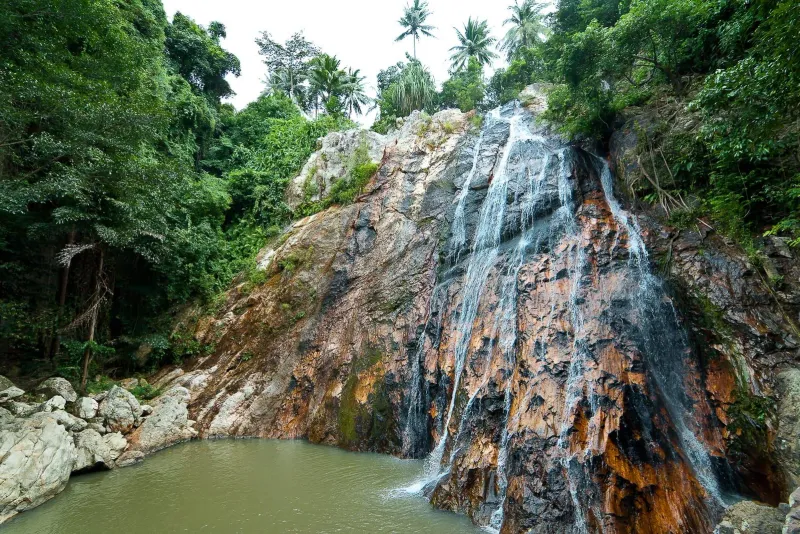
Na Muang Waterfalls — Samui's Purple Cascades and Jungle Pools
Explore Na Muang Waterfalls on Koh Samui — the accessible 18m Purple Waterfall with its swimming pool and the 80m jungle trek to the isla…
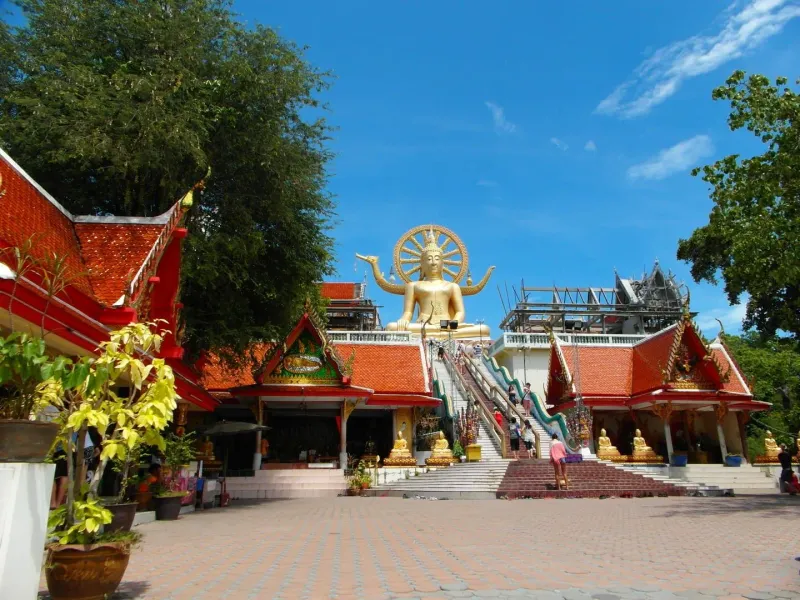
Wat Phra Yai — Big Buddha Temple on Koh Samui
Visit Wat Phra Yai (Big Buddha) on Koh Samui: a 12-meter golden Buddha, naga staircase, panoramic views, and market stalls.
Apirom Viewpoint — Koh Samui's Closed Hillside Lookout Above Ban Tai
Apirom Viewpoint: a ~304m hilltop lookout inland of Ban Tai, Koh Samui, its restaurant closed since the pandemic but the hillside track s…