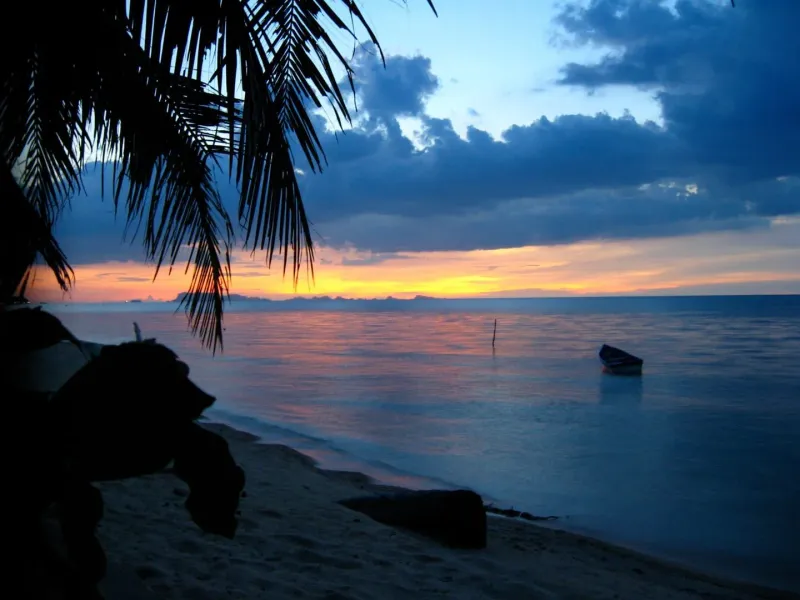
Overview
Bang Po Beach (หาดบางปอ) is a narrow, ~3 km stretch of sand on the northwest coast of Koh Samui, Thailand, running from the Ban Tai area toward the Laem Yai headland. It sits beyond the western tip of Maenam Beach, facing open water toward Koh Phangan, and it draws a fraction of the visitors that Chaweng or Lamai see on any given day.
What makes Bang Po worth the drive is what it lacks: no jet skis, no beach vendors hawking sarongs every few meters, no wall-to-wall sun loungers. In their place are small Thai seafood restaurants built right on the sand, a shallow reef that surfaces at low tide and opens up for snorkeling when the water rises, and long, uninterrupted sightlines across the strait to Koh Phangan’s hills.
![500px provided description: Belmond Napasai Resort, Koh Samui, Thailand [#sea ,#beach ,#sand]](/_astro/bang-koh-samui-beach-nearby-1-commons-83561778.CaN4lN7X_15OM0F.webp)
Geography: A Narrow Northwest Shoreline
Bang Po occupies the coastline between Ban Tai, at its eastern end, and the Laem Yai headland to the west: the northwestern tip of Koh Samui, Thailand’s third-largest island. Some travel guides stretch the “Bang Po” label as far as Mae Nam, quoting figures up to 5-6 km, but the core sandy stretch that locals and most maps call Bang Po Beach runs closer to ~3 km. It is one of the longer continuous beaches on the island regardless of exactly where the boundary is drawn.
The road behind the beach, part of the Route 4169 ring road network, stays low-key: small resorts, guesthouses, and a scatter of restaurants rather than the resort walls that line Chaweng. Because Bang Po faces northwest across the Gulf of Thailand, it looks directly at Koh Phangan, and on clear days the silhouette of Koh Tao is visible further out.
Sand and shoreline character
The sand along Bang Po ranges from golden to a lighter, almost pale yellow, and it is noticeably coarser in patches than the fine powder found at Chaweng or Choeng Mon: a mix of sand, soil, and clay that firms up underfoot rather than sinking. Palm trees lean over much of the shoreline, and several stretches report minimal seaweed and no beach hawkers, which keeps the walk from end to end genuinely relaxing.
The Beach: Sand, Tides, and Swimming
Is Bang Po Beach good for swimming?
Bang Po is good for swimming at mid to high tide, when the water covers the shallow flats and stays calm with essentially no wave action. Families with young children favor it for exactly this reason: there is no current to fight and no drop-off close to shore.
The catch is the tide. At low tide, Bang Po exposes wide sand and mud flats along with scattered rocks and boulders, and swimming becomes impractical until the water returns. Koh Samui’s tidal range runs roughly 1.0-2.1 m, and Bang Po’s gentle gradient means that swing translates into a large visible change in the shoreline. Check a Koh Samui tide chart before planning a swim, and aim for the two to three hours either side of high tide.
The double-sunset effect
One quirk that keeps photographers coming back: when the tide is low and the remaining water sits in a thin, glass-like sheet across the sand, the setting sun reflects off it almost perfectly, producing what regulars call a “double sunset”: the true sun above the horizon and its mirror image glowing in the wet sand below. It only works under the right combination of low tide and clear sky, so treat it as a bonus rather than a guarantee.
![500px provided description: Belmond Napasai Resort, Koh Samui, Thailand [#sea ,#beach ,#sand], view 2](/_astro/bang-koh-samui-beach-nearby-2-commons-83561780.63tgl_t1_UFFOO.webp)
Snorkeling and Activities
Bang Po is not an adventure-sports beach, but it has enough on offer for a full day without ever leaving the sand.
In the water
- Snorkeling: A small coral reef sits just offshore. Visibility is limited compared with Koh Tao or Ang Thong, but it holds enough fish and coral cover for a casual look, and it is best attempted at high tide when the reef is fully covered and easier to reach without scraping against exposed rock.
- Swimming: Best at mid to high tide in the calm, shallow water described above. Low tide is better spent walking than swimming.
- Stand-up paddleboarding (SUP): Conditions are typically flat enough for beginners, especially in the early morning before any onshore breeze builds.
- Sunset horse riding: Operators run beach and trail horse riding sessions along Bang Po’s sand, usually timed for the late-afternoon light.
On land
- Beach walking: The ~3 km length makes for a proper walk, and the coarse sand holds up well underfoot even after rain.
- Yoga: Several guesthouses and small resorts run drop-in or sunrise sessions on the beach or in garden studios facing the water.
- Beach hopping tours: Bang Po is a regular stop on half-day “hidden beaches” tours that combine it with Laem Yai and other northwest coast spots.
Where to Eat
Bang Po’s dining is built around small, family-run restaurants set directly on the sand, plus a handful of international kitchens that have moved in alongside the beach’s growing guesthouse scene.
Beachfront restaurants
| Restaurant | Cuisine | Price Range | Known For |
|---|---|---|---|
| Sassy Beach | Thai, international | $$ | Beachfront tables, sunset cocktails |
| Aromi Diversi Pizzeria & Beach Bar | Italian | $$ | Wood-fired pizza on the sand |
| Flavors of India | Indian | $$ | Curries and tandoori near the beach road |
| Villa Luna | Thai, seafood | $-$$ | Fresh grilled catch, casual toes-in-sand seating |
| Jeen Shop | Thai, seafood | $ | Simple grilled seafood a short walk from the water |
Thai seafood on the sand
Most of Bang Po’s Thai kitchens work the same way: pick your fish, squid, or prawns from an ice tray and have it grilled or steamed to order. Expect to pay roughly 150-350 THB (~4.50-10 USD) for a seafood plate, and 50-100 THB (~1.50-3 USD) for pad thai, fried rice, or a curry over rice: noticeably cheaper than the equivalent meal in Chaweng.
Price guide
- Budget: Local Thai dishes from ~50 THB (~1.50 USD)
- Mid-range: Beachfront seafood or pizza, 200-400 THB (~5.50-11 USD)
- Upscale: Resort dining at properties like the Four Seasons, from ~1,500 THB (~43 USD)
![500px provided description: Belmond Napasai Resort, Koh Samui, Thailand [#sea ,#beach ,#sand], view 3](/_astro/bang-koh-samui-beach-nearby-3-commons-83561782.DDewvQWz_22PaGI.webp)
Nearby Attractions
Bang Po’s position at the quiet end of the north coast keeps it close to several worthwhile stops without being crowded by them.
Under 15 minutes
- Maenam Beach: Borders Bang Po to the east. Longer, slightly more developed, with a Thursday night market and Santiburi Golf Course in the hills above it.
- Chinese Temple of Maenam (Chao Eng Sae Shrine): The Hainanese community shrine at the heart of Maenam village, a short drive from Bang Po’s eastern end.
- Wat Na Phra Lan: A quiet royal temple in the Na Phra Lan area with a revered King Rama V statue and traditional Thai architecture.
- St Anna Catholic Church: A small, well-kept church near Ban Tai, on the road linking Bang Po to Maenam.
Under 30 minutes
- Hin Lad Waterfall Trail: A ~2.6 km riverside jungle hike near Nathon leading to multi-tiered cascades and swimming pools.
- Laem Yai headland: The northwestern tip of the island, with secluded coves and views toward Ang Thong Marine Park.
- Nathon town and ferry pier: The island’s administrative center and main ferry link to the mainland.
Where to Stay
Accommodation at Bang Po is thinner than at Maenam or Bophut, but it spans a genuine range: from simple beachfront bungalows to one of Thailand’s best-known ultra-luxury resorts nearby on the same stretch of coast.
By budget
| Category | Average Price | Examples |
|---|---|---|
| Budget | 700-1,400 THB (~20-40 USD)/night | Anna Resort, local guesthouses along the beach road |
| Mid-range (3-star) | 1,750-3,500 THB (~50-100 USD)/night | Mimosa Resort & Spa, Code Hotel |
| Upscale (4-star) | 4,200-7,700 THB (~120-220 USD)/night | Karma Two Palms Beach, Secret Garden Beach Resort |
| Luxury (5-star) | 17,500+ THB (~500+ USD)/night | Four Seasons Resort Koh Samui |
Notable properties
- Four Seasons Resort Koh Samui: Perched on the headland near Bang Po and Laem Yai, with private-pool villas terraced into the hillside and sweeping views over the strait. Among the most awarded resorts on the island.
- Secret Garden Beach Resort: A small beachfront property with a garden setting and direct sand access, popular for its quiet, personal service.
- Mimosa Resort & Spa: A mid-range option with a pool and easy walking distance to several beach restaurants.
Getting There
From Samui Airport (USM)
Bang Po sits roughly 20 km northwest of the airport, past Maenam: figure on ~25-30 minutes by car in normal traffic.
- Airport taxi: ~350-450 THB (~10-13 USD), prepaid at the airport counter.
- Shared minivan / songthaew: From ~150-200 THB (~4.50-5.50 USD), slower with stops along the way.
- Grab: Works for trips originating elsewhere on the island but cannot pick up directly inside the airport terminal.
From other beaches
- From Maenam: ~5-10 min by taxi (~100-150 THB) or a walkable stretch of coastline at low tide.
- From Bophut: ~15 min by taxi (~150-200 THB).
- From Chaweng: ~30-35 min by taxi (~350-450 THB).
- From Nathon (ferry port): ~15-20 min via the coastal road.
Getting around
A rented scooter (~200-300 THB/day, ~6-9 USD) is the easiest way to combine Bang Po with Maenam, the Chinese temple, and Wat Na Phra Lan in a single loop. Confirm your travel insurance covers scooter riding before renting.
Best Time to Visit
Season breakdown
| Season | Months | Conditions | Rating |
|---|---|---|---|
| Peak / Dry | Dec-Feb | Sunny, calm seas, minimal rain | ★★★★★ |
| Hot | Mar-May | Hotter (35 degrees Celsius+), brief showers possible | ★★★★ |
| Inter-monsoon | Jun-Aug | Mixed weather, generally pleasant | ★★★★ |
| Monsoon | Sep - mid-Nov | Heavier rain possible, choppier water | ★★★ |
Bang Po-specific notes
- The northwest coast is sheltered from the worst of the southwest monsoon swell that hits the east coast, so Bang Po often stays calm when Chaweng and Lamai get rough.
- Plan around the tide, not just the season: check tide times and aim for a window either side of high tide for swimming and snorkeling regardless of month.
- December-February brings the clearest water and the best odds of seeing Koh Phangan sharply across the strait.
- The quieter monsoon months (September-November) bring lower guesthouse prices and even fewer visitors than usual.
Practical Tips
Essentials
- Parking: Free, informal parking near most beachfront restaurants; nothing metered.
- ATMs and shops: Limited directly on Bang Po itself, with the nearest concentration of ATMs, 7-Elevens, and minimarts in Maenam village, a short drive east.
- WiFi: Available at most guesthouses and beachfront restaurants; coverage is patchier than in Bophut or Chaweng.
- Safety: A low-key, low-crime area. Watch your footing on exposed rocks and coarser sand patches at low tide, and check for warning flags during occasional box jellyfish season (roughly October-December).
- Tide planning: Bring or check a tide chart app, since it decides whether you’ll be swimming or beachcombing on any given visit.
For families
The calm, shallow water at mid to high tide, the absence of beach hawkers, and the easy walking distance make Bang Po workable for families who want a quieter alternative to Maenam without giving up swimmable water. Bring water shoes for the rockier, coarser sections.
For digital nomads and long stays
Bang Po’s guesthouse scene is smaller than Maenam’s but growing, with monthly bungalow rentals available from roughly 8,000-15,000 THB (~229-429 USD). It suits people already settled on the north coast who want a quieter street than Maenam’s village center, though daily errands still mean a short drive.
Who Is Bang Po Best For?
| Traveler Type | Fit | Why |
|---|---|---|
| Families | ★★★★ | Calm water at high tide, no hawkers, but plan around the tide |
| Couples | ★★★★★ | Quiet sunset walks, Koh Phangan views, low-key beach dinners |
| Budget travelers | ★★★★ | Cheap Thai seafood and simple guesthouses |
| Luxury travelers | ★★★★ | Four Seasons Resort Koh Samui on the same stretch of coast |
| Snorkelers | ★★★ | A real reef, but visibility and access depend on the tide |
| Digital nomads | ★★★ | Workable but with thinner infrastructure than Maenam or Bophut |
| Party seekers | ★ | Nothing resembling nightlife: go to Chaweng instead |
![500px provided description: Belmond Napasai Resort, Koh Samui, Thailand [#sea ,#beach ,#sand], view 4](/_astro/bang-koh-samui-beach-nearby-4-commons-83561783.BTSJaGTD_ZV3s57.webp)
![500px provided description: Belmond Napasai Resort, Koh Samui, Thailand [#sea ,#beach ,#sand], view 5](/_astro/bang-koh-samui-beach-nearby-6-commons-87729513.BgUPoqZW_1lOtOi.webp)
![500px provided description: Belmond Napasai Resort, Koh Samui, Thailand [#sea ,#beach ,#sand], view 6](/_astro/bang-koh-samui-beach-nearby-9-commons-87729521.DAsKevF2_VB0Au.webp)
![500px provided description: Belmond Napasai Resort, Koh Samui, Thailand [#sea ,#beach ,#sand], view 7](/_astro/bang-koh-samui-beach-nearby-5-commons-83561786.Bsx0rU7A_23RKgo.webp)
![500px provided description: Belmond Napasai Resort, Koh Samui, Thailand [#sea ,#beach ,#sand], view 8](/_astro/bang-koh-samui-beach-nearby-7-commons-87729518.ByaL35br_Z1LROSc.webp)
![500px provided description: Belmond Napasai Resort, Koh Samui, Thailand [#sea ,#beach ,#sand], view 9](/_astro/bang-koh-samui-beach-nearby-8-commons-87729520.Ch2Ff7IG_Zk8HWi.webp)
FAQ
Is Bang Po Beach good for swimming?
Bang Po Beach is swimmable at mid to high tide, when the water is calm and covers the shallow sand and mud flats close to shore. At low tide, wide flats and scattered rocks are exposed, making swimming impractical until the tide returns. Check a tide chart and time your visit around high tide for the best experience.
Can you snorkel at Bang Po Beach?
Yes. A small coral reef lies just offshore from Bang Po Beach, best explored at high tide when it is fully submerged and easier to reach without contact with exposed rock. Visibility is more limited than at Koh Tao or Ang Thong Marine Park, but it is a convenient option for casual snorkeling without leaving Koh Samui.
How long is Bang Po Beach?
Bang Po Beach’s core sandy stretch runs approximately 3 km along Koh Samui’s northwest coast, between Ban Tai and the Laem Yai headland. Some sources describe a longer stretch of 5-6 km when the label is extended toward Mae Nam, but the beach most commonly identified as Bang Po is the shorter, quieter ~3 km section.
How far is Bang Po Beach from the airport?
Bang Po Beach is roughly 20 km from Samui International Airport, about 25-30 minutes by car. A prepaid airport taxi costs approximately 350-450 THB (~10-13 USD). Shared minivans are cheaper but slower, and Grab ride-hailing works for trips starting elsewhere on the island but not for airport pickups.
What is the “double sunset” at Bang Po Beach?
At low tide, a thin sheet of water can remain on Bang Po Beach’s flat sand, creating a mirror-like surface. When the sun sets under the right conditions, its reflection appears in the wet sand below the true horizon, producing a striking double-sunset effect that photographers seek out on clear, calm evenings.
Is Bang Po Beach good for families?
Bang Po Beach suits families reasonably well, with calm, shallow water at high tide, minimal seaweed, and no beach hawkers to navigate. The main caveat is the tide: low tide exposes rocky, coarser sand that is less comfortable for young children, so families should plan swimming around the tide schedule rather than a fixed time of day.
About the author

Migues Ferfumoz
Writer, Koh Samui resident since 2019
Freelance writer and Koh Samui resident since 2019. Migues covers local culture, food, and the best off-the-beaten-path destinations on the island.
Articles by Migues →Mentioned in Island Life
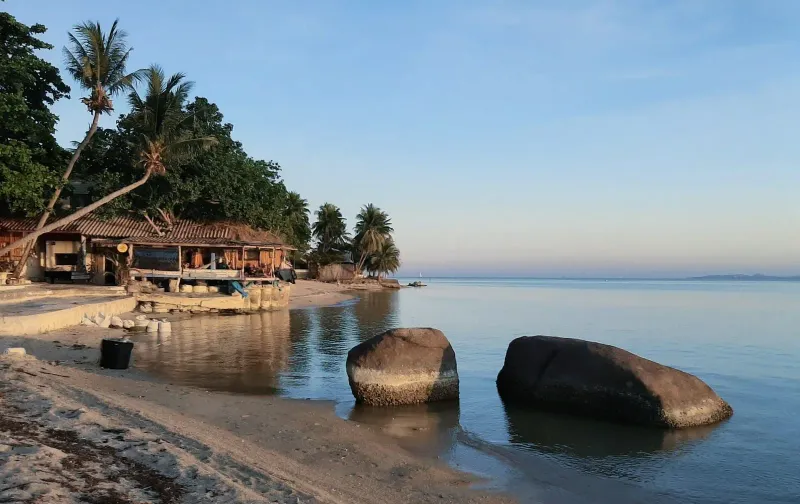
Open-Water Swimming on Koh Samui: Safe Lines, Boats and the Crew
Water stays 28-30°C year-round, with safe lines marked by beach, monsoon swell, jellyfish season and the tow-float rules that keep swimme…
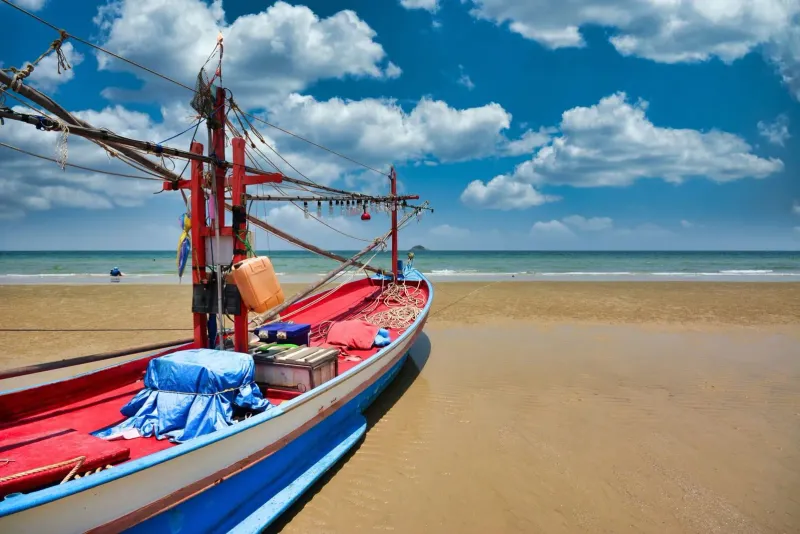
Samui's Fishing Families: Hua Thanon, Bang Po and the Boats
Koh Samui had an economy before tourism, and parts of it still work: Hua Thanon's Muslim fishing fleet, Bang Po's squid boats, and what's…
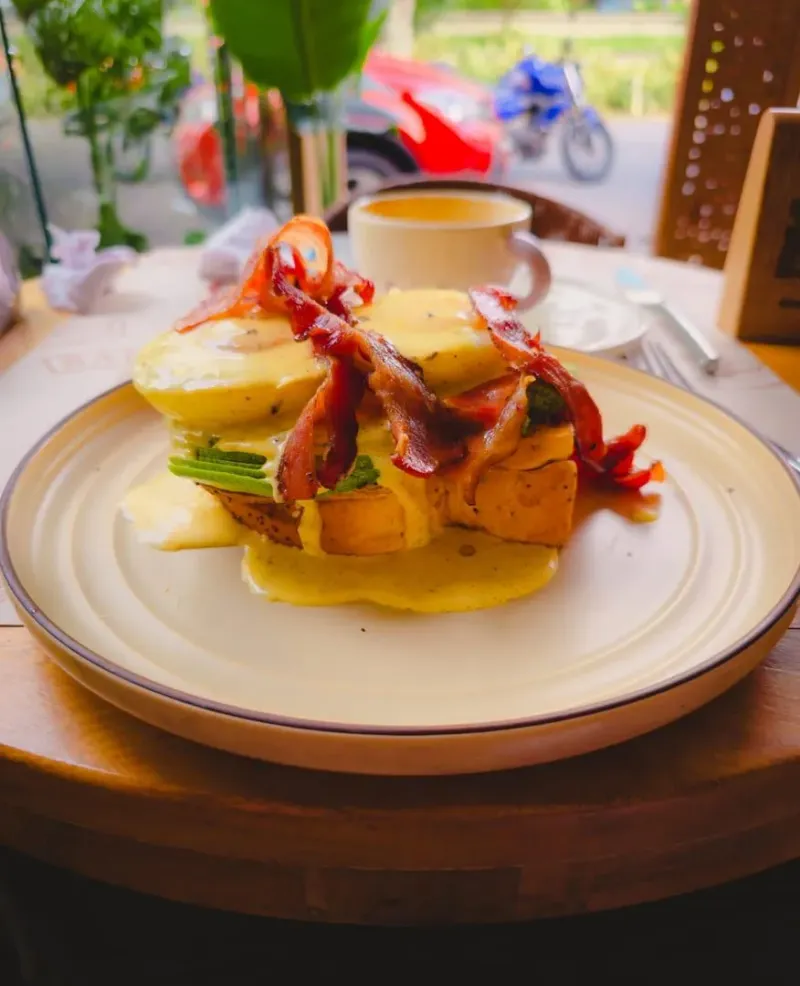
First-Date Places on Koh Samui: Low Stakes and Good Light
First date spots on Koh Samui with a built-in exit (cafés, a walking-street market, a viewpoint and a Muay Thai card) plus honest dating-…