Overview
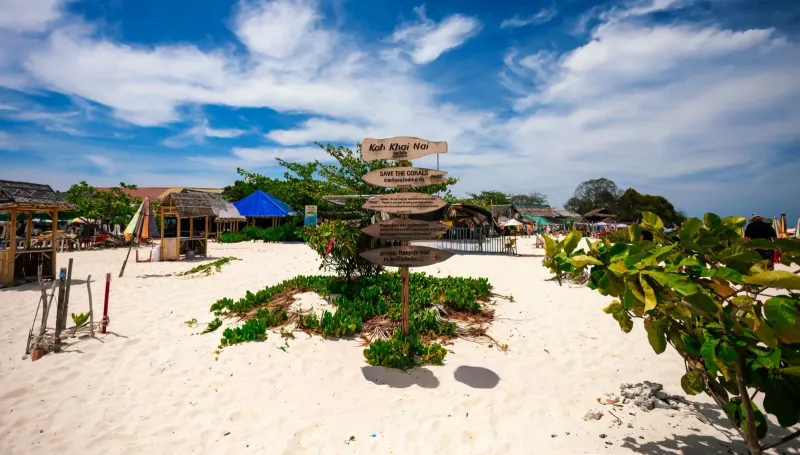
Na Khai Beach (หาดนาไข่), also written Nahai Beach, is a narrow strip of white sand on the south coast of Koh Samui, Thailand, running roughly 2 km from the old pier at Hua Thanon village to a small headland shaped like a hammerhead shark. There is almost no commercial development here: no beach bars strung with fairy lights, no souvenir stalls, no rows of sunbeds for rent. What Na Khai has instead is space, a reef-sheltered shallows, and some of the most consistent cross-shore wind on the island, which has made it one of Koh Samui’s two serious kitesurfing beaches.
Most visitors reach Na Khai either because they are chasing wind with a kite bag in the trunk, or because they want a stretch of coast where the loudest sound is the slap of a longtail boat engine from Hua Thanon’s fishing fleet. It is not a swimming beach in the Chaweng or Maenam sense (the water is shallow and the seabed uneven with patches of reef and rock), but for a quiet walk, a kite session, or a look at a working Muslim fishing village that has changed little in decades, Na Khai delivers something increasingly rare on Samui.
The beach sits about 27 km southwest of Samui International Airport, roughly a 30-35 minute drive, and about 7-8 km south of Lamai’s main strip.
Location: Koh Samui’s Quiet South Coast
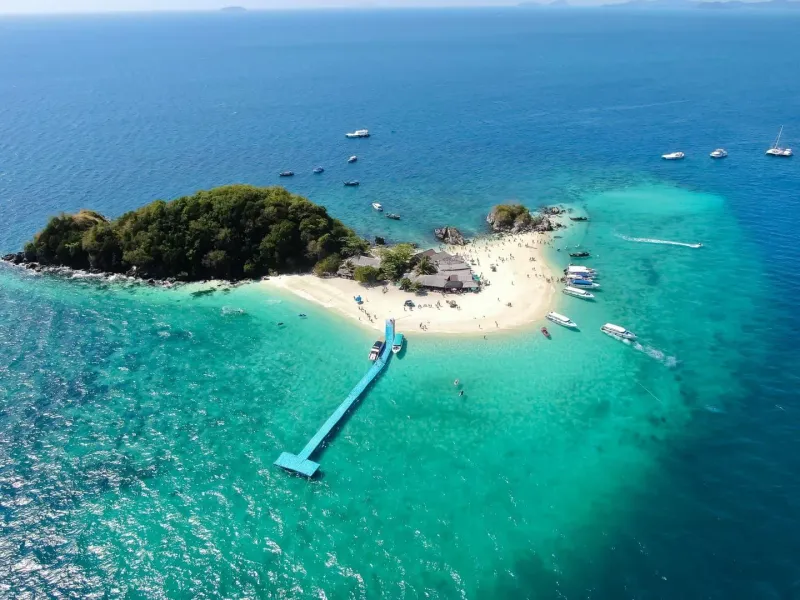
Na Khai belongs to a cluster of low-key south-coast beaches (alongside Natien, Laem Set, Bang Kao, and Thong Krut) that sit well outside Koh Samui’s main tourist circuit. The coastline here faces almost due south into the Gulf of Thailand, which is exactly why the northeast and east monsoon winds hit it so cleanly for half the year.
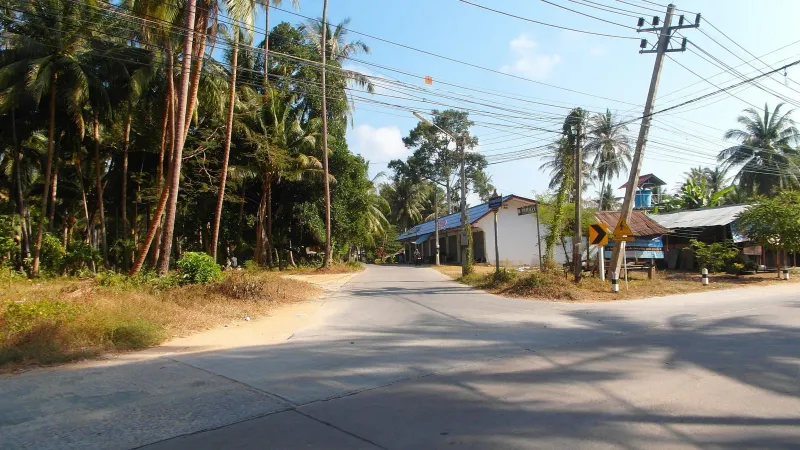
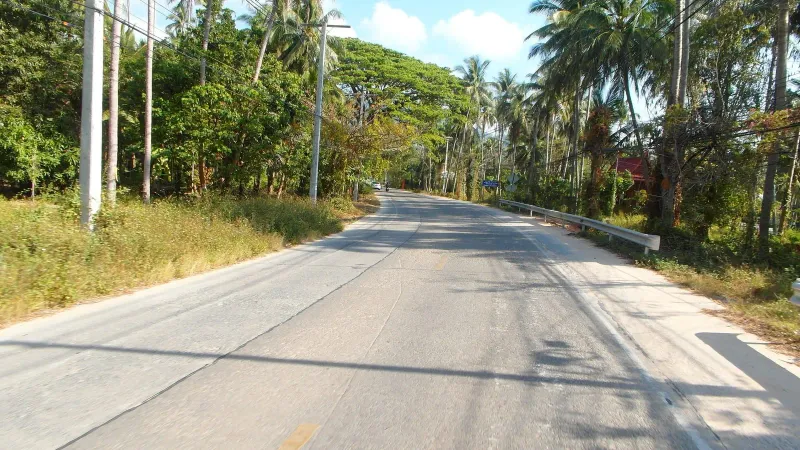
The beach begins at the ruined pier that once served Hua Thanon village and runs southeast to a rocky cape locals liken to a hammerhead shark’s head. Immediately behind the sand, Route 4170 (the coastal road that continues toward Laem Set and Bang Kao) gives access to parking near the beach’s entrance, close to where a kitesurfing school operates. Away from that entrance, the shoreline is flanked by a mix of high-fenced private villas, a handful of resort properties, and open scrubland.
Coordinates for the beach sit at approximately 9.4311°N, 100.0193°E, placing it just south of Lamai and a short drive north of Wat Khunaram and the Samui Butterfly Garden.
The Beach: Sand, Tides, and Coral Reef
Na Khai’s sand is fine-grained, light, and almost white, packed dense enough by wave action that it is walkable (and in places drivable) even where beaches elsewhere on the island turn soft and sinking. At low tide, the sea retreats to expose an estimated ~150-170 meters of flat sand, similar to (though slightly less extensive than) the neighboring Pang Ka stretch further along the south coast.
Reef and depth
A coral reef runs offshore, which does two useful things: it keeps the water inside consistently shallow (often barely ankle- to knee-deep well out from the shore) and it is credited locally with keeping box jellyfish away from this section of coast. The tradeoff is that the reef and scattered rock patches make the water unsuitable for serious swimming or diving in from any height; wading and shallow paddling are the practical options.
Tide and wave conditions
Conditions are typically described as flat and slightly choppy rather than surf-worthy, which is precisely what makes the shallows good for beginner kitesurfing and less appealing for bodysurfing. Visitors should expect occasional natural debris (seaweed, driftwood) and, after onshore wind, some windblown litter: a known drawback of this stretch that beach cleanup schedules do not always keep up with.
Kitesurfing at Na Khai Beach
Kitesurfing is Na Khai’s headline activity and the main reason it appears on any Koh Samui itinerary at all. The beach is widely rated as one of the island’s two premier kite spots (Chaweng’s far southern end is the other), thanks to a rare combination on Samui: wide, obstruction-free sand, a shallow reef-protected lagoon for launching and easing beginners in, and wind that arrives with real consistency for several months of the year.
Wind and season
- Peak season: ~November to April, with the most reliable and strongest wind from November through February
- Wind direction: predominantly northeast and east, blowing cross-shore to onshore across the bay
- Wind strength: ranges from light (under 10 knots) up to a comfortable 11-19 knots on good days: solid for freeride and freestyle, less so for heavy big-air sessions (conditions tracked by spot guides such as Spots4Kite’s Nahai Beach profile)
- Style: freeride and freestyle are the dominant disciplines given the flat, shallow water
Skill level and schools
The shallow lagoon and wide beach make Na Khai forgiving for beginners learning to body-drag and water-start, while the open bay still gives intermediate and advanced riders enough room to work on jumps and transitions. A kitesurfing school operates at the beach’s main entrance, offering lessons, gear rental, and storage: useful given how little else is available nearby. As with any reef-adjacent kite spot, riders should stay alert to rocks and shallow patches at low tide and give fishing boats working out of Hua Thanon a wide berth.
Swimming and Other Activities
Na Khai is not built for swimming laps or floating in deep water: the shallow, reef-scattered seabed and occasional rocks rule that out for most of the beach. It works better for wading, cooling off, and letting kids splash in ankle-to-knee depth close to shore, provided someone keeps an eye on footing.
Outside kitesurfing, the beach’s appeal is mostly about doing very little:
- Beach walking: The full 2 km stretch, hard-packed at low tide, makes for an easy, uncrowded walk from Hua Thanon’s old pier to the hammerhead-shaped cape.
- Photography: Wide skies, kite action on the water, and traditional longtail boats moored near the village give the beach a working-coast character that’s harder to find on Samui’s built-up east side.
- Beachcombing and quiet time: With few other visitors around outside kite season, Na Khai suits anyone who wants an empty stretch of sand rather than an activity list.
For actual swimming, most visitors base themselves at Lamai or Chaweng, 15-25 minutes away, and treat Na Khai as a day visit for the wind and the atmosphere rather than the water itself.
Hua Thanon: The Fishing Village Next Door
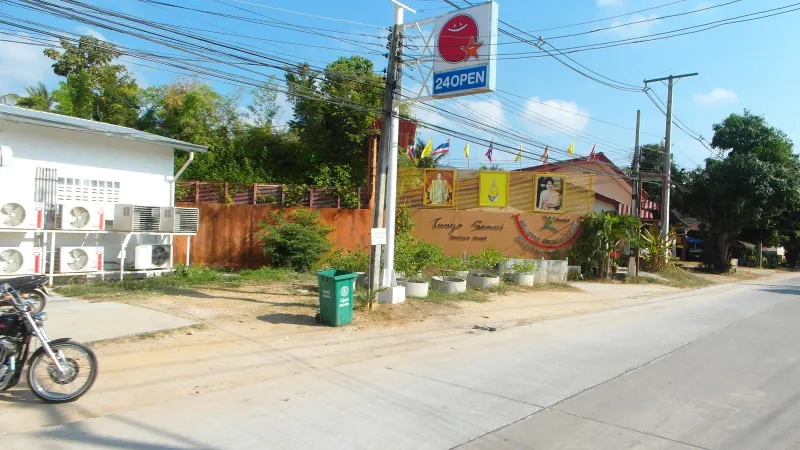
Na Khai’s northern end runs directly into Hua Thanon, a Muslim fishing village that is one of the most distinctive communities on Koh Samui. Unlike the resort towns further north, Hua Thanon still functions as a working fishing port: brightly painted longtail boats line the shore, nets are mended in the open, and a morning fish market sells the overnight catch to local buyers and the occasional curious visitor.
The village’s identity sets it apart on an island that is otherwise overwhelmingly Buddhist: mosques rather than temples anchor community life, and the call to prayer carries across this stretch of coast. It’s worth noting the working-harbor reality up close: visitors sometimes find the immediate pier area untidy, with fishing gear, waste, and the smell of the day’s catch part of daily operations rather than a curated tourist scene. That authenticity is also the point: Hua Thanon offers a version of Samui life that existed long before the island’s tourism boom, and it remains largely unstaged for visitors.
Some beachfront sections near Hua Thanon and toward the villas further south are managed by private hotel land and posted with restrictions on public access: walking, sitting, photography, and bringing animals may be prohibited on those specific fenced stretches. The public sand near the pier and kite school entrance remains freely accessible.
Where to Eat
Na Khai itself has essentially no beachfront dining: a handful of hotel restaurants on private land are the only formal option directly on the sand. For food, most visitors either eat in Hua Thanon village or drive the short distance to Lamai, which has Samui’s second-largest restaurant scene after Chaweng.
| Option | Location | Price Range | Notes |
|---|---|---|---|
| Hua Thanon food stalls | Village, north end of the beach | $ | Morning fish market snacks, simple noodle and rice stalls, halal food given the Muslim community |
| Hotel restaurants | Scattered along Na Khai/Laem Set coast | $$-$$$$ | Access generally limited to guests; a few allow outside diners with advance booking |
| Lamai beach road restaurants | ~7-8 km / ~15 min drive | $-$$$ | Full range from street food (~60-100 THB, ~2-3 USD) to seafood grills and international menus |
| Bang Kao / Laem Set cafes | 5-10 min south along the coast road | $-$$ | Small, low-key spots serving the villa and long-stay crowd |
Price guide
- Budget: Hua Thanon noodle and rice stalls, roughly 50-100 THB (~1.50-3 USD)
- Mid-range: Lamai seafood and Thai restaurants, roughly 200-400 THB (~5.50-11 USD)
- Upscale: Hotel dining along the Laem Set/Na Khai coast, typically 500-1,500 THB (~14-43 USD)
Nearby Attractions
Na Khai’s south-coast position puts it closer to Samui’s cultural and natural sights than to its beach-club scene.
Under 10 minutes
- Wat Khunaram: Home to Koh Samui’s famous mummified monk, displayed seated in a glass case inside the temple grounds. About 5-8 minutes by car.
- Samui Butterfly Garden & Insect Museum / Samui Aquarium and Zoo: A short drive along Route 4170, popular with families combining a beach morning with an animal park afternoon.
- Hua Thanon morning market: Right at the beach’s northern edge, best visited early, before the day’s heat sets in.
Under 25 minutes
- Lamai Beach: Samui’s second-biggest beach town, ~7-8 km / ~15 minutes north, with Hin Ta Hin Yai (Grandfather-Grandmother Rocks), a full restaurant strip, and nightlife.
- Wat Lamai: A working temple with a small folk museum on local Samui history and customs, close to Lamai’s main road.
- Na Muang Waterfalls: Two cascades on the island’s forested interior, roughly 20-25 minutes by car: Na Muang 1 is an easy walk-in, Na Muang 2 needs a short uphill hike.
- Laem Set and Bang Kao beaches: Neighboring south-coast bays, similarly undeveloped, good for a longer coastal drive.
Where to Stay
Accommodation directly on Na Khai is limited to a small number of resorts and private pool villas, several enclosed behind fencing on their own beachfront plots. Most visitors either book one of these south-coast properties directly or stay in Lamai and drive over for the wind.
| Category | Approximate Price | What to Expect |
|---|---|---|
| Villas (private, self-catered) | 2,800-8,750 THB (~80-250 USD)/night | Gated compounds along the Na Khai/Laem Set coast road, often with private pools, minimal walk-in access from outside |
| Boutique resorts | 3,500-7,700 THB (~100-220 USD)/night | Small-scale properties with direct or near-direct beach access and on-site restaurants |
| Lamai base + day trips | 875-5,250 THB (~25-150 USD)/night | Wider choice of budget to mid-range hotels, 15 minutes from Na Khai by car or scooter |
Because Na Khai has so little independent infrastructure, staying right on the beach suits travelers who want total quiet and don’t mind driving for meals; staying in Lamai suits anyone who wants Na Khai’s wind by day and a livelier base by night.
Getting There
Koh Samui itself is Thailand’s third-largest island, part of Surat Thani Province in the Gulf of Thailand, see Ko Samui on Wikipedia for general island geography and history.
From Samui Airport (USM)
Na Khai is roughly 27 km southwest of the airport, about a ~30-35 minute drive via the ring road (Route 4169) and Route 4170.
- Airport taxi: ~500-700 THB (~14-20 USD), prepaid at the airport counter
- Grab (ride-hailing): Available for the return leg from the beach; cannot pick up inside the airport terminal itself
- Rental car or scooter: The most practical option given the beach’s limited public transport links
From other beaches
- From Lamai: ~7-8 km, ~15 minutes by car or scooter along the coastal road through Hua Thanon
- From Chaweng: ~20-25 km, ~30-35 minutes by car
- From Nathon (ferry port): ~20 km via the south coast road or the interior route past Na Muang, roughly 30-40 minutes
Songthaew (shared taxi)
Songthaews running the south-coast loop pass through Hua Thanon village, but service is less frequent than on the north or east coast routes. Renting a scooter (~200-300 THB/day, ~6-9 USD) or booking a taxi for a fixed round trip is more reliable for reaching Na Khai directly.
Best Time to Visit
Season breakdown
| Season | Months | Conditions | Kite Rating |
|---|---|---|---|
| Kite peak / Dry | Nov-Feb | Consistent NE/E wind, sunny, calm seas | ★★★★★ |
| Late kite season | Mar-Apr | Wind tapering off, still swimmable and hot | ★★★ |
| Hot / low wind | May-Aug | Hotter (35 degrees Celsius+), lighter and less consistent wind | ★★ |
| Transition / rain risk | Sep-Oct | Wind building back up, but rain and rough seas more likely | ★★ |
Na Khai-specific notes
- The November-to-February window is the reason most visitors come to this beach at all: outside it, the wind is unreliable for kiting.
- Because the beach faces south, it does not get the same shelter that Samui’s north coast enjoys; expect choppier water and stronger gusts in peak wind months.
- Water stays warm year-round (~28-30 degrees Celsius), so the limiting factor for a beach visit is wind and rain, not temperature.
- Outside kite season, Na Khai is at its emptiest: worth it for the solitude, less so for activity.
Practical Tips
Essentials
- Parking: Available near the kite school entrance and along the Route 4170 approach; no formal paid lots.
- Shops and ATMs: Minimal directly at the beach: Hua Thanon village has small local shops; head to Lamai for ATMs, pharmacies, and convenience stores.
- Facilities: Basic toilets and showers are available near the kite school; beyond that, expect no beachfront infrastructure.
- Private land: Respect fenced sections belonging to hotels and villas along the coast: several properties post explicit no-access rules for non-guests.
- Footwear: Reef shoes or sandals are worth packing given the rocky patches and coral fragments at low tide.
For kitesurfers
Book a lesson or gear rental in advance during peak season (November-February), as the school at the beach entrance can fill up on the best wind days. Confirm current wind forecasts before making the drive from Lamai or Chaweng, since conditions outside peak months are inconsistent.
For families
Na Khai can work for a quiet morning with young kids in the shallow, reef-calmed shore water, but it is not a designed-for-families beach: there are no lifeguards, limited shade outside private resort land, and no facilities for a full beach day. Families wanting swimming and amenities are better served at Maenam or Choeng Mon.
For culture-focused visitors
Time a visit to coincide with Hua Thanon’s morning fish market for the most authentic look at the village, and treat the walk through it with the same courtesy you’d extend to any working community: it is not a tourist attraction, it is where people make their living.
Who Is Na Khai Beach Best For?
| Traveler Type | Fit | Why |
|---|---|---|
| Kitesurfers | ★★★★★ | One of Samui’s two serious kite spots, shallow lagoon, school on-site, strong Nov-Feb wind |
| Independent / quiet-seeking travelers | ★★★★★ | Almost no crowds or commercial development outside kite season |
| Culture seekers | ★★★★ | Direct access to Hua Thanon’s working Muslim fishing village and morning market |
| Photographers | ★★★★ | Kite action, longtail boats, wide open skies, uncluttered composition |
| Swimmers | ★★ | Shallow, reef-scattered seabed makes real swimming impractical |
| Families with young kids | ★★★ | Safe shallow wading, but no facilities, shade, or lifeguards |
| Nightlife seekers | ★ | No bars or venues on the beach: Lamai or Chaweng are the options |
| Budget travelers | ★★★ | Free to visit, but limited food means budgeting for a drive to Lamai |


FAQ
Is Na Khai Beach good for swimming?
Not really. Na Khai’s seabed is shallow and scattered with coral and rock patches, which is great for wading and kitesurfing but impractical for real swimming. Visitors who want to swim usually treat Na Khai as a day visit and swim at Lamai or Chaweng instead, both a short drive away.
Where is Na Khai Beach located on Koh Samui?
Na Khai Beach sits on Koh Samui’s south coast, starting at the old pier of Hua Thanon village and running roughly 2 km to a small hammerhead-shaped cape. It is about 7-8 km south of Lamai and roughly 27 km from Samui International Airport.
Is Na Khai Beach good for kitesurfing beginners?
Yes. The shallow, reef-protected lagoon makes it forgiving for beginners learning water-starts and body-dragging, and a kitesurfing school operates at the beach entrance offering lessons and gear. Peak wind runs from November to February, so beginners should plan lessons within that window.
How do I get to Na Khai Beach?
The easiest way is by rental scooter or car via Route 4170, about 15 minutes from Lamai or 30-35 minutes from the airport. A taxi costs roughly 500-700 THB (~14-20 USD) from the airport; songthaew service along the south coast is infrequent, so self-drive or a booked taxi is more reliable.
Is Na Khai Beach crowded?
No. Outside kitesurfing peak season, Na Khai is one of the quietest beaches on Koh Samui, with minimal tourist infrastructure and only local fishing activity from Hua Thanon village. Even during peak kite months (November-February), crowds are limited to riders and their instructors rather than general beachgoers.
What can I see near Na Khai Beach?
Hua Thanon’s fishing village and morning fish market sit right at the beach’s edge. Within a short drive are Wat Khunaram (home to Koh Samui’s mummified monk), the Samui Butterfly Garden and Zoo, Lamai Beach, Wat Lamai, and the Na Muang Waterfalls in the island’s interior.
About the author

Migues Ferfumoz
Writer, Koh Samui resident since 2019
Freelance writer and Koh Samui resident since 2019. Migues covers local culture, food, and the best off-the-beaten-path destinations on the island.
Articles by Migues →