Overview
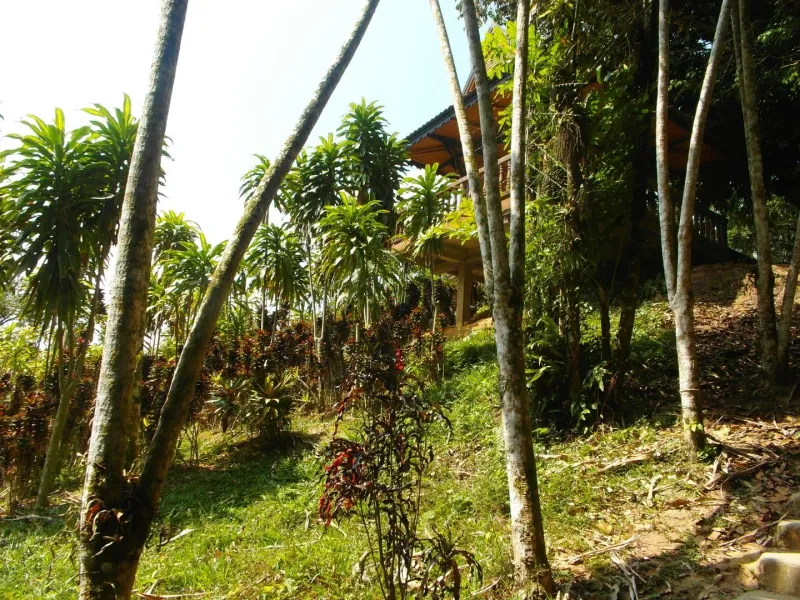
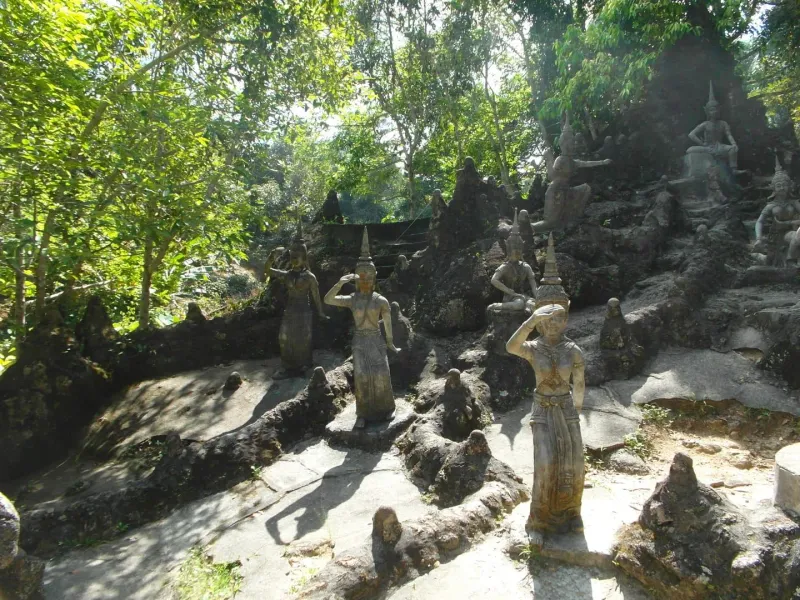
Tarnim Magic Garden and the Secret Buddha Garden are the same place. Other names are Magic Garden, Magic Buddha Garden and Heaven’s Garden. It is a private sculpture park at roughly 450 meters on Pom Mountain in Koh Samui’s central highlands, with 80 to 100+ stone and concrete figures (counts vary by source) scattered through jungle beside a cascading stream. See also the Wikipedia entry. Our temple page covers the same garden from the cultural side, and the trail guide covers the walk.
It was built by a single man: Khun Nim Thongsuk, a retired durian farmer who started the garden in 1976 at the age of 77 and continued working on it until his death at 91. He is buried in the garden he created.
This is not a temple. It’s not a museum. It’s one person’s vision of paradise: a place where Buddhist figures, Thai folklore creatures, dancing musicians, and guardian animals emerge from the moss-covered jungle as if they’ve always been there.
The Story of Nim Thongsuk
Khun Nim Thongsuk (born July 5, 1908) was not just any durian farmer: he was the first person to grow grafted durian varieties on Koh Samui, single-handedly launching the island’s entire durian industry. He introduced Monthong, Kradumthong, Ganyao, and Chanee varieties, spreading them to other farmers and finding the markets to sell them. After retiring, rather than resting, he began what would become a 14-year labor of devotion.
Why he built it
Nim developed a deep spiritual connection with the jungle landscape around his property on Pom Mountain. He envisioned the garden as two things simultaneously: a place where visitors could come to experience peace and natural beauty, and his own final resting place, a personal paradise that reflected the heaven he believed he would move on to.
The work
Starting in 1976, Nim crafted and positioned stone and concrete sculptures throughout the jungle surrounding a natural stream. He built shelters for traveling monks who might pass through the mountains and need rest. He carved pathways between the trees and placed figures of Buddhas, devas, dancers, and animals at points where they would surprise visitors rounding a bend in the trail.
He worked on the garden for 14 years, from age 77 until his death at 91. Today he is buried within the grounds: the garden is literally his final resting place, as he intended.
Legacy
Over the decades, moss and jungle have grown over many of the sculptures, giving them an ancient, timeless quality that Nim likely never planned but would probably have appreciated. The garden is now managed by his descendants and remains a privately owned attraction.
The Sculptures
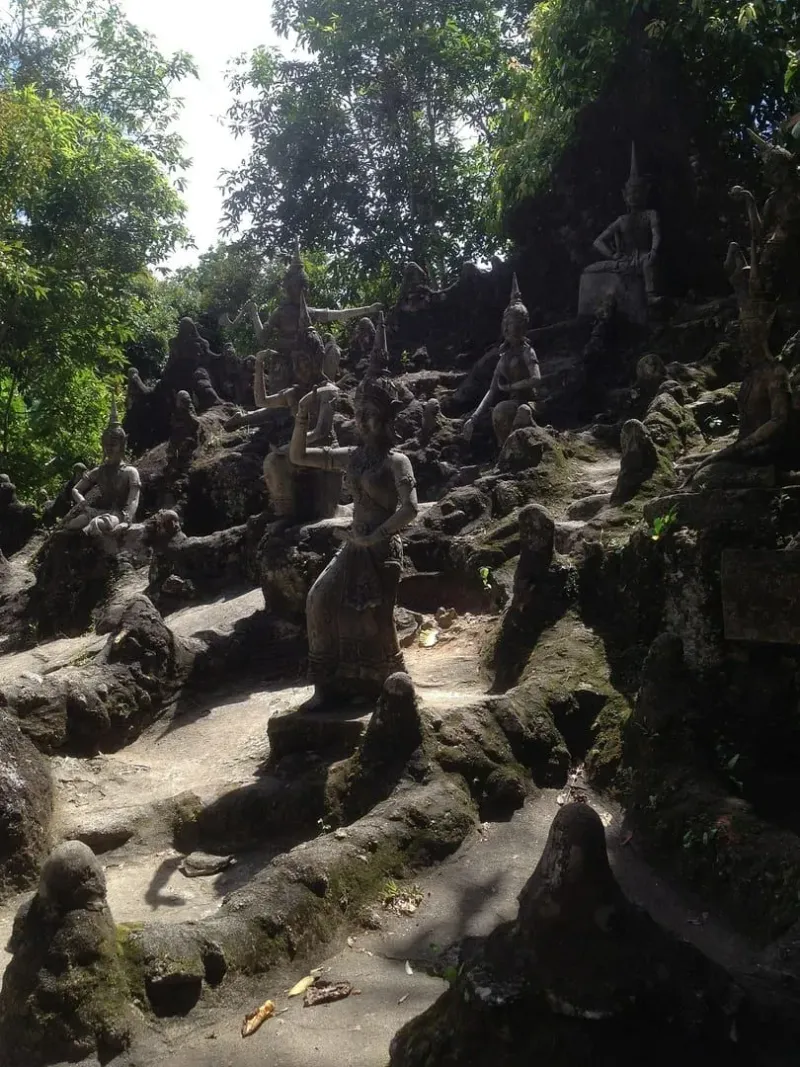
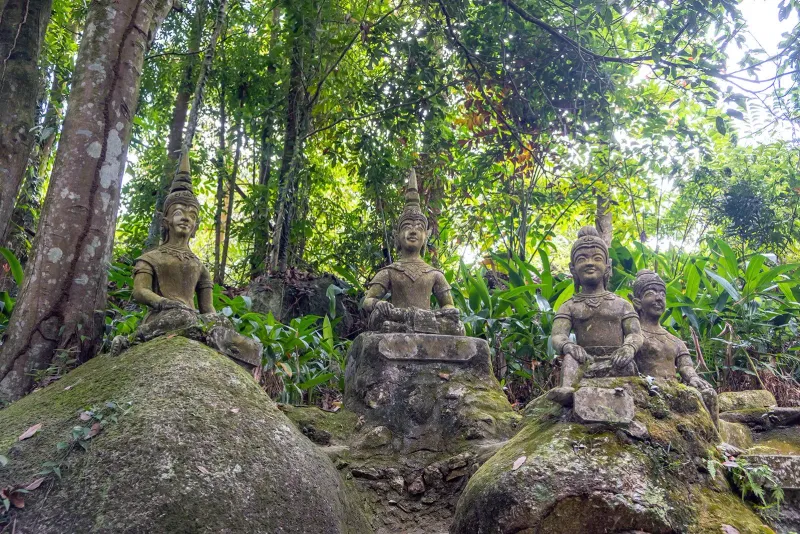
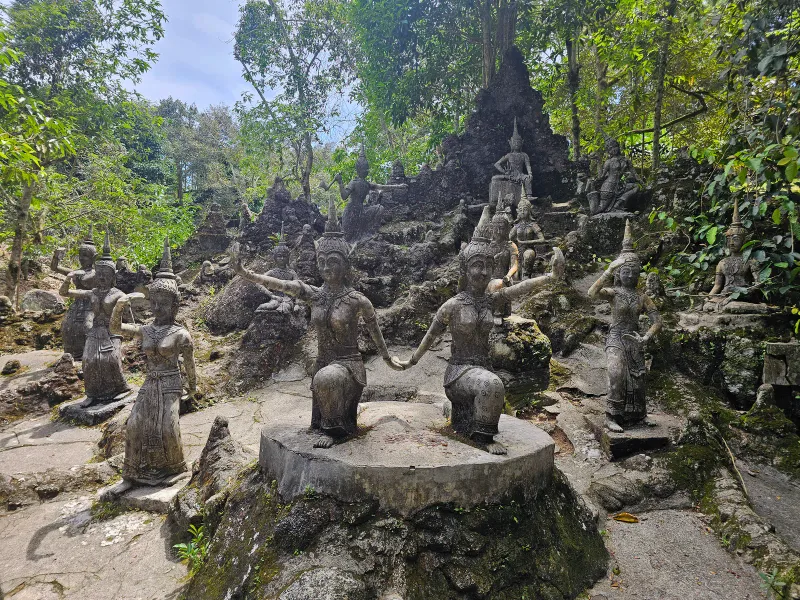
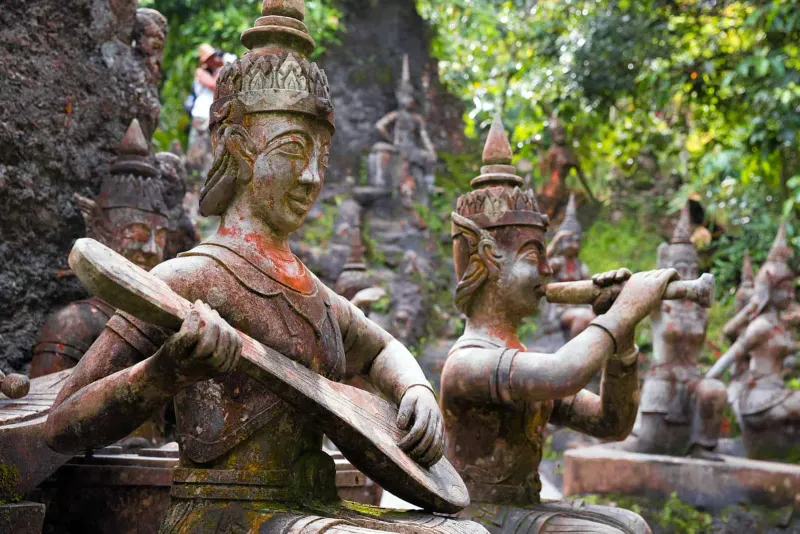
The garden contains 80 to 100+ stone and concrete figures spread along jungle paths and beside the stream. They’re not displayed in a formal gallery arrangement: they appear organically among the trees, rocks, and water features, half-swallowed by vegetation.
What you’ll see
- Buddhist figures: Buddhas in various poses, seated in meditation, standing, reclining. Some are full-sized, others miniature.
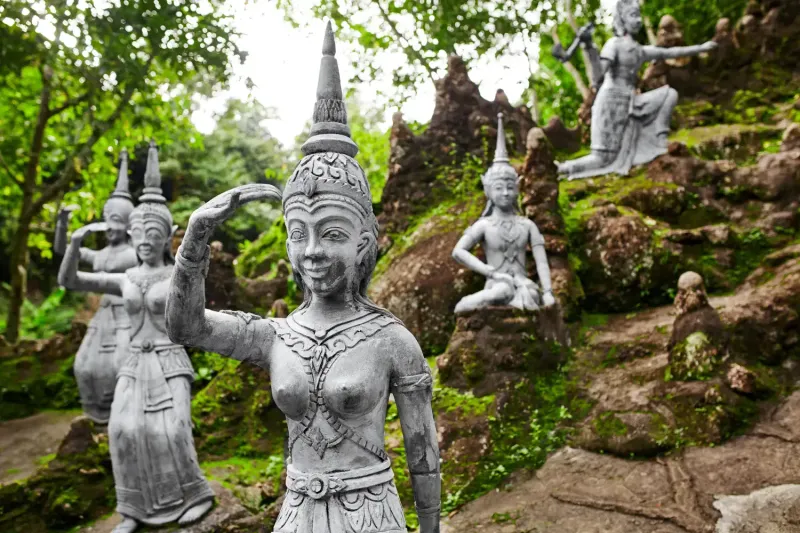
- Devas and celestial beings: Angels and heavenly figures from Thai Buddhist cosmology, often depicted dancing or playing instruments.
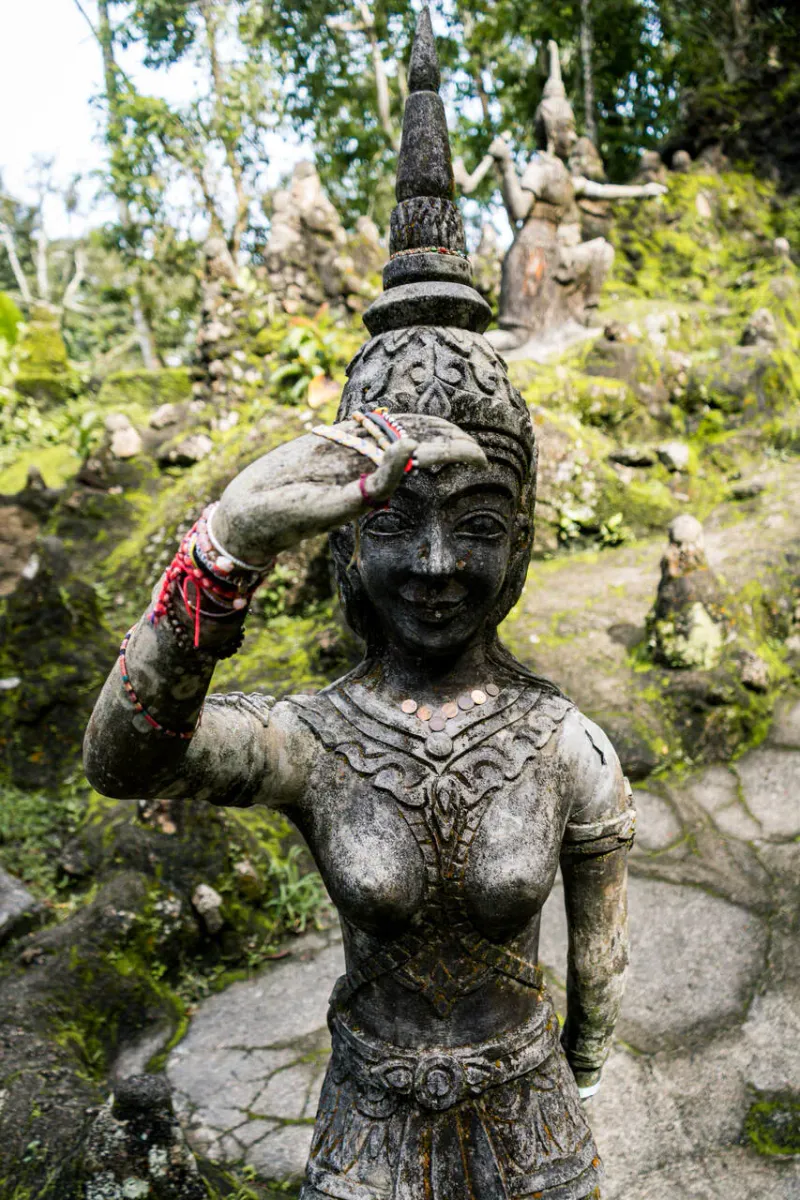
- Musicians and dancers: Human figures captured mid-performance, adding movement and joy to the stone-still jungle.
- Animals: Guardian lions at the garden entrance, birds pulling worms from a pond, serpents (nagas), and other creatures from Thai mythology and nature.
- Monks and hermits: Figures of meditating monks and forest-dwelling ascetics, fitting naturally into the monastery-like setting.
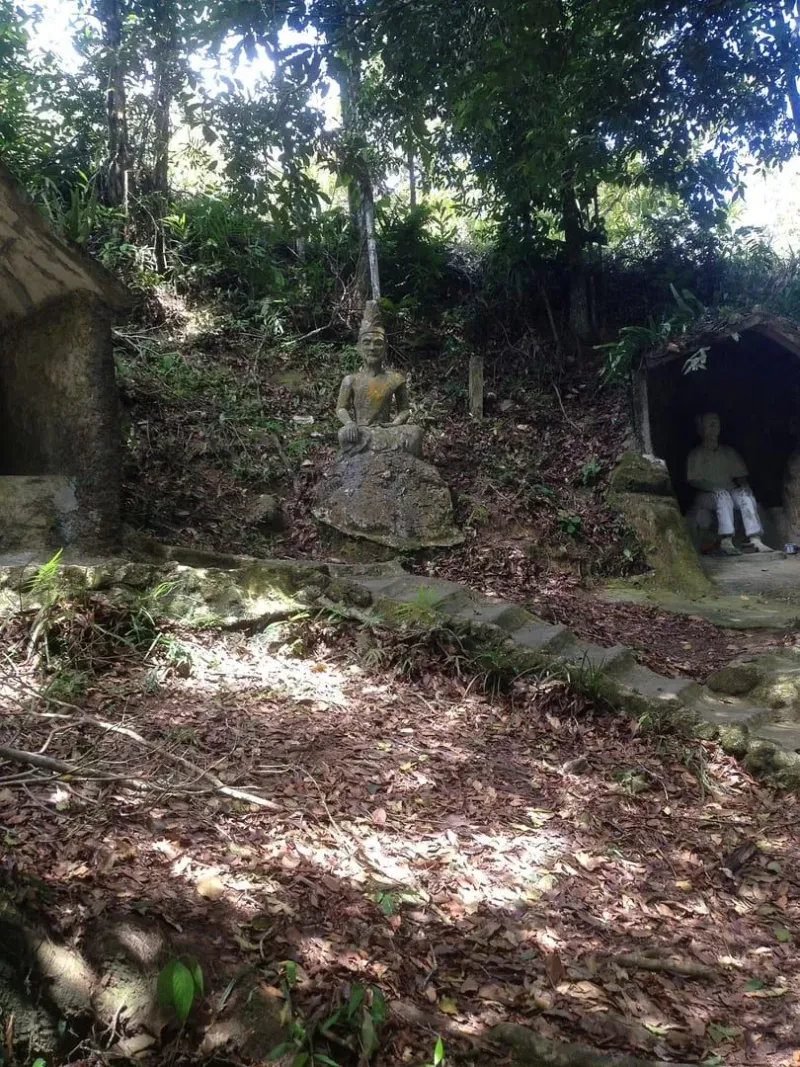
- Nim himself: A statue of Khun Nim Thongsuk seated in a relaxed position on a rock, the creator watching over his garden.
The atmosphere
Many sculptures are now covered in thick green moss, their features softened by decades of tropical rain and growth. This gives the garden a feeling of ancient discovery, as though you’ve stumbled upon ruins from a forgotten civilization, rather than the work of a 20th-century farmer. Some visitors describe it as mystical; others find it beautifully eccentric.
Shelters and enclaves
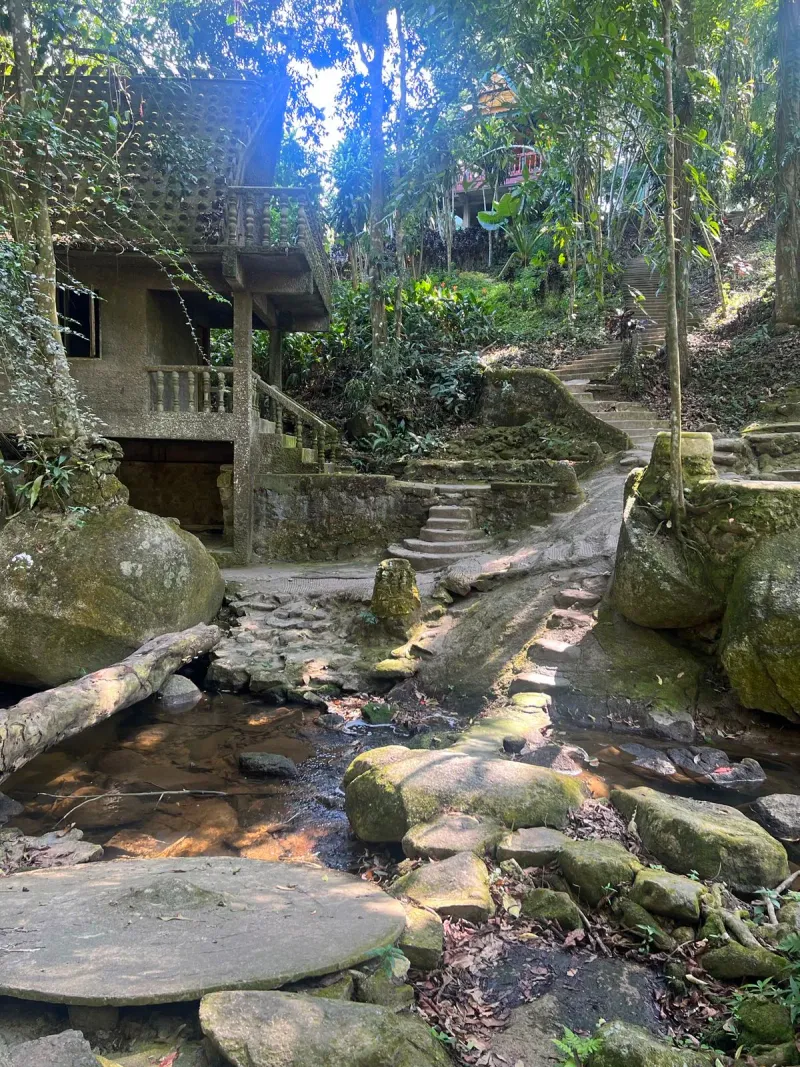
Scattered among the sculptures are small houses and shelters with thick vegetation growing wild on the roofs. Nim originally built these for traveling monks who might need rest during mountain crossings. They add to the sense that this garden is a living, inhabited place rather than a static display.
The Waterfall and Stream
A fresh-water stream runs through the center of the garden, creating a series of small sectioned waterfalls as it descends through the rocks and sculptures. This isn’t a single dramatic cascade. It’s a gentle, multi-level flow that provides the garden’s soundtrack.
What to expect
- Multiple small cascades, each 1-3 meters in height, flowing over mossy boulders
- A pond with a bridge where animal sculptures line the banks
- The stream is shallow throughout: wading depth, not swimming depth
- Water flow is strongest after rain (monsoon season) and can reduce to a trickle in dry months (March-May)
The waterfall is integrated with the sculptures: water flows around and sometimes over the stone figures, creating reflections and a sense that nature and art are inseparable here.
Viewpoints
One of Tarnim’s underappreciated features is its elevation. At ~450 meters above sea level, it offers panoramic views that most Samui visitors never experience.
What you can see
- Southern coastline: Views across the island’s interior to the south coast
- Ocean: The Gulf of Thailand stretching to the horizon
- Jungle canopy: The dense forest covering Samui’s mountainous interior, a reminder that much of the island is still wild
- Ang Thong Marine Park: On clear days, the silhouettes of the Ang Thong archipelago are visible to the west
The viewpoints are scattered along the garden’s upper paths. The combination of jungle sculptures below and vast ocean views above creates a surreal contrast.
Getting There
Getting to Tarnim is half the adventure. The garden sits atop Pom Mountain, and the access road is steep, rough, and not for the faint-hearted.
The road
From Route 4169 (the ring road), take the signed turnoff opposite Wat Khunaram. The road climbs steeply through jungle on a mix of concrete and dirt surfaces. The final stretch is rutted and uneven.
4WD is strongly recommended. Regular cars and scooters risk getting stuck or sliding on the steep gradients, especially after rain. Experienced scooter riders can attempt it in dry conditions, but it’s not advised.
Transport options
| Option | Cost | Notes |
|---|---|---|
| 4WD taxi | 500-1,000 THB round trip | Negotiate in advance; driver waits while you explore |
| Organized tour | 800-1,500 THB per person | Half-day tours often combine with Na Muang Waterfalls |
| Rental 4WD/SUV | 1,200-2,000 THB/day | If you want to self-drive; only with 4WD confidence |
| Scooter | Not recommended | Steep, rough road; dangerous when wet |
From different areas
| Starting Point | Drive Time | Notes |
|---|---|---|
| Nathon | ~40 min | Via ring road + mountain climb |
| Lamai | ~30 min | Closest beach area |
| Chaweng | ~40 min | Via ring road south |
| Bophut | ~45 min | Longest drive |
Entry fee
About 80-100 THB per adult (as of 2026, ~2.50-3 USD). Listings vary: some show 50 THB, others 150-200 THB with a drink or pickup included, so confirm on arrival. Children under 11 are commonly listed as free. Cash only.
Opening hours
Usually 9:00 AM - 5:00 PM daily, with some listings showing later closing; confirm locally. Arrive before 3 PM to allow enough time to explore (1-2 hours needed).
Is Tarnim Magic Garden Worth It? Pros and Cons
Worth it for: an unusual, quiet, cooler-than-the-coast attraction with moss-covered statues and photogenic light, cheap entry, and viewpoints. Think twice if: you dislike rough roads, have limited mobility, or expect one big waterfall. The water here is a gentle stream with 1-3 m cascades, and it can nearly dry up in March-May.
| Pros | Cons | |
|---|---|---|
| Cost | Entry about 80-100 THB | Transport up the mountain adds 500-1,500 THB |
| Experience | Unique art in jungle, cooler air | Uneven, slippery paths, basic toilets |
| Access | Signed turnoff at Wat Khunaram | Steep, rough road; scooter risky when wet |
Nearby Attractions
Under 15 minutes
- Na Muang Waterfalls: Samui’s most famous cascades, Na Muang 1 (easy, swimming pool) and Na Muang 2 (80m waterfall, ~30-min jungle trek). Free admission. Common to combine with Tarnim in a half-day trip.
- Wat Khunaram: Home to the famous mummified monk Luang Phor Daeng. Free. On the ring road at the base of the mountain road to Tarnim.
Under 30 minutes
- Hin Ta Hin Yai: Grandfather and Grandmother Rocks on the Lamai coast, iconic natural rock formations.
- Lamai Beach: Full beach with restaurants, bars, swimming. The nearest major beach area.
- Overlap Stone Viewpoint: Natural boulder viewpoint above Lamai Bay, easy 20-minute walk.
Best Time to Visit
| Season | Months | Conditions | Rating |
|---|---|---|---|
| Dry season | Dec-Feb | Clear views, dry paths, reduced stream flow | ★★★★ |
| Hot season | Mar-May | Hottest; stream can dry up; gardens still beautiful | ★★★ |
| Early monsoon | Jun-Sep | Lush greenery, good water flow, occasional showers | ★★★★ |
| Peak monsoon | Oct-Nov | Maximum green, best stream flow, road can be treacherous | ★★★ |
Tips
- Best balance: December to February, clear skies for viewpoints, comfortable temperature at elevation, garden lush from recent rains
- Greenest garden: June to September, monsoon rains make everything vivid, sculptures at their most moss-covered and atmospheric
- Avoid: Heavy rain days (the mountain road becomes dangerous when wet)
- Temperature: At 450m elevation, it’s noticeably cooler than the coast, welcome relief from beach heat
- Best time of day: Morning (9-11 AM) for softest light through the canopy and fewest visitors
Practical Tips
What to bring
- Footwear: Closed shoes with grip (paths are uneven, mossy, and sometimes slippery)
- Water: At least 1 liter, no shops at the top (some tours include refreshments)
- Camera: The moss-covered sculptures in dappled jungle light are extremely photogenic
- Insect repellent: Jungle mosquitoes are present, especially near the stream
- Light jacket: Cooler at elevation than the coast, and the canopy blocks sun
What to expect
- Allow 1-2 hours to explore the full garden
- Paths are unpaved: roots, rocks, and uneven surfaces throughout
- The garden is spread across a hillside: expect some uphill walking
- Shade is abundant under the jungle canopy
- Toilet facilities are basic
Photography tips
The best photos come from the interplay of light filtering through the canopy onto the moss-covered sculptures. Morning light (before 11 AM) creates the most atmospheric conditions. The stream reflections add depth to sculpture photos.
Who Is Tarnim Best For?
| Traveler Type | Fit | Why |
|---|---|---|
| Culture seekers | ★★★★★ | A unique fusion of art, spirituality, and nature found nowhere else on Samui |
| Photographers | ★★★★★ | Moss-covered sculptures, dappled jungle light, streams, endlessly photogenic |
| Adventurers | ★★★★ | The 4WD mountain road and jungle setting feel like a real expedition |
| Couples | ★★★★ | Romantic, mystical atmosphere, especially in morning light |
| Families (older kids) | ★★★ | Kids enjoy the sculptures and stream; paths require sure-footedness |
| Budget travelers | ★★★ | Entry is cheap (100 THB) but transport up the mountain adds cost |
| Mobility limited | ★ | Steep uneven paths and mountain access make this inaccessible |
FAQ
How much does Tarnim Magic Garden cost?
Entry is about 80-100 THB per adult (listings vary from 50 to 200 THB, as of 2026). Children under 11 are commonly listed as free. Cash only: no card payments. The main cost is transport: a 4WD taxi runs 500-1,000 THB round trip, or join an organized tour for 800-1,500 THB per person.
How do I get to the Secret Buddha Garden?
From Route 4169, take the turnoff opposite Wat Khunaram. The road climbs steeply up Pom Mountain: 4WD is strongly recommended. Most visitors arrange a 4WD taxi or join an organized tour. Regular scooters and cars are not advised due to the steep, rough road.
Is Tarnim Magic Garden worth visiting?
Yes: if you appreciate unusual cultural attractions and don’t mind a rough mountain road. The combination of 80+ moss-covered sculptures, jungle stream, and panoramic views is unlike anything else on Samui. Allow 1-2 hours at the garden plus transport time.
Is Tarnim Magic Garden the same as the Secret Buddha Garden?
Yes. Tarnim Magic Garden, Secret Buddha Garden, Magic Garden and Magic Buddha Garden all name the same private sculpture park on Pom Mountain, made by farmer Nim Thongsuk from 1976. Counts of figures vary by source, from about 80 to over 100.
What is the history of Tarnim Magic Garden?
Nim Thongsuk, a retired durian farmer, began building it in 1976 at age 77 and worked on it for about 14 years until his death at 91. He is buried in the garden, which his descendants now manage as a private attraction.
Can you swim at Tarnim Magic Garden?
The stream is mostly wading depth: you can cool your feet and splash, but there’s no deep swimming pool. Some smaller natural pools allow a shallow dip. Bring water shoes for the rocky stream bed.
What should I wear to the Secret Buddha Garden?
Closed shoes with grip are essential: the paths are uneven, mossy, and slippery. Lightweight long pants protect against mosquitoes and brush. Bring a light jacket: at 450m elevation, it’s noticeably cooler than the beaches.
About the author

Migues Ferfumoz
Writer, Koh Samui resident since 2019
Freelance writer and Koh Samui resident since 2019. Migues covers local culture, food, and the best off-the-beaten-path destinations on the island.
Articles by Migues →